

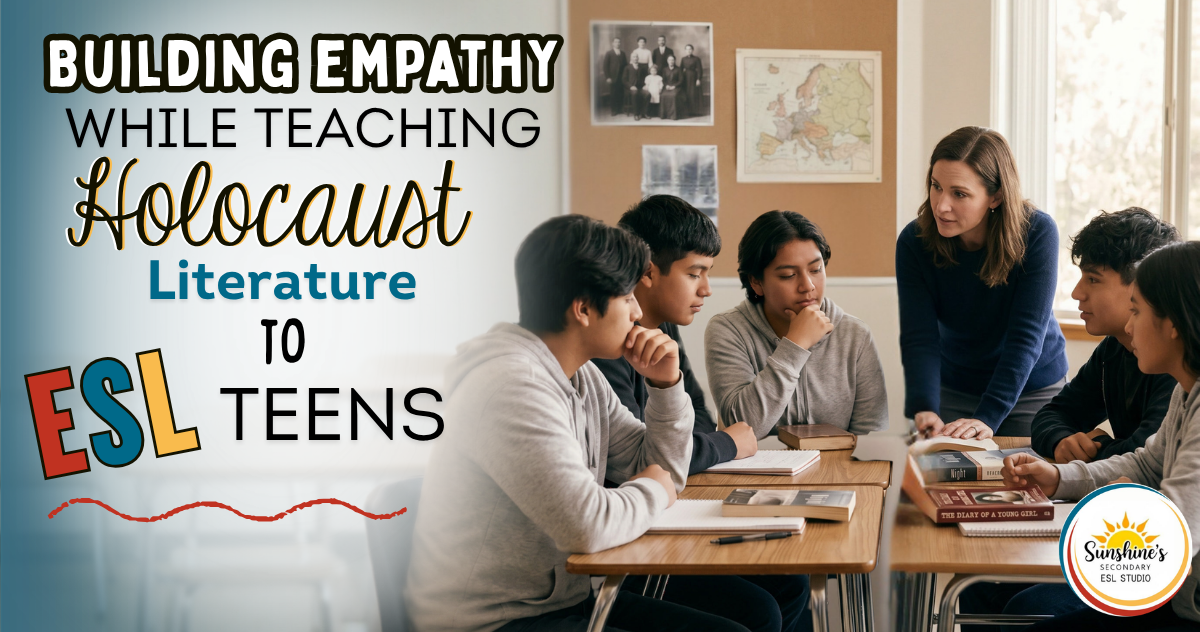
In a recent PLC meeting, my colleagues were frustrated. Their students didn’t seem to show empathy while reading Night by Elie Wiesel.
They kept asking:
- Do our students lack empathy?
- Are they disconnected from the text?
- Or are we missing something in how we approach it?
When it comes to teaching Holocaust literature in ESL, these are important questions—but the answer usually isn’t what we think.
More often than not, it’s not a lack of empathy. It’s a lack of access.
If students don’t fully understand what they’re reading, they can’t emotionally connect to it.
Why Empathy Matters in Holocaust Education
Empathy isn’t just about emotions—it directly impacts comprehension.
When students can visualize a story and connect to it emotionally, they understand it more deeply. But for ESL students, language barriers can block that process completely.
This is why teaching Holocaust literature in ESL classrooms requires intentional scaffolding.
Empathy:
- Makes history feel personal instead of distant
- Helps students connect past events to real-world issues like discrimination and human rights
- Strengthens reading comprehension
If you’ve ever worked with students reading below grade level, you’ll recognize this immediately. (You might also relate to what I share in ESL Students Reading Below Grade Level)
Choosing the Right Texts for ESL Students
One of the biggest mistakes in teaching Holocaust literature in ESL is choosing texts that are too complex linguistically.
If students can’t access the language, they won’t access the emotion.
Here are some strong options:
- The Boy in the Striped Pajamas (emotional entry point)
👉 Boy in the Striped Pajamas ESL Guide - Number the Stars (more accessible narrative)
- I Never Saw Another Butterfly (poetry + art connection)
- Graphic novels or visual adaptations of survivor stories
You’ll see similar scaffolding strategies in other literature units too, like How to Support ESL Students During Novel Studies
If you’re planning to use The Boy in the Striped Pajamas in your ESL classroom, having structured support makes a huge difference. I use a scaffolded resource that helps students follow the story, build vocabulary, and actually process what they’re reading—without feeling overwhelmed.
Scaffolding Strategies That Actually Work
Even with the “right” text, students still need support.
When teaching Holocaust literature in ESL, try:
- Paired reading with audio
- Pre-teaching vocabulary
- Visual supports (maps, timelines, photos)
If you’re looking for structured listening support, this pairs well with Cloze Listening Activities for ESL
And if you need vocabulary reinforcement, your grammar and support routines matter more than you think ESL Vocabulary Activities for High School
Build Empathy Before Reading Starts
This is where a lot of teachers miss the mark.
If students don’t have background knowledge, they can’t connect emotionally.
Before reading, focus on activating thinking.
Try:
- “How would you feel?” scenario cards
- Photo discussions (shoes, train tracks, memorials)
- Emotion-based KWL charts
You can grab a free one here KWL Chart for ESL Students
This step alone can completely change how students respond to the text.
Humanize the Story with Real Voices
For many ESL students, this is their first exposure to the Holocaust.
They need real people—not just text.
Try:
- Short survivor videos with subtitles
- Diary excerpts (like Anne Frank)
- Mini-biographies
This aligns closely with culturally responsive teaching practices Culturally Responsive Teaching for ESL Teens
When students see real faces and hear real voices, empathy starts to build naturally.
Discussion Strategies That Support Language AND Emotion
Discussions can be tough in ESL classrooms—but they’re essential here.
Students need language support to express empathy.
Use:
- Sentence frames
- Partner discussions
- Structured sharing
Examples:
- “I felt ___ when I read ___ because ___.”
- “This reminds me of ___.”
If you need ready-to-use supports, this is a great companion Free ESL Sentence Starters for Teens
You can also build stronger routines with How to Build ESL Speaking Routines
Creative Expression Builds Deeper Empathy
Not every student is comfortable sharing emotions out loud—especially teens.
Give them other ways to process:
- Journal writing (even in their native language)
- Poetry
- Drawing or symbolism
- Letter writing to a character
Letter writing, especially, works beautifully here Teach Letter Writing for ESL Students for State Testing
These activities allow students to feel without the pressure of speaking publicly.
A Note on Emotional Safety
This content can be heavy.
Some students may have personal or family trauma connected to violence, displacement, or discrimination.
When teaching Holocaust literature in ESL:
- Be flexible
- Offer opt-out options
- Watch for signs of overwhelm
This is where strong classroom culture matters most ESL Classroom Management for High School
Final Thoughts
Teaching Holocaust literature isn’t just about history.
It’s about helping students understand humanity.
And when it comes to teaching Holocaust literature in ESL, empathy doesn’t come from simply reading the text—it comes from making the text accessible.
With the right supports, your students won’t just understand the story.
They’ll connect to it.
And that’s where real learning happens.