
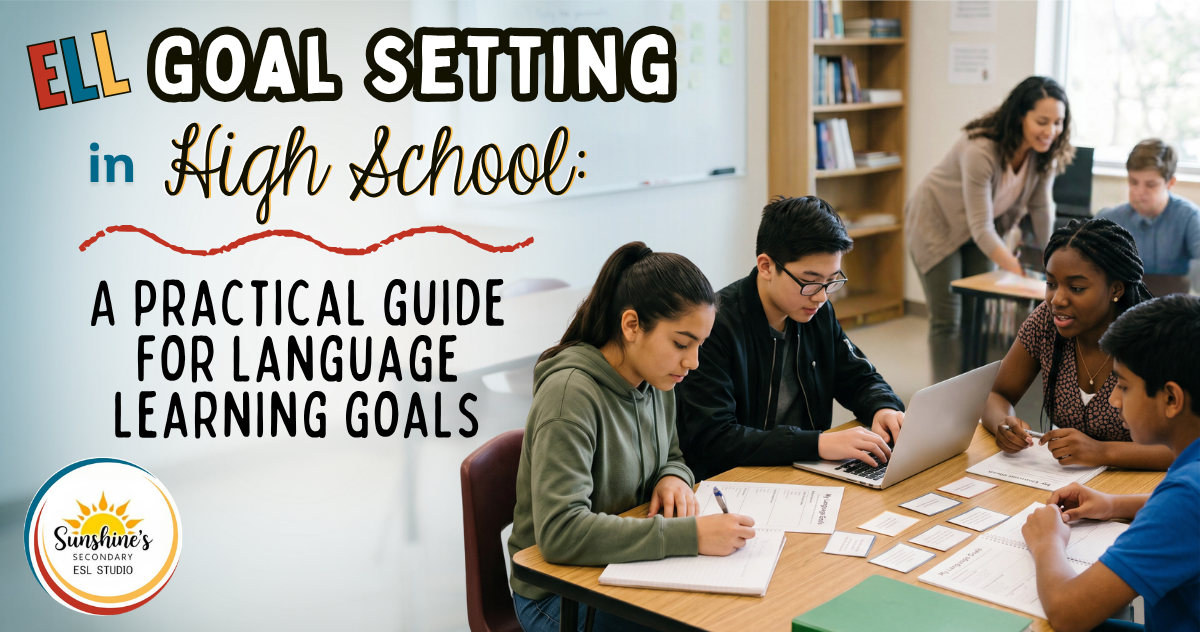
ELL goal setting in high school works best when students understand exactly what they are working toward, why the goal matters, and how they will recognize progress.
Unfortunately, many language goals sound more like paperwork than something a teenager can actually use.
“Improve English proficiency.”
“Develop academic language.”
“Demonstrate growth in speaking.”
Although those goals may make sense in a data meeting or instructional plan, they do not tell students what to practice tomorrow. A newcomer cannot easily act on “improve speaking.” Likewise, a more advanced English learner may not understand what “develop academic language” should look like in English class, science, history, or another content area.
In my high school ESL classroom in El Paso, Texas, I work with students across approximately A1–B2 proficiency levels. Some are newcomers from Mexico or Juárez who are learning the English they need to navigate school. Others speak comfortably with friends but struggle to explain an idea, support an argument, participate in academic discussion, or write for a school audience.
Because their needs are different, those students should not all receive the same goal.
Instead, meaningful language-learning goals should begin with a student’s current abilities, connect to a real classroom need, and describe a next step that feels possible. This guide will help you create practical goals for speaking, listening, reading, writing, vocabulary, and grammar without turning goal setting into another beginning-of-the-year activity that disappears into a folder.
Why ELL Goal Setting in High School Often Fails
Most weak language goals have at least one of three problems:
- The goal is too broad.
- The student did not help choose it.
- No one decided how progress would be measured.
For example, a student may write, “I want to get better at English,” because that is what the worksheet appears to ask. The answer is not wrong. However, it is too large to guide daily practice.
What does “better” mean?
Perhaps the student wants to understand class directions without asking a friend. On the other hand, the student may want to participate in an English discussion, read a chapter more independently, write a complete paragraph, or learn enough academic vocabulary to understand biology.
Until the goal names a specific language action, neither the student nor the teacher can track it meaningfully.
CEFR and WIDA-style “Can Do” descriptors are helpful because they focus on what learners can accomplish with language. In addition, they allow teachers to identify a reasonable next step without defining students only by a score, level, or label.
Ultimately, the purpose of goal setting is not to show students everything they cannot do. Instead, the goal should help each student identify one useful area of growth.
Teacher Goals, Student Goals, and Language Objectives Are Different
These terms are often used interchangeably. However, they serve different purposes.
Teacher goals
A teacher goal describes what I plan to improve through my instruction.
For example:
I will increase structured speaking opportunities so every student participates in academic discussion at least three times each week.
In this case, the goal focuses on my planning and instruction rather than on one student’s individual language growth.
Learning objectives
A learning objective describes what students should accomplish during a particular lesson or unit.
For example:
Students will compare two characters using comparative adjectives and evidence from the text.
Because objectives guide daily instruction, they are usually shorter-term than individual student goals. For more examples, see my guide to writing language objectives for high school ESL.
Long-term student language goals
A long-term student goal may cover several weeks, a grading period, or a semester.
For example:
By the end of the grading period, I will explain my opinion and give two supporting reasons during a small-group discussion.
This goal gives the student a clear direction over time.
Short-term practice goals
A practice goal explains what the student will do regularly to make progress toward the larger goal.
For example:
Twice each week, I will record a one-minute response that includes an opinion statement, two reasons, and a closing sentence.
Therefore, the long-term goal provides direction, while the short-term goal creates a routine.
How Assessment Supports ELL Goal Setting High School Plans
Goal setting should begin with evidence. Nevertheless, students should never be reduced to a proficiency score.
A test result provides one piece of information. Classroom conversations, writing samples, listening tasks, reading responses, pronunciation, confidence, and content-area performance also help complete the picture.
At the beginning of the year, I recommend gathering manageable evidence across the four major language domains:
- a short speaking sample or interview;
- a listening task with a few comprehension questions;
- a brief reading passage;
- an age-appropriate writing sample.
You can find additional ideas in Beginning-of-Year ESL Assessments for High School Students. An elaborate testing week is not necessary. Instead, gather enough information to identify patterns in each student’s language strengths, challenges, and classroom needs.
For example, one student may demonstrate strong conversational speaking but limited academic writing. Another may know a great deal of vocabulary but struggle to understand spoken directions. Meanwhile, a student who completes grammar exercises accurately may still have difficulty using those same structures during real communication.
A student might also show:
- strong reading comprehension but limited speaking confidence;
- clear ideas but weak organization in writing;
- strong social English but difficulty explaining academic concepts;
- good listening comprehension in conversation but difficulty following lectures;
- accurate sentence-level writing but trouble developing paragraphs;
- solid vocabulary recognition but weak vocabulary use.
These patterns are more useful for goal setting than a single overall proficiency level. More importantly, they help teachers and students select a next step that is specific, realistic, and connected to an actual school task.
Use assessment data as a conversation starter
Instead of telling a student, “Your speaking score is low,” try saying:
You communicate your ideas well when you have time to prepare. During spontaneous discussions, your answers are usually shorter. Would you like to work on adding reasons and examples when you speak?
This approach recognizes a strength first. Next, it identifies a specific need. Finally, it invites the student to participate in the decision.
For mixed-proficiency classes, goals should reflect the different language students are ready to produce. My guide to differentiating ESL instruction from A1–B2 explains how to adjust language demands without lowering the value or complexity of the task.
Turn Vague Goals into Useful Language Goals
A useful student goal should answer five questions:
- What will I do?
- Which language skill will I use?
- Under what conditions will I do it?
- How often or how well will I do it?
- How will I know I am improving?
The table below shows how broad goals can become more practical.
| Weak goal | More useful goal |
|---|---|
| Get better at speaking. | During partner discussions, I will answer in at least two complete sentences and ask one follow-up question. |
| Learn more vocabulary. | I will learn and correctly use eight words from my science and English classes each week. |
| Improve grammar. | I will use past-tense verbs correctly in at least eight of ten sentences in my weekly writing sample. |
| Understand English better. | After a two-minute classroom audio clip, I will identify the main idea and three important details. |
| Become a better reader. | I will read a one-page text and identify its central idea and two supporting details. |
| Improve writing. | I will write a paragraph with a clear topic sentence, supporting details, and a concluding sentence. |
The stronger goals are not perfect because language growth is not always predictable. Even so, they are useful because teachers and students can look at real evidence together.
Student-Friendly SMART Goals for English Learners
SMART goals can help secondary English learners when the framework is explained in plain language. However, the process should not feel corporate, overly formal, or disconnected from school.
Specific: What exactly will you do?
Instead of:
I will improve speaking.
Try:
I will give longer answers during partner discussions.
A specific goal names an observable action.
Measurable: What evidence will show progress?
Students do not need to depend only on test scores. Instead, they might count or track:
- complete sentences;
- supporting details;
- minutes of sustained speaking;
- vocabulary words used accurately;
- reading responses completed independently;
- writing rubric criteria achieved;
- listening questions answered correctly.
For instance, a student could compare a beginning-of-the-month speaking recording with an end-of-the-month recording.
Achievable: Is this a reasonable next step?
An A1 newcomer should not be expected to lead an extended academic seminar in English after two weeks. A more realistic goal might be:
I will ask for help using one of three practiced classroom questions.
The goal should stretch the student. At the same time, it should remain within reach.
Relevant: Why does the goal matter?
Teenagers are more likely to care about a goal that connects to something they need or want to do.
A relevant goal might help a student:
- participate in class;
- understand a teacher;
- complete an assignment independently;
- communicate with classmates;
- earn course credit;
- prepare for state testing;
- apply for a job;
- speak with a counselor;
- advocate for needed support.
Therefore, relevance should be part of the goal-setting conversation.
Time-bound: When will the goal be reviewed?
A deadline should create a check-in rather than a punishment.
For example:
We will review this goal in four weeks and decide whether to continue it, adjust it, or choose a new one.
This keeps the goal active and allows for revision.
When SMART goals become too rigid
Not every language goal needs five separate boxes and a complicated tracking system.
For an A1 student, the following may be enough:
My goal: I can ask my teacher for help in English.
My practice: I will use one help sentence three times this week.
My check-in: Friday.
In other words, clarity matters more than completing a formal acronym.
ELL Goal Setting in High School for Speaking
Speaking goals should focus on what the student will communicate rather than simply how often the student talks.
Weak goal: I will speak better.
Improved goal: I will participate more during partner discussions.
Highly specific goal: During two partner discussions each week, I will give an answer of at least three connected sentences and ask one follow-up question.
Student-friendly version: I can explain my answer and keep the conversation going.
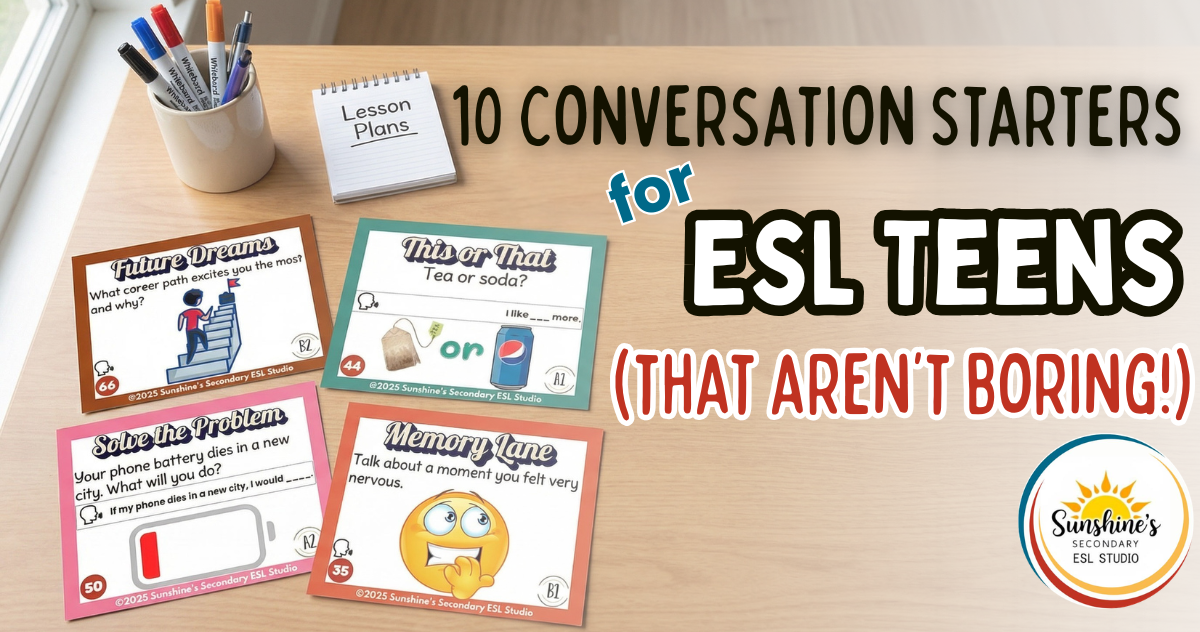
Because speaking improves through repeated practice, students need regular opportunities to use the exact skill named in the goal. You can connect speaking targets to consistent ESL speaking routines or use conversation starters for ESL teens for structured practice.
Some students understand the language but hesitate to participate. In that situation, these ESL speaking confidence activities may help students build comfort before they are expected to speak in larger groups.
ELL Goal Setting in High School for Listening
Listening goals should describe what students are listening for and how they will show understanding.
Weak goal: I will understand English better.
Improved goal: I will identify important information while listening.
Highly specific goal: After listening to a two- or three-minute classroom recording twice, I will identify the main idea and three supporting details with at least 80 percent accuracy.
Student-friendly version: I can listen for the big idea and important details.
Evidence can come from short audio clips, teacher directions, classroom videos, peer presentations, or content-area explanations. Authentic materials can also be useful when teachers control the length, purpose, and support. For practical ideas, see how to use authentic videos with high school ESL students.
ELL Goal Setting in High School for Reading
Reading goals should focus on comprehension, strategy use, or independence.
Weak goal: I will read better.
Improved goal: I will identify the main idea and evidence in a text.
Highly specific goal: Once each week, I will read a one-page informational text and correctly identify the central idea, two supporting details, and five important words.
Student-friendly version: I can find what a text is mostly about and prove my answer.
A student may understand a text with pictures, translated vocabulary, and teacher guidance. Over time, however, the goal may shift toward completing the same type of task with fewer supports.
For secondary-specific strategies, see ESL reading comprehension in high school.
ELL Goal Setting in High School for Writing
Writing goals should match the student’s most important need rather than trying to fix everything at once.
Weak goal: I will improve my writing.
Improved goal: I will organize my paragraphs more clearly.
Highly specific goal: By the end of the month, I will independently write a paragraph containing a topic sentence, three related supporting details, transitions, and a concluding sentence.
Student-friendly version: I can organize one clear paragraph from beginning to end.
One student may need to expand ideas. Another may need to work on sentence boundaries, verb consistency, transitions, organization, or academic evidence.
Because writing needs vary widely, goals should focus on one or two features at a time. My ESL writing support strategies provide scaffolds that can be matched to individual writing goals.
ELL Goal Setting in High School for Vocabulary
Vocabulary goals should move beyond copying definitions.
Weak goal: I will learn more words.
Improved goal: I will learn important words from my classes.
Highly specific goal: Each week, I will learn ten academic or content-area words and correctly use at least seven in speaking or writing.
Student-friendly version: I can use new school words when I speak and write.
Students might show vocabulary growth by:
- using a word in an original sentence;
- explaining it in simpler English;
- connecting it to a picture or example;
- using it during a discussion;
- applying it in a written response.
For additional classroom ideas, see ESL vocabulary activities for high school.
ELL Goal Setting in High School for Grammar
Grammar goals should connect to real communication.
Weak goal: I will improve grammar.
Improved goal: I will use past tense more accurately.
Highly specific goal: During four weekly speaking or writing tasks, I will use regular and irregular past-tense verbs accurately in at least eight of ten sentences.
Student-friendly version: I can talk and write about past events using the correct verbs.
A student may complete isolated grammar exercises successfully but still omit the same forms while speaking or writing. Therefore, grammar practice should include both focused instruction and authentic use.
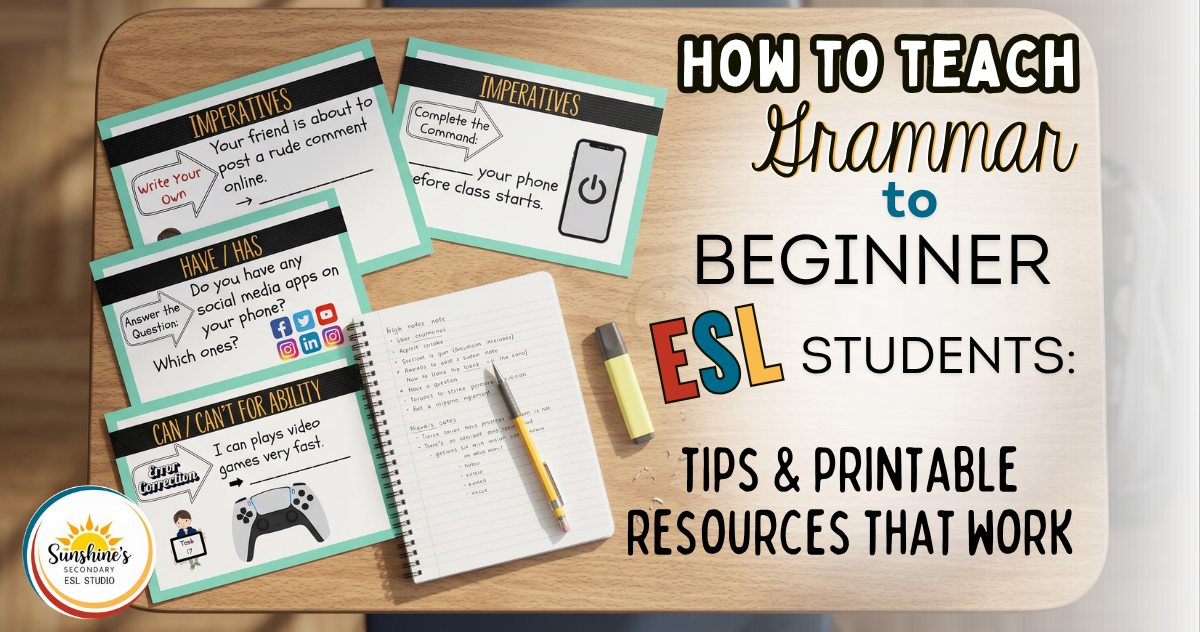
My article on how to teach grammar to beginner ESL students explains how to move from rules and practice toward communication.
Adjust the Same Language Goal from CEFR A1 to B2
The general skill may stay the same while the language demand changes.
Speaking goals from A1 to B2
A1: I can introduce myself and answer five familiar questions using words, phrases, or short sentences.
A2: I can describe a familiar experience using five connected sentences and basic sequence words.
B1: I can explain my opinion, give two reasons, and respond to one follow-up question.
B2: I can contribute to an academic discussion by developing a claim, supporting it with evidence, and responding to another viewpoint.
Writing goals from A1 to B2
A1: I can write five understandable sentences about myself, my family, or my daily routine.
A2: I can write one organized paragraph about a familiar topic using basic transitions.
B1: I can write a multi-paragraph response with a clear main idea, supporting details, and appropriate transitions.
B2: I can write an evidence-based response that explains relationships among ideas and uses varied academic language.
Listening goals from A1 to B2
A1: I can follow familiar one-step classroom directions with visual support.
A2: I can identify the topic and key details in a short, clearly spoken message.
B1: I can take notes on the main idea and supporting information in a short classroom explanation.
B2: I can distinguish a speaker’s main claim, evidence, examples, and attitude during an academic presentation.
Reading goals from A1 to B2
A1: I can identify familiar words and basic information in a short text with visuals.
A2: I can find the main idea and important details in a short passage about a familiar topic.
B1: I can summarize a grade-appropriate adapted text and explain how details support the main idea.
B2: I can analyze an authentic or lightly scaffolded text and explain the author’s claim, evidence, purpose, or tone.
These progressions allow teachers to adjust goals by language level while keeping students connected to the same topic or assignment.
Beginning-of-Year Reflection Questions for Teenagers
Before students select a goal, give them time to consider how they currently use English.
Questions for A2–B2 students may include:
- What feels easiest for you in English?
- What feels hardest?
- When do you feel most confident speaking English?
- What do you avoid doing in English?
- Which school task is hardest because of English?
- What would you like to do more independently?
- Which English skill would help you most in your classes?
- What is one thing you want to do more confidently this month?
- What kind of support helps you most?
- How will you know that you are improving?
These questions work well in writing, partner discussion, a digital form, or a brief teacher conference.
Adapt reflection questions for A1 students
Beginning students do not need to write a paragraph about their learning.
Instead, use icons, translated directions, modeled choices, sentence frames, or a short conference.
Students can circle answers such as:
English feels easiest when I:
- listen;
- speak;
- read;
- write;
- use pictures;
- work with a partner.
I want help with:
- understanding directions;
- asking questions;
- talking to classmates;
- reading assignments;
- writing sentences;
- learning school words.
Strategic use of a student’s strongest language can lead to more accurate reflection. My article on translanguaging in the secondary ESL classroom explains why home-language support can strengthen rather than replace English development.
A Repeatable ELL Goal Setting High School Process
Teachers do not need to hold a 20-minute conference with every student each week. Instead, use a simple cycle that fits normal classroom routines.
1. Identify a starting point
Begin with assessment data, classroom work, observation, and student reflection.
2. Choose one priority
One focused goal is more useful than six goals students cannot remember.
3. Write an “I can” statement
Translate the goal into language the student understands.
4. Choose a practice routine
Decide what the student will do during regular classroom activities.
5. Identify evidence
Possible evidence includes an audio recording, discussion checklist, writing sample, reading response, listening score, or vocabulary journal.
6. Set a review date
Revisit the goal after two to four weeks.
During the review, students can choose:
- I reached this goal.
- I am making progress.
- I need more practice.
- I need a different strategy.
- This goal is no longer my priority.
Because goals can change, revision should be viewed as part of the process rather than as failure.
Progress Tracking for ELL Goal Setting High School Plans
Progress monitoring does not need to become a separate grading system.
Weekly check-ins
Students answer three brief questions:
- What did I practice?
- What evidence do I have?
- What will I try next week?
These responses can take less than five minutes.
Audio recordings
Students can record the same type of response at the beginning and end of the month. Then, they can compare the recordings for changes in length, clarity, vocabulary, grammar, and confidence.
Writing samples
Save one short sample each month. Afterward, ask students to highlight evidence of their goal, such as transitions, verb forms, details, or academic vocabulary.
Can-do checklists
Students choose one statement:
- I can do this independently.
- I can do this with some help.
- I am still practicing this.
This format works especially well for A1–A2 students.
Goal ladders
A larger goal can be broken into visible steps.
For example:
- I can state my opinion.
- I can give one reason.
- I can give two reasons.
- I can add an example.
- I can respond to another person’s idea.
As a result, students can see progress even before they reach the final target.
Brief teacher conferences
Three-minute conferences can take place while classmates complete independent work. In addition, teachers can meet with only a few students each day rather than trying to conference with everyone at once.
Portfolios
A simple digital or paper folder might include:
- one speaking recording;
- one writing sample;
- one reading response;
- one vocabulary sample;
- one student reflection.
The purpose is not to collect everything. Instead, save enough evidence for students to recognize growth.
Printable or Digital Goal-Setting Sheet for A1–A2 Students
My English Goal
My name: ________
Date: _________
We will check my goal again on: _______
1. My strongest English skill
I feel strongest when I:
☐ listen
☐ speak
☐ read
☐ write
☐ learn vocabulary
☐ use grammar
2. My challenging English skill
I need more practice with:
☐ understanding directions
☐ answering questions
☐ talking to classmates
☐ reading school texts
☐ writing sentences or paragraphs
☐ learning new words
☐ using grammar when I communicate
3. My goal
I can ______________.
4. This goal matters because
☐ It will help me in class.
☐ It will help me talk to people.
☐ It will help me complete my work.
☐ It will help me feel more confident.
☐ Other: ___________________.
5. I will practice by ___________.
6. I will practice
☐ every day
☐ two times each week
☐ three times each week
☐ once each week
7. I will know I am improving when _____________.
8. A person who can help me _____________.
Printable or Digital Goal-Setting Sheet for B1–B2 Students
My Language-Learning Goal
Name: ______________________________
Date: ______________________________
Review date: ______________________________
My current strengths
What can I already do well in English? ___________________.
My current challenge
Which English task is difficult, uncomfortable, or less independent for me? __________________.
My goal
By __________________, I will ___________________________.
Why this goal matters
How will this skill help you in school, outside school, or in the future? ___________________.
My practice plan
What will you practice? ___________________.
How often will you practice? ______________.
Which tools, strategies, or supports will you use? __________________.
My evidence
What work sample, recording, checklist, score, or observation will show improvement? ______________.
My support
Who can help you, and what kind of help do you need? ________________.
Weekly Goal Check-In
My goal: __________________________________________
This week, I practiced by: ________________.
One piece of evidence is: ________________.
Something that became easier was: ________________.
Something I still need to practice is: _________________.
Next week, I will: __________________.
End-of-Month Reflection
My goal was: _________________.
I reached this goal:
☐ Yes
☐ Almost
☐ Not yet
☐ I changed my goal
My best evidence is: ______________.
One change I noticed was: ________________.
A strategy that helped me was: ______________.
Next month, I want to:
☐ continue this goal
☐ make the goal more challenging
☐ choose a different goal
☐ ask for more support
My next step is: _______________.
Common ELL Goal-Setting Mistakes to Avoid
Giving every student the same goal
Students in the same class may have completely different language needs. Therefore, one classwide goal is rarely enough.
Choosing goals without student input
Teachers may identify an area of need. However, students should understand and help shape the final goal.
Writing goals that are too broad
“Improve English” does not identify a practice activity or a form of evidence.
Depending only on test scores
Scores can inform a goal. Still, classroom communication and student work provide important context.
Tracking too many goals at once
One priority goal is usually enough for a short goal cycle. Later, students can choose another area.
Setting goals and never revisiting them
A goal-setting worksheet is not useful when it is completed in August and never opened again.
Using language students do not understand
A student cannot take ownership of a goal that sounds like an adult evaluation rubric.
Turning goal setting into a compliance activity
Students should not be expected to write the “correct” motivational answer. Honest reflection provides more useful information.
Expecting A1 students to write long reflections
Beginning students can reflect through pictures, sentence frames, translated choices, audio, or a short conversation.
Treating progress as linear
Language growth does not happen in a straight line. A difficult text, unfamiliar topic, stress, interrupted attendance, or a new classroom environment can affect performance.
For that reason, one weaker sample does not erase earlier growth.
Practical Resources That Can Support Student Goals
A classroom resource should support a goal rather than replace it.
For speaking practice, students can use the Teen Talk ESL Conversation Starters Bundle to practice level-appropriate responses and collect speaking evidence.
Meanwhile, newcomers who are working on classroom independence may benefit from A1–B2 Survival English Desk Mats. These supports give students accessible language they can use during daily routines.
Teachers who want a speaking or pronunciation baseline can explore the ESL Diagnostic Assessment Bundle for A1–B2 Teens.
In addition, the Goal Setting for ESL Teens informational text with audio can introduce the goal-setting process in an age-appropriate format.
Newcomers who enroll after the school year begins may need immediate survival-language goals before broader academic targets. My first 30 days with a newcomer in high school ESL provides a practical starting point. Similarly, the Secondary ESL Newcomer Launch Bundle supports early classroom routines and communication.
Final Thoughts on ELL Goal Setting in High School
ELL goal setting in high school should help students notice their growth and understand their next step. It should not become another form teachers complete simply because the calendar says it is August.
First, begin with what the student can already do. Next, choose one language action that matters. Then, make the goal understandable and connect it to a regular classroom routine. Finally, save a small amount of evidence and revisit the goal often enough for the student to see that it still matters.
When language growth becomes visible, students begin to notice changes that might otherwise be easy to miss. A longer answer, a clearer paragraph, a question asked without help, a class discussion joined for the first time, or a text understood with fewer supports all represent meaningful progress.
Although those changes may appear small on paper, they can reflect major movement toward independence in a secondary ESL classroom.
Use the goal-setting templates above with your beginning-of-year assessment information. Then, adapt the language to each student’s proficiency level and review the goal after two to four weeks.
For more practical strategies and resources created specifically for middle and high school English learners, join the Sunshine’s Secondary ESL Studio email list and explore the related secondary ESL articles linked throughout this post.