
Finding authentic literature for secondary ESL students can be challenging. Teachers want stories that feel mature and engaging without overwhelming multilingual learners with inaccessible language. During Hispanic Heritage Month, that challenge becomes even bigger because many teachers are searching for meaningful ways to celebrate Latin American culture while still supporting language development.
That’s exactly why I love teaching The Night Face Up by Julio Cortázar in my secondary ESL classroom.
This suspenseful short story pulls students between two worlds—a modern motorcycle accident and an ancient Aztec setting—until they begin questioning what is real and what is imagined. Even reluctant readers become invested because the tension builds quickly, the atmosphere feels eerie and cinematic, and the ending sparks genuine discussion.
For ESL students, the story also opens the door to rich conversations about culture, identity, dreams, symbolism, and magical realism. When paired with the right scaffolds, The Night Face Up becomes one of those rare stories that feels academically rigorous while still being accessible to multilingual teens.
If you’re looking for more ways to bring culturally responsive instruction into your classroom, you might also enjoy my post on Culturally Responsive Teaching for ESL Teens.
Why The Night Face Up Hooks Secondary ESL Students
One reason this story works so well with teenagers is that it doesn’t feel childish. Students immediately notice the mystery surrounding the motorcycle crash and the strange dream sequences. As the story shifts between the modern world and the ancient Aztec setting, students begin debating which world is actually real.
That confusion is exactly what keeps them engaged.
In my own classroom, students often start interrupting each other with theories as we read. Some believe the hospital scenes are real. Others insist the Aztec world is reality from the very beginning. The suspense naturally encourages discussion, prediction, and critical thinking.
The story also fits perfectly during Hispanic Heritage Month because students are exposed to:
- Latin American literature
- magical realism
- Aztec culture and history
- authentic Spanish-speaking authors
- higher-level literary analysis in an accessible format
If you teach students who struggle with reading stamina or confidence, you may also find these posts helpful:
- ESL Reading Comprehension Strategies for High School Students
- Supporting ESL Students Reading Below Grade Level
Teaching Magical Realism in ESL Classrooms
For many students, The Night Face Up becomes their first introduction to magical realism. That alone makes the story memorable.
Before reading, I spend time helping students understand how magical realism blends realistic settings with strange or dreamlike elements. Once students recognize that the genre intentionally blurs reality, they become much more comfortable analyzing the story.
I also like connecting magical realism to movies or shows students already know. Suddenly the genre feels less intimidating and more relatable.
During Hispanic Heritage Month, this creates opportunities for students to explore how Latin American authors often use magical realism to challenge readers’ understanding of reality, history, and culture.
To build background knowledge before reading, I usually introduce:
- Aztec culture and traditions
- visuals of temples and historical artifacts
- basic magical realism concepts
- discussion questions and predictions
You can pair this type of literary analysis with informational reading as well. If you want additional culturally connected reading ideas, check out:
- Boost ELL Skills with Hispanic & Latino Informational Texts
- Halloween vs. Día de los Muertos ESL Lesson
Scaffolding The Night Face Up for Different English Levels
Authentic literature can absolutely work in ESL classrooms, but scaffolding matters.
Cortázar’s writing is vivid and atmospheric, which makes the story engaging, but some students may struggle with:
- shifting timelines
- figurative language
- unfamiliar vocabulary
- dense descriptions
- abstract themes
That’s why I break the story into manageable chunks and provide structured support throughout the reading process.
Some of the scaffolds that help my students most include:
- guided reading notes
- vocabulary sorts
- context slides
- comprehension questions
- graphic organizers
- sentence stems for discussion
- chunk-by-chunk reading support
These supports allow students to focus on comprehension and analysis instead of shutting down when the language becomes difficult.
For newer ESL teachers who feel nervous about teaching authentic literature, remember that scaffolding does not reduce rigor. It simply gives multilingual learners access to rigorous content.
You can read more about differentiation and scaffolding here:
- Differentiating ESL Instruction from A1 to B2
- How to Support ESL Students During Novel Studies
- Why Rigor in ESL Looks Different
Speaking Activities for The Night Face Up
One thing I love about this story is how naturally it encourages speaking.
Students genuinely want to argue about the ending, explain their theories, and defend their interpretations. That makes it perfect for structured speaking practice in secondary ESL classrooms.
Some of my favorite speaking activities include:
- prediction discussions
- partner retells
- evidence-based debates
- “Which world was real?” discussions
- dual timeline partner activities
- small-group thematic analysis
- recorded reflections using Vocaroo
Even quieter students often participate because the story creates authentic curiosity.
If you’re trying to build stronger classroom discussion routines, these posts may help:
- ESL Teen Speaking Activities
- How to Build ESL Speaking Routines
- ESL Speaking Confidence Activities
- Conversation Starters for ESL Teens
Translanguaging and Native Language Support
I also think it’s important to acknowledge that students do not stop thinking in their home language simply because they are in an English classroom.
When appropriate, I allow students to:
- discuss ideas in Spanish before responding in English
- compare translations
- listen to excerpts in Spanish
- clarify difficult concepts bilingually
For many multilingual students, translanguaging actually increases comprehension and participation.
Instead of viewing native language use as a weakness, I see it as a bridge toward deeper analysis and confidence.
If this is something you’re exploring in your classroom, you may enjoy:
- Translanguaging in the Secondary ESL Classroom
- Native Language Use in the ESL Classroom
- Using Google Translate in the ESL Classroom
Ready-to-Use The Night Face Up ESL Resources
To save prep time, I created a complete collection of ESL resources for teaching The Night Face Up in secondary classrooms.
These activities are designed specifically for multilingual teens and include supports that help students engage with authentic literature while still maintaining rigor.
The resource collection includes:
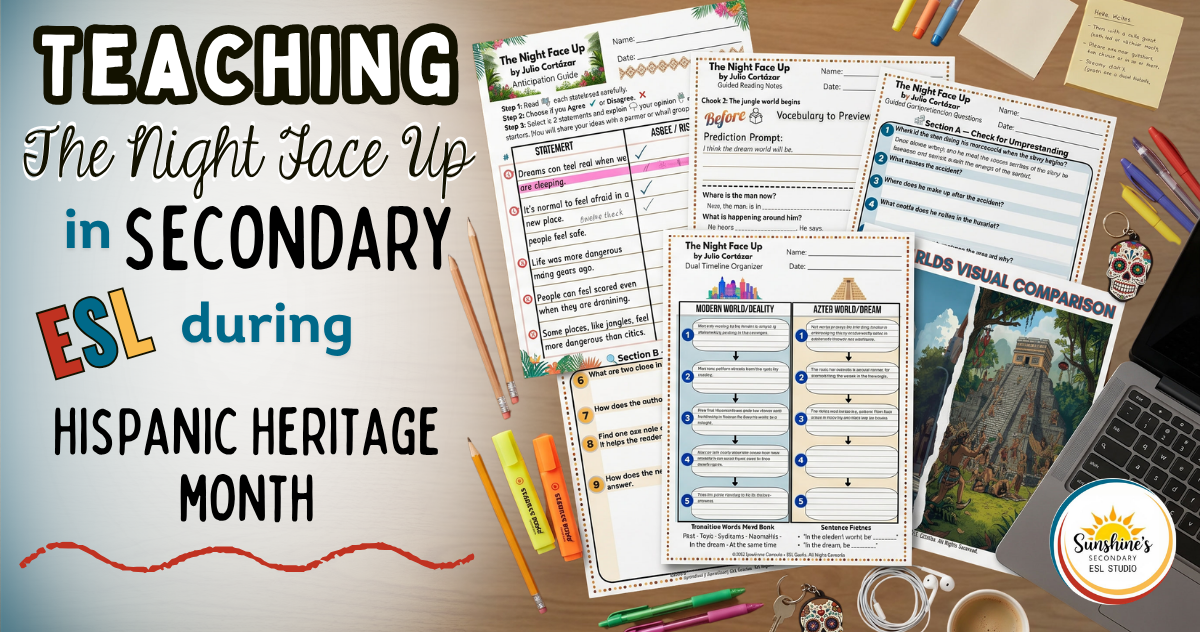
- Guided Reading Notes
- Scaffolded Comprehension Questions
- Aztec Culture & Magical Realism Context Slides
- Dual Timeline Graphic Organizers
- Vocabulary Sorts
- Anticipation Guides
- Differentiated supports for multiple proficiency levels
I especially love using the Dual Timeline Organizer because it helps students visually track the shifting realities throughout the story. That visual support makes a huge difference for many learners.
Please note that the full text of the story is not included due to copyright restrictions, but the resources provide instructions and QR code access for legally locating the text.
If you want everything in one place, the Night Face Up ESL Bundle combines all the activities together and saves teachers time during Hispanic Heritage Month planning.
Why The Night Face Up Belongs in Secondary ESL
There are very few stories that simultaneously feel:
- culturally meaningful
- academically rigorous
- genuinely suspenseful
- discussion-friendly
- accessible for multilingual learners
The Night Face Up manages to do all of those things.
During Hispanic Heritage Month, it gives students an opportunity to experience authentic Latin American literature while building reading, speaking, listening, and critical thinking skills in English.
More importantly, it creates the kind of classroom conversations students actually remember.
If you’re planning a Hispanic Heritage Month unit for secondary ESL, this is one story I truly recommend adding to your classroom.