

If you’ve ever felt stuck when it comes to grading ESL students high school, you’re not alone. It’s one of those things that sounds simple—until you’re actually doing it. You’ve got students at completely different proficiency levels, some who understand everything but can’t express it yet, and others who are still building basic vocabulary. So what does “fair” even mean in this context?
Let’s talk about what actually works in real classrooms—without making your grading system complicated or overwhelming.
The Truth About Grading ESL Students
Here’s the reality: grading ESL students isn’t the same as grading native English speakers—and it shouldn’t be.
That doesn’t mean lowering expectations. It means adjusting how students demonstrate their learning.
A student might fully understand a concept but struggle to show it in perfect English. If we only grade language accuracy, we’re not actually measuring what they know—we’re measuring their current stage of language development.
And those are two very different things.
If this idea resonates with you, you might also find yourself rethinking rigor in your classroom—because it doesn’t always look the same in ESL settings. ( Why Rigor in ESL Looks Different)
What Does “Fair” Grading Look Like?
Fair doesn’t mean equal—it means appropriate.
When it comes to grading ESL students high school, fairness often looks like separating content knowledge from language proficiency.
Here’s what that can look like in practice:
- A student understands a theme in a story but writes in simple sentences → still shows comprehension
- A student uses incorrect grammar but gives a strong, thoughtful response → still demonstrates thinking
- A beginner student uses sentence frames → still doing the work at their level
If your grading system only rewards perfect English, your ESL students will almost always be at a disadvantage—even when they’re trying their best.
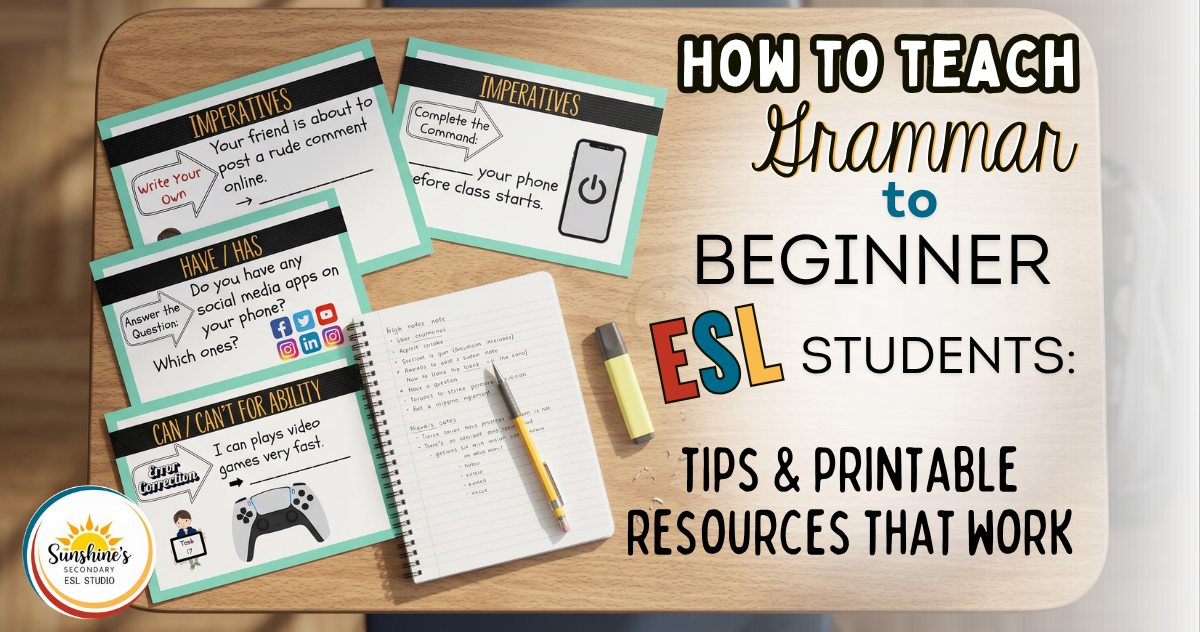
This is why I rely heavily on structured activities that allow students to show understanding without needing perfect grammar right away. For example, when I use grammar-focused practice like task cards or scaffolded worksheets, I’m looking at whether students understand the concept—not whether every sentence is flawless.
This is also where differentiation plays a huge role—especially in mixed-level classrooms. ( Differentiate ESL Instruction in High School)
A Simple Shift That Changes Everything
One of the most effective ESL grading strategies is this:
Grade content and language separately.
This is also why I like using activities where I can clearly separate those two areas. For example, during grammar practice, I might focus only on one specific skill—like verb tense—using targeted activities instead of overwhelming students with everything at once.
Instead of one overall grade, think in terms of:
- Content (understanding, ideas, analysis)
- Language (grammar, vocabulary, structure)
This doesn’t mean you need two grades in your gradebook—it just means you’re recognizing both intentionally.
For example:
- Content might be worth 70%
- Language might be worth 30%
This allows students to succeed academically while still growing linguistically.
Grading ESL Students High School: What to Prioritize
When you’re grading ESL students high school, it helps to be really clear about your goal for each assignment.
Ask yourself:
Am I assessing content, language, or both?
If you’re assessing content:
Focus on:
- Understanding of the topic
- Use of evidence
- Ability to explain ideas
Be more flexible with:
- Grammar mistakes
- Sentence structure
- Spelling
If you’re supporting students with writing tasks, this mindset aligns really well with scaffolded writing strategies. (ESL Writing Support Strategies)
Sometimes I even allow students to use supports like sentence starters or reference tools so they can focus on their ideas instead of getting stuck on how to begin.
If you’re assessing language:
Focus on:
- Sentence formation
- Grammar accuracy
- Vocabulary usage
This is where more traditional grading makes sense—but it should be intentional, not automatic.
If you’re assessing both:
Use a rubric that clearly separates the two.
This is where a lot of teachers run into frustration—because without clarity, grading starts to feel inconsistent.
Why Overcorrecting Can Hurt Your ESL Students
This is something I’ve seen a lot—especially from teachers who are new to ESL or coming from general education English classes.
They care. They want students to improve. So they correct everything.
Every grammar mistake. Every spelling error. Every awkward sentence.
And while that might feel helpful… it can actually do more harm than good.
When students get papers back covered in red marks, it sends a very clear message:
You’re doing everything wrong.
For multilingual learners, that can be discouraging fast.
Some students will start to shut down. Others will stop taking risks with their writing altogether. And many begin to feel like they need to be “perfect” in English just to pass—which isn’t realistic during language development.
This connects closely to building confidence in ESL learners—especially when it comes to speaking and writing. (ESL Speaking Confidence Activities)
A Better Approach: Be Intentional With What You Correct
In my own classroom, I take a much more focused approach.
I only correct what I’ve explicitly taught.
That means if we’ve been working on:
- Past tense verbs → I’ll give feedback on that
- Sentence structure → I’ll look closely at that
- Specific grammar skills → I’ll target those
But I don’t overwhelm students by correcting everything all at once.
Why this works:
- Students can actually learn from the feedback
- It feels manageable instead of defeating
- They start to recognize patterns in their own mistakes over time
Instead of drowning in corrections, they’re building skills step by step.
What This Looks Like in Practice
A student might turn in a paragraph with multiple errors—but instead of marking every single one, you might:
✔ Highlight or correct only the target skill
✔ Leave other errors for future lessons
✔ Give one clear, actionable piece of feedback
This keeps the focus on growth—not perfection.
The Problem With “Participation Grades”
Participation sounds like an easy solution… but for ESL students, it can get tricky.
Some students:
- Are quiet because they’re processing language
- Are afraid to make mistakes
- Need more time to respond
So if participation is part of your ESL classroom grading, consider redefining it.
Instead of:
“Speaks often in class”
Try:
“Engages in learning tasks (writing, partner work, responding when ready)”
If you’re looking to better support students during these moments, wait time strategies can make a huge difference. (Wait Time Strategies in the ESL Classroom)
For participation, I’ve found that structured speaking activities work much better than just expecting students to “talk more.” When students have clear prompts and expectations, they’re much more willing to participate.
Practical Ways to Make Grading More Fair
You don’t need a complete overhaul. A few small adjustments can make a huge difference.
✔ Use sentence stems and scaffolds
If a student uses a frame correctly, that counts as success—not a shortcut.
( Free ESL Sentence Starters for Teens)
✔ Allow multiple ways to show understanding
- Writing
- Speaking
- Drawing + explaining
- Partner responses
Sometimes I even use activities like logic-based tasks or problem-solving activities where students can show comprehension without relying entirely on language production.
✔ Give credit for growth
A student going from one-word answers to full sentences? That’s progress—and it deserves recognition.
Tracking growth is something I take seriously, especially with language development. Even something like pronunciation or fluency can improve over time, and having a way to measure that progress helps students stay motivated.
✔ Adjust expectations by proficiency level
Your A1 student and your B2 student should not be graded the exact same way—and that’s okay.
(Differentiating ESL Instruction from A1 to B2)
What About Late Work and Missing Assignments?
This is where things can get frustrating.
Sometimes ESL students fall behind not because they don’t care—but because:
- They didn’t fully understand the directions
- The task took them longer
- They were mentally translating everything
You don’t have to accept everything late—but a little flexibility can make a big difference.
Even something simple like:
- Extra time
- Clarified instructions
- Checking for understanding before starting
…can prevent a lot of those issues.
The Balance: High Expectations + Realistic Support
Here’s the goal:
Keep expectations high—but make the path accessible.
We’re not lowering the bar. We’re giving students a fair chance to reach it.
That’s what strong multilingual learners assessment really looks like.
If you’re thinking about the bigger picture of supporting ESL learners across your classroom, this ties into overall classroom management and structure as well. ( ESL Classroom Management in High School)
Final Thoughts on Grading ESL Students
If you take nothing else from this, remember this:
Your grading system should reflect what your students know—not just how well they can say it (yet).
When you approach grading ESL students high school with that mindset, everything shifts:
- Students feel more confident
- You get a clearer picture of their learning
- And grading becomes a lot less frustrating
And honestly? That’s a win for everyone.
Tools That Make Grading ESL Students Easier
Over time, I’ve realized that grading becomes much easier when your activities are already structured in a way that supports language development.
If you’re looking for ready-to-use resources that align with everything in this post, here are a few I personally rely on in my classroom:
- Grammar task cards for targeted skill practice
- Scaffolded grammar worksheets for focused feedback
- Sentence starters and desk mats for writing support
- Conversation cards for structured participation
- Pronunciation assessments to track growth
These aren’t about making things easier—they’re about making grading more accurate and fair for multilingual learners.
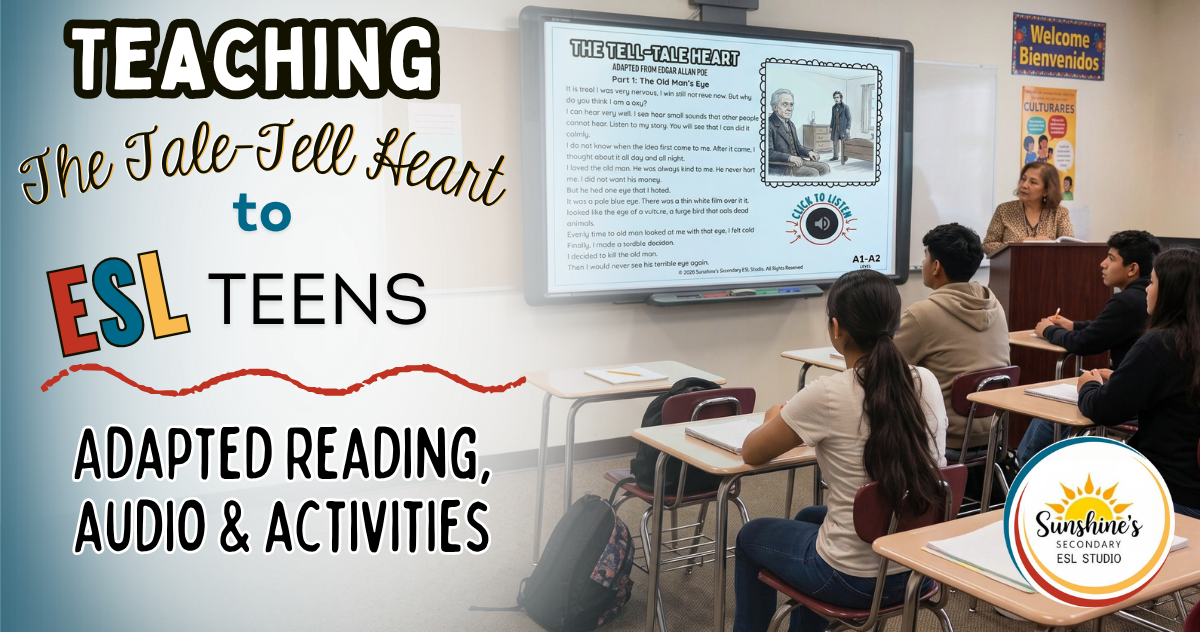
Teaching The Tell-Tale Heart to ESL Teens: Adapted Reading, Audio & Activities

The Monkey’s Paw ESL: How to Teach the Classic Short Story to English Learners
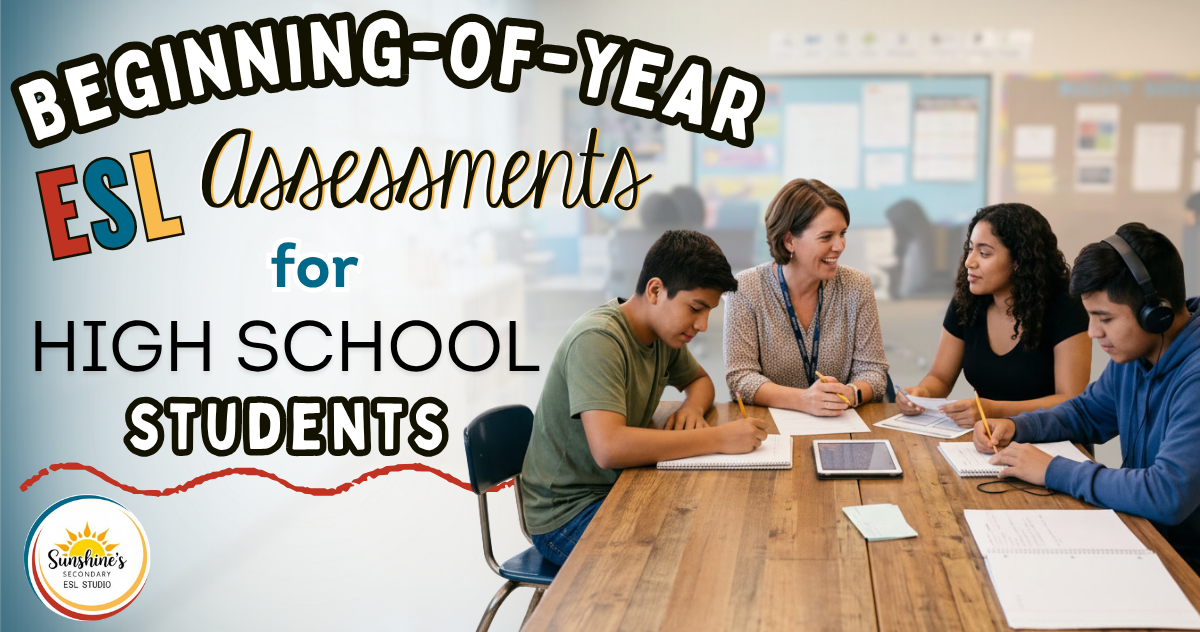
Beginning-of-Year ESL Assessments for High School Students