
By the time state testing is over, something shifts in the classroom.
Students are still physically present—but mentally, many of them have already checked out for summer. Attention spans shrink, motivation drops, and even your most structured lessons can start to lose their impact.
And if you’re teaching a novel at the end of the year—like I am right now with To Kill a Mockingbird—you’ve probably felt this even more. There’s often a point near the end of class where engagement fades, and pushing forward with traditional instruction just isn’t effective anymore.
That’s where having a set of end of year ESL activities for high school becomes essential.
These aren’t just “time-fillers.” They’re structured, purposeful activities that keep students using English—just in a way that feels lighter, more interactive, and more manageable for this time of year.
If you’re trying to maintain momentum while adjusting expectations, this also connects closely with strategies I share in: How to Support ESL Students During Novel Studies
Here are the activities I consistently rely on during those end-of-year moments when attention is low—but learning still matters.
1. ESL Charades: High Energy Without Losing Structure
When students need to move, reset, and re-engage, charades is one of the fastest ways to shift the energy in the room.
But what makes it effective for ESL isn’t just the movement—it’s the language practice.
Students are:
- describing
- guessing
- connecting vocabulary to actions
It becomes a natural way to reinforce language without it feeling like a formal lesson.
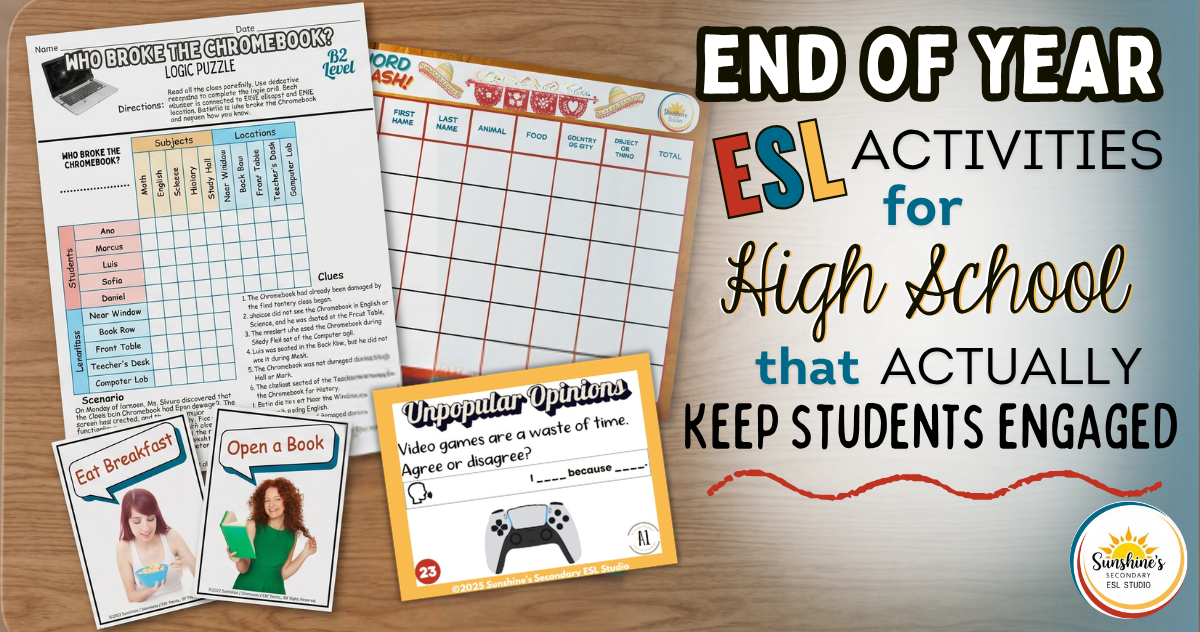
If you want a ready-to-use version, I use my ESL Charades sets with my students. They’re designed specifically for high school learners and include structured prompts that keep the activity focused while still feeling fun.
If you want a structured version that works specifically for teens, I use resources like: Charades Game for ESL High School Students
These kinds of activities also support the speaking routines I talk about here: How to Build ESL Speaking Routines
2. Teen Talk Cards: Low-Pressure Speaking That Actually Works
Some days, students don’t need high energy—they just need something simple that gets them talking.
That’s where conversation cards come in.
Teen Talk-style prompts give students:
- a clear starting point
- built-in structure
- the chance to connect ideas to their own experiences
Even quieter students tend to participate when the expectations are clear and manageable.
For this, I often use my Teen Talk Conversation Cards, which are organized by theme and level so students always have something to say—even on low-energy days.
If you need extra support for responses, pairing this with: Free ESL Sentence Starters for Teens
makes a big difference—especially for A1–B1 students.
You can also explore more structured speaking ideas here: ESL Speaking Confidence Activities
3. Word Dash (Inspired by ¡Basta!): Fast-Paced and Competitive
This is one of the most engaging end-of-year activities I use.
Inspired by the game ¡Basta!, Word Dash combines:
- vocabulary recall
- categories
- quick thinking
- friendly competition
Students stay engaged because every round feels different—and because there’s a clear goal.
I also use my Word Dash game (inspired by ¡Basta!), which students absolutely love. It combines vocabulary, categories, and competition in a way that keeps everyone engaged—especially at the end of the year.
It’s also a great example of how culturally responsive activities can increase participation, especially when students recognize elements of familiar games. If that’s something you’re focusing on, this connects well with: Culturally Responsive Teaching for ESL Teens
4. ESL Logic Puzzles: Quiet Focus When Energy Drops
Not every class needs high energy.
Sometimes, especially late in the day, students need something quieter that still challenges them.
That’s where logic puzzles come in.
They allow students to:
- slow down
- think critically
- stay engaged without pressure to speak
I often use these when I notice the class energy dipping or after a more active activity.
When I need something quieter but still meaningful, I pull from my ESL Logic Puzzles. These give students a chance to slow down and think critically while still using English in a structured way.
If you’re looking for structured options, I use resources similar to: ESL Logic Puzzle for Teens
5. Rotating Activities to Keep Engagement Consistent
One of the most effective strategies at the end of the year is rotation.
Instead of relying on one type of activity, I mix:
- speaking
- movement
- critical thinking
For example:
- one day: charades
- next day: conversation cards
- next day: Word Dash
- then: logic puzzles
This variety keeps students engaged because the routine feels fresh—even when motivation is low.
Final Thoughts: Keeping Learning Going Without Burnout
At the end of the school year, the goal isn’t to push through content at the same pace as earlier months.
It’s to adjust intentionally.
Using end of year ESL activities for high school allows you to:
- maintain structure
- keep students using language
- reduce frustration (for both you and your students)
These activities aren’t just for May—they’re tools you can use anytime engagement drops. But at the end of the year, they become essential.
If you’re looking for ready-to-use versions of these activities, you can explore the ones I use in my classroom through my TPT resources, including charades, conversation cards, Word Dash, and logic puzzles—all designed specifically for secondary ESL students.
Because even when students feel like they’ve already started summer, meaningful learning can still happen—it just needs to look a little different.
If you want to see how these activities work with your students, you can try one for free before committing to a full set. I’ve included sample versions so you can test them out and see what works best for your classroom. 👉 FREE Word Dash! Traditional Vocabulary Game for ESL | Inspired by the Game Basta