


Estimated reading time: 4 minutes
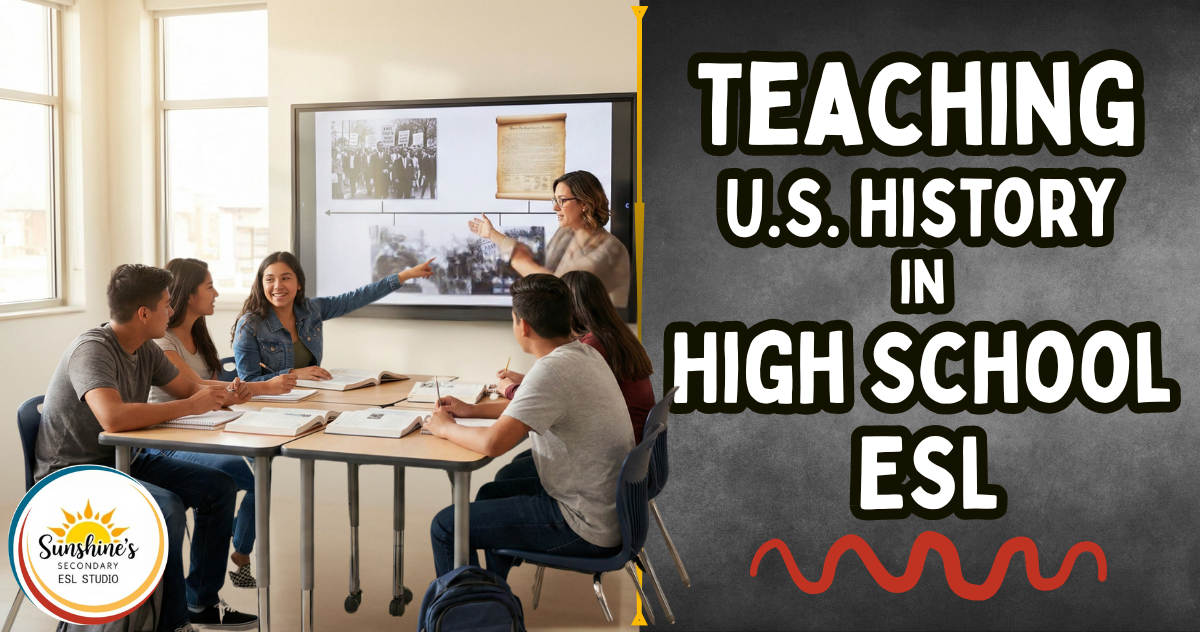
Teaching U.S. History in high school ESL is essential preparation for multilingual learners entering content-area classrooms.
Every year, high school English learners walk into U.S. History classrooms expected to discuss topics they may have never encountered before.
Reconstruction. Jim Crow laws. The Civil Rights Movement. The Holocaust. The Constitution. The Cold War.
For many multilingual learners, these are not just new vocabulary terms — they are entirely new historical frameworks.
That’s why teaching U.S. History in high school ESL is not optional support. It is foundational preparation.
Why Teaching U.S. History in High School ESL Matters
When students encounter American historical topics for the first time in a content-level class, several challenges appear at once:
- Unfamiliar historical context
- Dense academic vocabulary
- Abstract political and legal concepts
- Cultural references they may not recognize
A student may understand English conversationally but struggle with words like segregation, amendment, federalism, or civil rights.
Without structured support, comprehension shuts down.
This is where the ESL classroom becomes a bridge.
This is why teaching U.S. History in high school ESL must be intentional and proactive.
For a deeper look at how language proficiency impacts comprehension, you may find my post on ESL Students Reading Below Grade Level helpful.
Teaching U.S. History in High School ESL Before They See It in Content Classes
One of the most powerful moves, therefore, a secondary ESL teacher can make is pre-exposure.
If students have already:
- Read a simplified informational text
- Studied a biography from that era
- Discussed key vocabulary
- Practiced structured conversation
They enter their U.S. History classroom with confidence instead of confusion.
For example, before students analyze primary sources in history class, they can explore scaffolded biography passages like:
These readings build both background knowledge and academic language. If you’re looking for additional examples, you can explore my collection of ESL biography reading passages designed specifically for secondary learners.
Collaborating with the U.S. History Teacher
Ideally, teaching U.S. History in high school ESL should not happen in isolation.
Additionally, meeting with the history teacher allows you to anticipate vocabulary demands.
One of the most effective strategies is meeting briefly with the content-level history teacher and asking:
- What unit is coming up next?
- What vocabulary will students need?
- Are students reading primary sources?
- Will there be an essay or project?
With that information, you can:
- Pre-teach vocabulary through context
- Assign leveled informational texts
- Build discussion routines
- Practice short constructed responses
This transforms ESL from “extra support” into intentional academic preparation, especially when you are intentionally differentiating ESL instruction from A1 to B2 levels to match upcoming content demands.
Using Informational Texts to Prepare Students
Historical topics are language-heavy.
Teaching informational texts in ESL before students encounter textbook chapters can dramatically improve comprehension.
For example:
- Black History Month informational texts
- African American Inventors informational texts
- Holocaust support materials
This allows students to:
- Learn vocabulary in manageable chunks
- Practice comprehension questions
- Engage in supported discussion
- Build writing confidence
Literature as a Bridge to Historical Understanding
Sometimes literature is the most accessible entry point into history.
Teaching a scaffolded novel study such as:
Teaching a scaffolded novel study helps students emotionally connect to historical periods before analyzing them academically. For practical scaffolding ideas, you can explore my guide on supporting ESL students during novel studies.
Why This Matters
When students encounter historical topics in U.S. History without preparation, they may disengage.
But when teaching U.S. History in high school ESL provides:
- Background knowledge
- Academic vocabulary
- Structured discussion
- Scaffolded reading
- Writing practice
Students participate.
As a result, students begin asking questions, developing empathy, and succeeding across classes.
ESL becomes the bridge — not the barrier.
Ultimately, teaching U.S. History in high school ESL bridges language development and content mastery.
Final Thoughts
High school ESL classrooms are uniquely positioned to prepare students for academic success beyond English class.
By collaborating with history teachers, pre-teaching key content, and using scaffolded informational texts and biographies, we give multilingual learners the tools they need to thrive.
Teaching U.S. History in high school ESL is not about replacing the content class.
It’s about equipping students to enter it confidently.

