

The Ultimate Guide to Teaching High School ESL: Strategies, Classroom Ideas, and Support for Teachers
Teaching ESL at the high school level is different. You’re balancing language development, grade-level expectations, mixed proficiency levels, and teens who want to feel respected—not “babied.”
In this guide, you’ll get:
-
A simple way to plan lessons using SWIRL (so language and content happen together)
-
Practical strategies for reading, writing, speaking, and listening with teens
-
Scaffolds that keep rigor high without watering things down
-
A few ready-to-use freebies and resources if you need something you can use tomorrow
If you’re feeling overwhelmed, you’re not alone. High school ESL can be challenging, but it can also be one of the most meaningful teaching experiences—because you’re helping students build language, confidence, and a sense of belonging at a critical time in their lives.
Table of contents
Start Here (Free + Done-for-You Options)
If you’d like something you can use right away, start here:
🎁Free: Grab my Teen Talk Conversation Cards “Would You Rather” A1 Level (a sample you can try with ESL teens) → Click Here
🌟Ready-to-use: Want the full classroom version that matches this guide?
→ Teen Talk ESL Conversation Cards A1 Level
❤️Best value: If you want everything in one place and levels A1 to B2, save with the bundle: → Teen Talk ESL Conversation Bundle 320 Speaking Prompts
New to teaching ESL? You’re not alone! This guide to teaching high school ESL offers practical strategies to help you plan lessons, pace the year, scaffold language skills, and keep students engaged. Whether you’re just starting out or looking to refine your approach, this guide is packed with real-world tips you can use right away.
Teaching teenagers in the age of cellphones can pose its own challenges. Teaching those same high school ESL teens is a feat of its own. It isn’t as simple as grammar worksheets and vocabulary drills. These young people are at a critical time in their lives. Because they are balls of emotion and teenaged angst, adding a language barrier to that makes things all the more difficult. In this Ultimate Guide to Teaching High School ESL, you’ll find practical strategies, real classroom insights, and tools designed specifically for secondary ESL educators who want to engage, support, and empower their multilingual learners.
Understanding High School English Learners
For this guide I will use the term ELLs (English Language Learners). Sometimes they are also called EBs (Emergent Bilinguals) and the more outdated term LEP (Limited English Proficient). No matter the terminology used, they are all unique in their needs. They don’t come in a one-size-fits-all package. They are often misunderstood by those that don’t work with them. However, you will need to know a few things about the types of ELL students that you may face in your career.
Types of ESL students
In an ESL program, many teachers will work with the newcomer ESL student. This student meets two criteria: they are in their very first year in the United States, and they are at a beginner level of English. However, it isn’t uncommon with some ESL students to arrive from another country and already possess some foundational skills in English. This was my experience in my current school. Most of my ESL students are actually considered intermediate level ESL students.
Intermediate ESL students will be able to understand some English, but still need a lot of guidance. They still depend heavily on language supports. They can form some basic sentences whereas their newcomer counterparts have little to no skills to do such things.
Long-Term English Learners (LTELs) are students that have stalled in the English learning process. They have been in the United States for over 6 years and lack the academic language to handle many of the classes they will face in high school.
Academic vs. social language needs
In the world of ESL, you will hear two terms floating around:
-
- BICS (Basic Interpersonal Communication Skills)
-
- CALP (Cognitive Academic Language Proficiency)
When thinking of BICS, think of it as the social language that our teens learn first. We often open up units with some social language. This is essentially: survival English. It is how they are going to navigate an English speaking world. However, their academic world that exists in their textbooks and their upcoming college years, has a far more difficult type of English. Academic English (CALP). It can take several years to acquire academic language skills in the second language. Sadly social English isn’t enough to meet state tests and complex subjects. This poses challenges to our students. This is also why we end up having “lifers” or the long-term English learners that I previously mentioned.
Common emotional and cultural challenges
Do you remember when you were a teenager? You were mortified over very simple things like a pimple on the tip of your nose. You often cared deeply about what others thought of you (except of course the adults in your life). Imagine adding to that a language barrier, an accent, cultural norms that don’t fit your new life. We worry about teens because they are emotional by nature. In your ESL classes, you may notice that these teens are bubbly and loud. So many times in my career, I have had core content teachers approach me about the shy and quiet kid that they have in their class. That kid is usually not the quiet one in my class. ESL seems to be their gathering spot away from classes they fear being called on and having to expose that they don’t understand or that they have an accent.
Our students deal with anxieties around speaking a language they aren’t comfortable in or have the academic language to handle being picked on to answer. They require a lot of support. Unfortunately there are teachers who don’t feel it is their job to provide sentence stems and scaffolds because that is an “ESL teachers job”. My state (Texas) provides the ELPS (a set of standards separate from TEKS) that mandate that these teachers should be language teachers as well. Teachers that help ELLs to speak, read, listen, and write in English.
Teen-specific concern
Lack of Motivation
If I had to rank reasons my students didn’t learn English, I would say lack of motivation would be at the top of that list. There have been times in my career where I have had students tell me that they don’t want to learn English. They felt forced by their parents to come to school in the United States. I try to change their thinking, but because we are a border town, they often tell me that there will always be someone willing to speak Spanish to them. They are not wrong about that.
I also have the teens that don’t want to put in the effort. They want to learn, but they aren’t willing to practice. These students seem to think the English will somehow miraculously come to them. I wish I had that kind of magic. Wouldn’t that be the best resource. Automatic English for all that enter your class.
Curriculum Planning & Standards
What would a guide to teaching high school ESL be without talking about the curriculum and standards? The big dilemma that many ESL teachers face is not seeing their students voices reflected in the state guidance materials. These documents can often leave us with more questions than answers.
Aligning with state/national standards
Most of the United States uses common core standards (CCSS). I will not attest to being an expert on them as I teach in Texas and we use the TEKS. No matter the state or the standards used, we know as teachers that we must incorporate them into our curriculum. Our school district, like many districts, lays out the curriculum documents for us. However, their text selections and pacing guides may not be appropriate for ESL.
What can a teacher do when the curriculum guide doesn’t reflect our English language learners and their needs?
-
- Choose your own texts! Just make sure that the standards are covered.
-
- You can go along with the curriculum guide, but modify the texts for your students.
Whatever option you choose, you will need to make sure that your students are meeting the standards outlined by your state. But what if your students can’t meet the standards?
-
- You will need to look at where your student currently is and create extra scaffolds (essentially a boost) to get them up where they need to be.
-
- You will need to change the pacing to be able to get your students on par with those standards. (If this isn’t possible, it is probably not the right text for your students.)
Balancing content + language objectives
Many forget that ESL is also a content class. We are expected to teach the same curriculum that is seen in regular classes. However, what makes ESL unique is that we are also teaching the English language. We do this by incorporating the SWIRL method. SWIRL stands for speaking, writing, interacting, reading and listening. It is making sure that you mindfully plan each lesson to include:
-
- An opportunity to SPEAK English.
-
- To create a plan to WRITE in English.
-
- Small and whole group INTERACTION opportunities.
-
- An opportunity to READ English.
-
- A chance to LISTEN to English.
If you incorporate these five necessary skills within the content of teaching the curriculum, you are essentially teaching the English language while also teaching the content. I didn’t have a guide to teaching high school ESL when I started, but this was the very first and most important thing that I learned.
When building your personal guide to teaching high school ESL, keeping SWIRL in mind will give you a strong foundation.
Read: Conversation Starters for ESL Teens
Building units and lesson plans
When reviewing your curriculum documents, always keep your students’ needs at the center. You don’t need to water down the content — ESL students still deserve the rigor built into academic standards. Here are a few tips to help you as you build your guide to teaching high school ESL:
-
- Center Your Students:
Build lessons and units around your students’ interests and backgrounds. Reflect their home cultures and experiences whenever possible. Choosing culturally relevant texts through Culturally Responsive Teaching can make a world of difference in student engagement.
- Center Your Students:
-
- Minimize Teacher Talk:
Long lectures don’t work well in today’s classrooms, especially in ESL settings. Plan short, focused instruction followed by quick activities that get students actively using language.
- Minimize Teacher Talk:
-
- Give Yourself Grace:
Some lessons won’t work — and that’s normal. Teaching is a craft, and teaching ESL is a masterpiece in progress. Students change, technology evolves, and your teaching will adapt with it. Think of each school year as a new chapter in your own guide to teaching high school ESL.
- Give Yourself Grace:
Pacing tips across the school year
Many curriculum documents are designed primarily for mainstream students, often overwhelming them with an abundance of resources and pacing calendars that may not align with their abilities. A practical approach within your guide to teaching high school ESL is to ensure that you meet the required standards while selecting a few manageable resources.
You can also look for adapted texts or eliminate certain pages or sections of materials that can be easily summarized. My district assigned us to teach Macbeth by Shakespeare; however, I could have opted for Julius Caesar or an adapted version instead. Ultimately, I chose to introduce my ESL students to Macbeth, aiming to keep the plot intact and highlight some key elements of the play. In the end, they found it enjoyable and comprehensible. To adhere to the timeline, I focused on scaffolding essential aspects of the play and provided summaries for parts that could be condensed easily.
Macbeth worked well with my class because they are mostly upper intermediate level English language learners. If, for example, I had newcomer beginners I may have chosen a different play. Just know your particular students and what they can handle and pace the lessons accordingly. Ultimately, you must tailor your pacing based on your students’ English proficiency. This flexibility is an important part of any effective guide to teaching high school ESL.
Read: First Week Tips for New ESL Teachers
The Four Language Domains
a. Reading
Choosing accessible, age-appropriate texts
When selecting a reading for a high school ESL class, it is important that the text be age-appropriate. A teacher from the SPED department once handed me a Dora the Explorer book for my high school ESL class. At that time, I was new to teaching ESL. Although the gesture seemed sincere, I knew from that moment on that my students were misunderstood. Teaching with rigor and trying to mirror as best as possible what regular English classes are reading is a better course of action.
When choosing texts as part of your guide to teaching high school ESL, ensure that they are rigorous, age-appropriate, and culturally inclusive.
This will ensure that your classroom readings are engaging and age-appropriate while also respecting the cultures and languages of our students.
Read: Why Rigor in ESL Looks Different
Vocabulary building techniques
Before assigning a reading, take time to review the vocabulary and anticipate challenges from an ELL perspective.
-
- Are there any words that they just won’t know?
-
- Are there idiomatic expressions that need to be clarified?
-
- Are any of the words cognates (similar in English and the student’s primary language)?
Tier 1, Tier 2, and Tier 3 words explained!
Tier 1 words are words that a newcomer probably will encounter. These are survival type words: body parts, clothes, school supplies, etc.
Tier 2 words are academic vocabulary terms that are commonly used in everyday English.
Tier 3 words are content specific. They are not common. They only occur in certain circumstances. For example: the equipment in a science lab would generally only be used in a science situation.
Thinking of these three types of words, it is the tier 2 words that should be pulled as they are new words to our students, but common. For newcomers with a beginning level of English, they will need the survival of the tier 1 words as well. The tier 3 words can be demonstrated through photos as you are reading.
Vocabulary needs to not be overwhelming. Many things can be learned through the practice of reading in its context. Any words chosen need to be repeated over the course of a lesson in order for our students to learn it.
Pre-reading, during, post-reading strategies
Pre-reading (building background knowledge)
Goal: Build background knowledge, activate prior knowledge, preview vocabulary.
-
- Preview Vocabulary: you’ll want to introduce any key vocabulary that your ELLs will encounter during the reading of the text.
Important Tip: Use simple, visual word walls or quick flashcard games.
- Preview Vocabulary: you’ll want to introduce any key vocabulary that your ELLs will encounter during the reading of the text.
-
- Make Predictions: Show them the title, pictures, or first paragraph and have them predict what the text will be about.
-
- K-W-L Charts (Know, Want to Know, Learned): Start with “What do you already know about ___?” to connect their experiences to the topic.
-
- Picture Walk or Text Feature Walk: If the text has visuals, headings, subheadings, captions, walk students through them first. (This lowers anxiety for newcomers.)
-
- Activate Prior Knowledge with Quick Discussions: 1–2 sentence discussions about the topic before reading.
You May Also Like: Building Empathy while Teaching Holocaust Literature to ESL Teens
It is highly important that you follow some sort of scaffolding like the ones I’ve outlined here in order for students to connect meaningfully and to understand the reading.
During reading strategies
Goal: Support comprehension in real-time, chunk the text, and keep engagement active.
-
- Guided Reading Questions: Give students specific questions to answer as they read. (ex: “Find out what problem the character faces.”)
-
- Chunking the Text: Pause after each paragraph or section and discuss or summarize. ESL students process better in small pieces.
-
- Annotation Support: Teach students how to annotate even with limited English (ex: underline new words, star important ideas, use simple symbols like ? or !).
-
- Partner Reading / Choral Reading / Echo Reading: Allow students to read out loud together instead of picking on them individually.
-
- Visual Aids: Create quick sketches or diagrams during reading to help with comprehension.
Chunking is an essential strategy when teaching high school ESL students. While teenagers are often expected to read long texts, we must remember that for English learners, reading in a new language is much harder. The best way to teach chunking is to model it. Draw a line after each paragraph and show students how to pause and reflect after reading each section. Encourage them to write about their thinking. It’s also helpful to let students annotate in their native language, since their notes are simply tools to help them process and understand the reading.
Post-reading strategies
Goal: Solidify understanding, apply critical thinking, and extend language use.
-
- Summarizing with Sentence Frames: Provide sentence starters like, “The story is about ___,” “The main character feels ___ because ___.”
-
- Graphic Organizers: Plot diagrams, cause-and-effect charts, character maps that help ELLs organize ideas visually.
-
- Retelling Activities: Students retell the story in small groups or write a short summary. (Can be oral or written depending on language level.)
-
- Discussion Circles: Provide simple, scaffolded questions like “What was your favorite part?” “What surprised you?” to encourage speaking practice.
-
- Connection Activities:
-
- Text-to-Self: How does this story relate to your life?
-
- Text-to-World: How does this relate to what’s happening in the world?
-
- Text-to-Text: Have you read something like this before?
-
- Connection Activities:
Don’t simply stop at the end of a reading! English language learners need to unpack their learning and this is where the real comprehension begins. These are also awesome opportunities for practicing speaking and listening skills.
🎁Try a Freebie! Día de Los Muertos ESL Informational Text and Comprehension
b. Writing
Sentence starters, modeled writing, scaffolded paragraphs
Goal: Help ESL students start writing without feeling overwhelmed
-
- Sentence starters reduce writing anxiety for English learners. ELL teens often feel that they will get something wrong. Without the boost that sentence starters provide, your students may sit quietly looking around to see what others may be writing. It helps to have a guide so they can get started.
-
- Examples of sentences starters can change depending on the writing task:
-
- Narrative writing: “One day, I decided to…”
-
- Argument writing: “I believe that… because…”
-
- Informational writing: “The most important reason is…”
-
- Examples of sentences starters can change depending on the writing task:
-
- Teacher modeled writing:
-
- Think aloud as you write a paragraph on the board or a shared document.
-
- Emphasize imperfect drafting (“I’m going to add more details later”) to reduce pressure.
-
- Teacher modeled writing:
-
- Scaffolded paragraph writing:
-
- Provide frameworks like:
-
- Topic sentence starter
-
- Transition sentence starters
-
- Conclusion starters
-
- Provide frameworks like:
-
- Example: Use a fill-in-the-blank paragraph for early practice.
-
- Scaffolded paragraph writing:
This is where an I Do, We Do, You Do method or gradual release can be affective in helping students to be better writers.
Read: ESL Writing Support Strategies
Grammar instruction in context
Goal: Teach grammar naturally within real reading and writing — not isolated drills.
-
- Traditional grammar worksheets don’t work alone for ESL teens (abstract grammar without context is confusing). They need to practice it in real world contexts.
-
- Teach grammar “in the moment”:
-
- While analyzing a mentor text.
-
- While editing a student’s journal or story.
-
- Teach grammar “in the moment”:
-
- Example of grammar in context:
-
- Teaching subject-verb agreement while writing about a personal experience.
-
- Highlighting verb tenses while discussing a class novel.
-
- Example of grammar in context:
-
- Mini-lessons tied to authentic writing:
-
- After a journal entry, do a mini-lesson on past tense verbs the students used.
-
- Mini-lessons tied to authentic writing:
-
- Use students’ own writing as grammar teaching material (anonymous samples).
Grammar will come easier when it is tied to meaning and not memorized in drills.
Journals and personal responses
Goal: Foster fluency, confidence, and authentic language production.
Journaling can be a low-stress form of expression for ESL teens. They make excellent bell work and help students to practice writing. If you are able to allow for students to be free to make mistakes in their English writing through journaling the practice will be rather enjoyable and help students to grow.
-
- Ideas for ESL journal prompts:
-
- “Describe your perfect weekend.”
-
- “Write about a time you learned something new.”
-
- “What is one goal you have for this school year?”
-
- Ideas for ESL journal prompts:
-
- Benefits of personal responses to reading:
-
- Allow students to connect texts to their own lives.
-
- Use personal reactions as a bridge to analytical writing.
-
- Benefits of personal responses to reading:
-
- Low-pressure writing expectations:
-
- Focus on ideas first, not grammar perfection.
-
- Low-pressure writing expectations:
-
- Offer sentence frames for journal starters if needed.
Using journaling as both a writing tool and informal assessment can help students to become better in their writing. Just remember that they should be allowed to make mistakes with the language through this type of writing.
❤️ Try something fun with your ESL Teens: My Name – ESL Identity & Writing Activity
c. Listening
Our ESL students are surrounded by English every day — in every class, every hallway, every conversation. Even though they hear English constantly, it doesn’t mean it’s always easy to understand. Many content teachers may not realize how quickly they speak or how often they use idioms and academic vocabulary that English learners might not recognize. That’s why high school ESL students need structured, meaningful listening practice that helps them not just keep up, but build real confidence in understanding spoken English. Here are some strategies to help them find listening success:
Active listening practice
Passive listening — simply hearing English — is not enough for language development. Students must be taught to actively listen, meaning they are mentally engaged, predicting, asking questions, and making connections while listening.
Ways to build active listening skills:
-
- Set a Purpose Before Listening: Tell students what to listen for (main idea, details, tone, etc.).
-
- Use Listening Guides: Provide graphic organizers, simple note-taking frames, or T-charts (“main idea” vs. “details”) to guide focus.
-
- Ask Predictive Questions: Pause the audio at key points and have students predict what will happen next.
-
- Repeat and Reflect: Allow students to listen twice — first for general understanding, then for specific information.
Encouraging active engagement transforms listening from a passive experience into an intentional, skill-building task.
Read: Cloze Listening Activities for ESL Teens
Ready-to-Use Activity: The Necklace Cloze Listening Activity
Listening for gist vs. listening for details
Teaching students the difference between listening for gist and listening for details is essential for real-world English success.
-
- Listening for Gist:
The focus is on more-or-less the general understanding of what was heard. Students should be able to answer broad questions like, “What is this story about?” or “What is the main topic?”
- Listening for Gist:
-
- Listening for Details:
This is where you have students zero-in on specific details of what they heard. Students should listen for answers to questions like, “When did the event happen?” or “What are two reasons the speaker gives?”
- Listening for Details:
Classroom Tip:
Always focus first on the gist, or the big picture, then move into detailed specific comprehension by providing your students with questions that help them to find what they are looking for. This may take a second or third listen. This helps build a layered understanding. I would also add that students should have different mediums for listening. They should focus on both face-to-face listening and audio recordings as well.
Tools for supporting ESL listening skills
Choosing the right listening materials is key in helping our ESL teens to become better listeners of English. Consider some of these:
Audio Files via QR Code
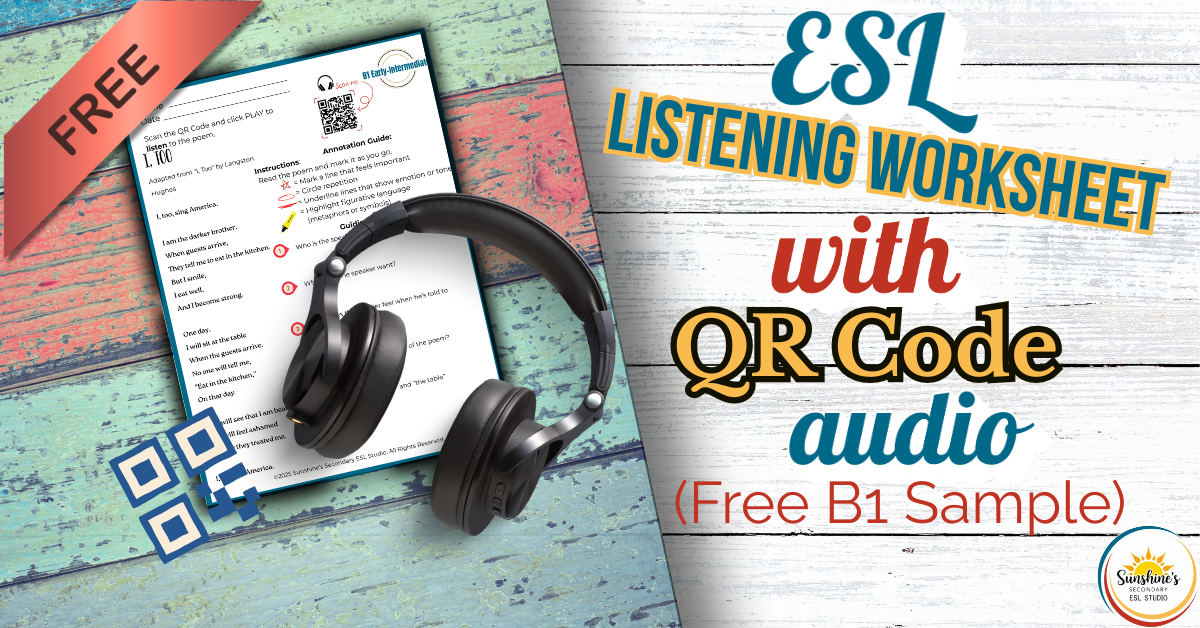
You can attach audio files to QR Codes. Students can simply scan the code that you put on their worksheets and listen to audio that goes along with their assignment. I use Vocaroo.com to upload my audio files and then get a free QR code that I can then save to my computer and then place that on my lessons. By the way Vocaroo is also a great up for students to practice speaking in and they can give you QR codes, so you can access their practice.
YouTube
-
- ESL-friendly channels offer videos with controlled speech, visuals, and subtitles.
-
- Use settings to slow down playback speed for clearer understanding.
Learning English with Voice of America News
-
- This government website offers news stories that are not only adapted for ESL, but offer read alouds to go with them.
-
- They also offer videos that teach English.
Podcasts
-
- Short, teen-friendly podcasts expose students to natural speech patterns and academic vocabulary.
-
- Use guiding questions before and during podcast listening to maintain focus.
Classroom Tip: You can find website like Canva that have awesome templates to help students create podcasts.
Teacher read-alouds
-
- As a teacher, you can model intonation, pacing, fluency, etc.
-
- You can slow down and see where the confusion is within your own classroom.
No matter what materials you would like to explore, it is vital that you really research as there is a plethora of useful resoures out there.

d. Speaking
At one time, ESL classrooms were “English-Only” spaces that punished students for not speaking English. Thankfully, those days are behind us and replaced by a respect for the native languages of our students. Instead, we provide opportunities to practice English speech that doesn’t harm or demean the native languages of our students. Matter of fact, we can use the native languages of our students in helping build their fluency.
Build confidence in shy students
Let’s face it. Our teen ESL students can refuse to speak English for various reasons. I hear the groaning when I tell them that we are going to practice speaking. In our classrooms, we have many personalities and some students not only need the vocabulary that comes with speaking, but they also are shy. Here are some ways to help your students regardless of their hesistancy levels at speaking:
-
- Provide a sentence frame similar to the type in their writing assignments. This will help them to know where to start, but also requires them to finish their thoughts.
-
- Provide a word bank, so that they can find the words they need to carry-out their thoughts.
-
- Provide differentiated activities, such as video or audio recording what they want to say. This allows them to not be put on the spot and they can adjust their speech if they make mistakes.
-
- Have students work in group settings, where they are told that they will be sharing their thoughts. This helps students to peer support each other in finding ways to express themselves in English.
Correcting mistakes without shame
Avoid overcorrecting the mistakes your ESL teens make in the classroom. It is easy to think that you are helping, but constant correction can actually hinder a student from wanting to participate in learning English. Instead, be a model for language. Use the common mistakes of your classroom as teaching moments.
This is not to say that you should NEVER correct. Absolutely, you should correct the things you have worked as a class. For example, if you taught correct capitalization, you definitely should correct students. This way students are able to make mistakes, which is simply just part of learning a language, and they will feel less anxious about their learning journey.
Grammar in the Classroom
As mentioned earlier, grammar instruction must be meaningful to truly support ESL teens. You can’t simply teach a concept and then test it. English learners need to see grammar in context — embedded in what they’re reading, writing, hearing, and saying.
Grammar should never feel disconnected from the real reason students are learning English: to express themselves, succeed in school, and be understood. That’s why grammar practice should be woven across all four domains: listening, speaking, reading, and writing.
One effective and flexible way to provide this kind of practice is through task cards.
Why use task cards in the ESL classroom?
Task cards are small, versatile tools that offer targeted practice in a low-pressure format. They function similarly to flashcards, but instead of simple memorization, they invite students to apply what they’ve learned.
-
- Grammar task cards focus on specific language skills, like subject-verb agreement, articles, or verb tenses.
-
- Conversation task cards provide prompts to get students speaking using key grammar structures in natural ways.
-
- Mixed-format cards can combine reading and writing or integrate visuals to support understanding.
In an ESL classroom, task cards give students repeated, scaffolded exposure to grammar while keeping the format interactive and manageable. They’re ideal for bellringers, partner work, small groups, stations, or fast finishers — and they promote active learning without the pressure of a traditional worksheet.
You May Also Like:
Lesson Planning & Differentiation
The infamous buzzword, differentiation, gets thrown around when it comes to working with emergent bilinguals. It may even be something your adminstrator looks for in evaluating your teaching style even in a regular content area classroom. This concept is vital in the planning of instruction in the ESL classroom.
Planning lessons for mixed-level ESL classrooms
Teaching ESL at the high school level almost always means managing mixed proficiency levels in the same room. You may have newcomers learning basic survival English sitting next to intermediate students preparing for grade-level content. Planning for this kind of classroom can feel overwhelming — but with the right structure, scaffolds, and flexibility, it’s absolutely manageable.
This section offers a practical framework to help you plan for a range of learners without watering down your instruction.
A sample weekly structure
A consistent weekly structure helps students know what to expect and gives you space to differentiate meaningfully. Here’s an example:
-
- Monday: Introduce a theme or vocabulary set with visuals and listening activities.
-
- Tuesday: Shared reading (with supports like sentence frames and tiered questions).
-
- Wednesday: Guided writing related to the topic — model together, then practice.
-
- Thursday: Grammar focus connected to the week’s reading/writing (task cards, sentence editing, etc.).
-
- Friday: Speaking activity, project work, or reflective journal writing.
Classroom Tip: Adjust activities based on the language levels of your students, but keep the theme consistent.
Planning for newcomers and intermediates together
I once worked with an ESL colleague that wanted her classes to be differentiated by language level. After our initial testing of our new students, she would contact the counselors and request that all her newcomers be in her morning class, her intermediate level students in her midday class, and her advanced students be placed in her end of day classes. I always thought this was more work for her. Students had schedules that would conflict with sports and the like and this teacher would spend a great deal of time arguing for changes to schedules instead of just differentiating instruction in a room with mixed levels.
This teacher was just searching for the perfect scenario and we know that really doesn’t exist, but how do you differentiate for a mixed room of levels?
Use thematic units or texts where all students can engage at their level. For example, while intermediates write short paragraphs, newcomers might label images, complete sentence frames, or speak using modeled sentence stems.
Tips for simultaneous differentiation:
-
- Use the same materials, but adjust the task (e.g., newcomers match images to sentences, intermediates summarize or analyze).
-
- Provide extra language scaffolds (word banks, visuals, audio) for beginners, while offering more independence to higher-level students.
-
- Use small group rotations so you can give more guided support to one group at a time.
Pacing and prioritizing language objectives
You won’t be able to cover everything — so focus on what matters most:
-
- Clear, achievable language objectives tied to your content theme.
-
- Repeat and revisit key structures and vocabulary across the week.
-
- Plan lessons that build toward a simple product — a short paragraph, a presentation, or a class discussion.
Classroom Tip: Language objectives should be visible and discussed with students — they help teens understand what they’re working toward.
Use scaffolds that work: visuals, frames, and supports
No matter the lesson, strong scaffolds help all learners engage meaningfully:
-
- Visuals: Real images, drawings, diagrams, and infographics
-
- Sentence Frames: “I agree with ___ because ___.” / “In the story, the character feels ___.”
-
- Word Banks: Key vocabulary tailored to the task
-
- Graphic Organizers: For reading, writing, and speaking tasks
-
- Audio Supports: Read-alouds, videos with subtitles, and slowed-down speech
These scaffolds allow students to show what they know while continuing to develop their language skills — without overwhelming them.
Classroom Management for ESL Students
In your career you will certainly face discipline issues with your students. Afterall, you have many different personalities in one room and teens don’t exactly have a stellar reputation of being little angels. If it seems like everything around you is crumbing when it comes to your classroom behaviors, you can at least control some of the misbehaviors. For starters, your students need to feel connected to your classroom. They need to feel respected and they need to have a language-rich classroom environment.
❤️Ready-to-Print Back to School ESL Desk Mat Bundle – A1 to B2 help teens get survival English at their fingertips!
Creating a supportive environment for ESL teens
Classroom management in an ESL setting goes beyond rules and routines — it’s about building a space where students feel safe to make mistakes, try new language, and grow academically and personally. This section outlines key strategies to help you create a welcoming, structured environment that supports risk-taking and trust.
Read: Google Translate in the ESL Classroom
Setting clear expectations
High school ESL students, especially newcomers, thrive with structure. Establishing clear, consistent expectations from day one helps reduce confusion and anxiety — especially when students are navigating both a new language and new school system.
Tips:
-
- Post expectations visually and review them regularly.
-
- Keep language simple and direct.
-
- Use modeling and nonverbal cues to clarify what’s expected (e.g., routines for entering the classroom, asking for help, transitioning between tasks).
Consistency builds security — and security builds confidence.
Use multilingual supports to reinforce routines
Visual and multilingual tools are essential for classroom clarity. Even intermediate students may miss key instructions due to gaps in vocabulary or processing time.
Tools that work:
-
- Visual schedules: Use icons or real images to show the structure of the day or class period.
-
- Translated classroom rules: Post your expectations in students’ home languages to show respect and build understanding.
-
- Picture-based cues: Use hand signals, photos, and visual prompts for common procedures (e.g., partner work, listening time, writing time).
These supports empower students to follow expectations independently, reducing behavior issues and fostering self-reliance.
Relationship-building and restorative practices
Trust is the foundation of any well-managed classroom — and it’s especially important for ESL students who may be carrying trauma, fear, or isolation from entering a new school system.
Strategies:
-
- Greet students at the door using their names (even if you’re still learning pronunciation).
-
- Use one-on-one check-ins or journals to get to know their interests and stories.
-
- Incorporate restorative conversations when problems arise instead of defaulting to punishment — ask questions like, “What happened?” “How did it affect others?” “What can we do to fix it?”
When students feel seen and respected, they’re more likely to engage and less likely to act out. Often times, the entire premise of students acting out is a coping mechanism because they don’t have enough of the language to feel comfortable and they hope that you won’t call on them and everyone see their flaws. Even in an ESL class, student possess insecurities with learning English and teens often care what their peers think of them.
Encourage risk-taking in language use
Language learning requires vulnerability. Students must feel safe enough to make mistakes, say things incorrectly, and try again — especially in front of peers.
Ways to encourage risk-taking:
-
- Celebrate effort, not just accuracy.
-
- Create a “no correction during fluency” rule during speaking activities.
-
- Offer sentence frames and word banks to support output, not replace it.
-
- Share your own language-learning challenges to build empathy.
When students feel emotionally safe, they’re more likely to speak, write, and grow.
Final Thoughts
Teaching high school ESL is both a challenge and a privilege. It requires creativity, patience, cultural awareness, and a deep commitment to helping students thrive in both language and learning. Whether you’re just starting your journey or refining your approach, I hope this guide has given you a solid foundation for supporting your students with purpose and clarity. As your classroom evolves, so will your strategies — and that’s part of what makes this work so rewarding. Keep showing up, keep learning, and know that you’re making a lasting impact, one lesson at a time.