



Estimated reading time: 7 minutes
When I first told English teachers who don’t teach ESL that I would be teaching Julius Caesar to my ESL students, they couldn’t even wrap their heads around how that would be possible. Many of them said things like, “But Shakespeare’s language is so hard!” or “How will they understand any of it?” And honestly, I get it. There are still a lot of misconceptions about what ESL students are capable of—especially when it comes to classic literature.
But the truth is, our students are often more insightful than we give them credit for. They just need the right scaffolds and supports to make the text accessible. That’s exactly why I set out to figure out how to teach Julius Caesar to ESL students in a way that felt engaging, empowering, and true to Shakespeare’s tone. What I discovered completely changed the way I approach reading in my ESL classroom—and it might inspire you, too.
Why Shakespeare Still Belongs in the ESL Classroom
There’s a reason Julius Caesar continues to appear in high-school curricula: its themes—ambition, loyalty, power, and persuasion—still resonate with teens today. The political drama and personal conflict mirror the kind of social dynamics our students already understand, even if the language feels distant. The challenge isn’t what the story says; it’s how it’s said. So rather than skipping Shakespeare altogether, I focus on translating the experience—making the text linguistically approachable without losing its emotional depth or rhetorical power.
How to Teach Julius Caesar to ESL Students (and Keep Them Engaged)
This is the heart of it: scaffolding and multi-modal learning. When students can hear, see, and act out the story, comprehension and confidence grow side by side. Here’s how I break it down scene by scene.
1. Start with Visual Context
Before students ever read a line, I introduce the setting through visuals. For Act I, we look at AI-generated storyboards showing ancient Rome during a festival—Caesar among the cheering crowds, the tribunes scolding workers, and stormy skies foreshadowing chaos. These images spark curiosity and set the emotional tone. Students immediately start asking questions like:
“Who is that?” “Why is he important?” “Why are people scared?”
Visuals make abstract language tangible. They give ESL students something concrete to discuss using sentence frames such as “I see…” and “Maybe he is…”, building oral fluency before reading even begins.
2. Move from Listening to Reading
Next comes listening. I play short, clearly voiced recordings of the modernized script—about one minute per section. During the listening phase, students focus on tone and rhythm rather than decoding every word.
Afterward, I pause for quick checks like “Who’s speaking?” or “What emotion do you hear?”
Once they open the adapted text, the dialogue already feels familiar. Students recognize lines like “Beware the Ides of March” and connect what they heard to what they see.
That sense of recognition builds confidence and curiosity for what comes next.
3. Use Modern English Adaptations
This is where my ESL Adapted Texts come in. Each scene is rewritten in A2–B1 modern English, preserving Shakespeare’s tone while simplifying syntax. For example:
Original: “These growing feathers pluck’d from Caesar’s wing / Will make him fly an ordinary pitch.”
Adapted: “If we take away Caesar’s power now, he won’t rise above the rest of us later.”
Students grasp the metaphor instantly and can discuss themes like ambition, jealousy, and power dynamics instead of getting lost in translation. Modern English adaptations don’t “water down” Shakespeare—they open the door to understanding his ideas.
4. Add Speaking Through Mini Drama
After reading, we move into short role-plays. Students perform short scenes in pairs, using expression and tone to bring meaning to life. It’s amazing how acting transforms comprehension. When students deliver a line like “The fault, dear Brutus, is not in our stars” with feeling, they own the language. They’re not just reading; they’re interpreting. This step is especially powerful for TELPAS and CEFR speaking standards—it builds real oral fluency through authentic performance.
5. Close with Reflection and Writing
Each scene ends with structured writing frames that guide students toward analysis:
- Cassius feels ___ because ___.
- Caesar ignores the warning when ___.
- The storm represents ___.
Sentence stems lower the barrier to entry but still demand critical thinking. Over time, students move from supported to independent writing—and that’s when you see real growth.
Inside My Classroom: What Act I Looks Like
In Act I, my students follow three connected scenes:
- The Celebration and the Scolding – Caesar’s return to Rome and the citizens’ divided opinions.
- The Warning and the Ambition – the Soothsayer’s famous warning and Cassius’s manipulation of Brutus.
- The Night of Omens – thunder, lightning, and eerie signs that foreshadow conspiracy.
By the end, students can summarize the act, discuss motivation, and reflect on big questions like: “Should one person have that much power?” Hearing them debate that question—in English, with evidence from the text—is one of the most rewarding moments of the year.
Scaffolding Strategies That Work
For teachers wondering how to teach Julius Caesar to ESL students effectively, here are the scaffolds that make the biggest impact:
✔️ Chunk the text into short, manageable sections.
✔️ Use visuals before reading to preview key vocabulary and emotion.
✔️ Play audio twice—once before and once after reading.
✔️ Model sentence stems and let students rehearse orally.
✔️ Connect to universal themes—students understand power, jealousy, and friendship no matter their first language.
These same supports work beautifully in mixed or mainstream classrooms, too.
Why Modern English Versions Work
Some teachers worry that adapting Shakespeare might strip away the beauty of his words. But the opposite is true: accessibility allows appreciation. When students understand what they’re reading, they start to notice tone, irony, and symbolism. They can finally engage with the deeper meaning. A faithful adaptation doesn’t replace Shakespeare—it reveals him.
Beyond Act I: Building Confidence for Acts II–V
After finishing Act I, my students are usually hooked. They ask questions, make predictions, and even quote lines back at me. From there, we move through Acts II–V using the same formula:
Audio + Visuals + Simplified Text + Speaking + Reflection.
Each act introduces slightly more complex language, allowing steady growth without overwhelming learners.
Final Thoughts: Making Shakespeare Speak ESL
Teaching Julius Caesar to ESL students isn’t about simplifying greatness—it’s about unlocking it. When learners can hear, see, and perform Shakespeare in language they understand, they realize that classic literature isn’t reserved for native speakers—it belongs to everyone. And if you’re looking for a place to start, I’ve already built the framework for you.
After finishing Act I, my students were hooked—and yours might be too. From there, we journeyed through every act of Julius Caesar, discovering that Shakespeare’s themes only grow stronger as the story unfolds. What began as a one-act experiment in accessibility turned into a complete teaching sequence that carries English learners from their first “Beware the Ides of March” all the way to Antony’s powerful farewell to Brutus.
That’s why I decided to expand my original resources into a full-length collection designed specifically for A2–B1 learners.
Explore the Complete Julius Caesar ESL Adapted Texts Collection
After months of classroom testing, recording, and refining, the entire Julius Caesar ESL Adapted Texts with Audio Collection (Acts I–V) is finally complete!
Each act continues the same proven approach you read about above—accessible modern English scripts, audio narration, visuals, and scaffolded comprehension tasks—all written for A2–B1 ESL and ELL learners.
What’s Included
- Act I – The Conspiracy Begins
Caesar’s growing fame divides Rome and sets betrayal in motion. - Act II – Dreams and Decisions
Calpurnia warns Caesar as Brutus struggles with loyalty and fate. - Act III – The Ides of March
The assassination unfolds in gripping, simplified language students can truly understand. - Act IV – Chaos and Consequence
Brutus and Cassius face the fallout of their choices and prepare for battle. - Act V – Honor and Redemption
The tragedy reaches its climax at Philippi, ending with Antony’s moving tribute.
Each act bundle includes:
💠Simplified modern-English scenes (A2–B1 CEFR)
💠Professionally narrated audio for every scene
💠Printable and digital versions (PDF, Google Slides, PowerPoint)
💠Comprehension and speaking tasks that build TELPAS-aligned fluency
Together, these materials let you teach the entire play with confidence—no outdated summaries or overwhelming original text required.
“My students actually understood Shakespeare—and wanted to keep reading.”
— ESL Teacher, Texas
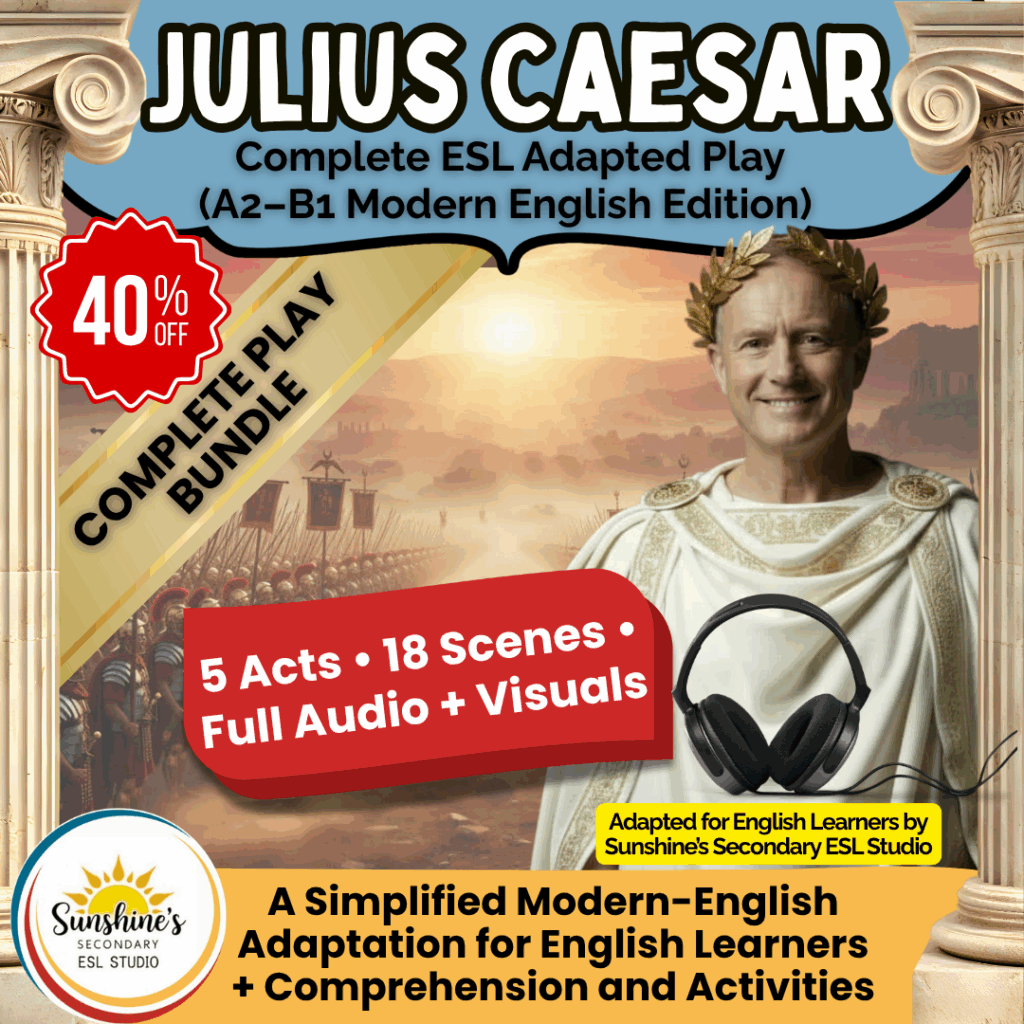
Explore the Complete Julius Caesar Bundle →
Or browse the acts individually:
Final Thoughts: Making Shakespeare Speak ESL
Teaching Julius Caesar to ESL students isn’t about simplifying greatness—it’s about unlocking it. When learners can hear, see, and perform Shakespeare in a language they understand, they discover that classic literature belongs to them, too.
If you’re ready to show your students that Shakespeare can be both powerful and accessible, start here: