

Estimated reading time: 8 minutes
If you teach high school ESL, you know the struggle: you ask a question, wait expectantly… and get silence. Incorporating real-world ESL speaking activities for teens can help break this silence. Maybe a few students glance around nervously. Maybe one brave soul mumbles an answer under their breath. But most of your class is perfectly content to avoid eye contact and let someone else do the talking. Sound familiar?
It’s not that your students don’t want to speak English — they just don’t always feel ready, confident, or motivated to do so. And honestly, who can blame them? Many ESL textbooks rely on overly scripted dialogues or artificial “practice” conversations that don’t sound anything like how teens actually talk. That’s where real-world ESL speaking activities for teens come in.
These are speaking tasks that reflect situations your students actually care about — ordering food, asking for help, giving advice, making plans, or even resolving a disagreement with a friend. When done right, they turn awkward, forced participation into authentic, spontaneous communication that builds both confidence and language fluency.
Let’s dig into why your ESL teens aren’t talking, and how you can change that with real-life speaking tasks that actually work.
Why Teens Struggle to Speak in ESL Class
Before we can fix the silence, we need to understand it. High school ESL students face a mix of linguistic, emotional, and social barriers that make speaking up in English one of the hardest things they do at school.
1. Fear of Mistakes
Teenagers care deeply about how they’re perceived — by peers and teachers alike. The thought of making a mistake and being laughed at or corrected publicly can be paralyzing. In a classroom where fluency and accuracy are constantly under the microscope, “safe silence” often feels easier than “risky speaking.”
2. Script Fatigue
Many ESL programs still rely heavily on dialogues like:
A: How are you today?
B: I am fine, thank you. And you?
Sound familiar? These patterns might be useful for beginners, but for teenagers who watch YouTube, play video games, and scroll social media in English, they’re painfully robotic. Students quickly disengage because they know that’s not how people really talk.
3. Lack of Relevance
When speaking topics don’t reflect a teen’s actual life — their friends, jobs, classes, social media, or plans for the weekend — motivation drops. Why would a 17-year-old get excited about practicing airport vocabulary if they’ve never been on a plane?
4. Teacher Overload
We get it — between lesson planning, grading, and behavior management, it’s hard to find time to create fresh, realistic speaking prompts that actually work. So teachers often fall back on what’s quick and easy: textbook scripts or recycled role plays that don’t quite land with this age group.
What Makes Real-World Speaking Tasks Different
Unlike textbook role plays, real-world ESL speaking activities for teens help students connect classroom English to real-life communication. Real-world speaking tasks flip the script — literally. They move away from pre-written dialogues and toward authentic communication scenarios that invite creativity, decision-making, and meaningful interaction. Instead of rehearsing how to greet a tourist, students might practice how to ask their boss for a day off. Instead of pretending to buy a souvenir, they might role-play what to say when a friend posts something offensive online.
Here’s what sets these tasks apart:
1. They mirror teen experiences.
The best speaking activities are grounded in familiar contexts — cafeteria conversations, planning a school event, apologizing to a friend, or giving advice about a social situation. These feel real, not artificial.
2. They’re scaffolded for success.
Real-world tasks don’t mean “throw them in and hope for the best.” They work best when you provide structured supports:
- Sentence starters and key phrases
- Visual cues or vocabulary previews
- Role cards with specific goals
- Optional listening models (like short audio examples)
This scaffolding keeps students from freezing up while still giving them room to speak naturally.
3. They focus on communication, not perfection.
When the goal shifts from getting it right to getting your message across, students relax. Fluency improves naturally because the focus is on meaning, not grammar drills.
How to Bring Real-Life Speaking Into Your ESL Classroom
If you want to make the most of real-world ESL speaking activities for teens, focus on creating scenarios that feel natural and relatable. If you want to get your high schoolers talking, you don’t need to scrap your whole curriculum — just rethink how you frame your speaking time. Here are some teacher-tested strategies that make a big difference.
1. Start with Scenarios, Not Scripts
Instead of handing students a full dialogue, give them a situation.
For example:
You and your friend are planning a surprise birthday party. You disagree on where to have it.
Then provide:
- Roles: Student A (the planner) and Student B (the friend)
- Objectives: Agree on a final plan
- Useful language: “What if we…?” “That sounds expensive.” “I think it would be better if…”
This way, students are guided but still have to think, react, and create language in the moment — just like real life.
2. Use Audio Models Strategically
AI-generated voiceovers (like ElevenLabs or other natural-voice tools) can model pronunciation and tone without being tied to stiff textbook recordings. Let students listen once for comprehension, once for pronunciation, and once as a “launch pad” for their own version of the scenario. Hearing fluent speech before they speak builds confidence and helps internalize rhythm and phrasing — especially for intermediate learners.
3. Add Real Consequences
Make speaking tasks more engaging by giving them a purpose. For example:
- After a “restaurant” role play, have the class vote on which team had the most convincing menu.
- During a “conflict resolution” task, let another group act as mediators.
- For a “planning” task, have the winning plan become the topic of the next class activity.
When speaking connects to a real outcome, motivation skyrockets.
4. Celebrate Imperfect English
Normalize mistakes. Praise students for trying, not just for being accurate. A quick “Great job expressing that!” or “I like how you explained your opinion” goes a long way. When students realize their ideas matter more than perfect grammar, they start speaking more — and improving faster.
5. Rotate Roles Often
Don’t let the same confident few dominate every discussion. Rotate roles so that quieter students get a turn to lead, question, or summarize. Scaffold their turn with helpful notes or sentence starters. You’ll be surprised how quickly their confidence grows when they’re supported instead of spotlighted.
A Day in the Real-World Speaking Classroom
This kind of task perfectly captures the spirit of real-world ESL speaking activities for teens — engaging, authentic, and fun. Imagine this:
It’s Friday, last period. You announce, “Today, we’re practicing how to resolve conflicts — something every friend group has to deal with.” Your students groan at first. But as they get their cards and see scenarios like “Your friend posted something embarrassing about you online” or “You lent your friend money and they haven’t paid you back,” the energy shifts. They start laughing, debating, even defending their opinions — in English.
You circulate the room, hearing language that’s alive:
“I get why you’re mad, but maybe they didn’t mean it.”
“That’s not fair, you should have told me first!”
Suddenly, it’s not an ESL lesson anymore. It’s communication practice that feels real, relevant, and personal.
That’s the power of real-world ESL speaking activities for teens — they turn language learning into something that matters right now.
Tips for Building a Safe Speaking Culture
If you’re ready to bring more authenticity into your speaking lessons, remember that the environment is just as important as the activity.
- Model vulnerability. Speak in your students’ first language sometimes and let them correct you. It shows that language learning is messy for everyone.
- Start small. Short pair interactions feel safer than whole-class performances. Build up gradually.
- Use visuals and humor. Memes, TikTok screenshots, or even a funny misunderstanding story can break the ice.
- Reflect after speaking. Have students share what phrases helped them the most or what they would say differently next time.
Over time, students start to see speaking not as a test, but as a tool — one that helps them connect, express, and belong.
The Bigger Picture: Preparing Students for the Real World
At the end of the day, we’re not just teaching English — we’re teaching communication. Our students will need to speak up in job interviews, college discussions, and daily life situations far beyond our classrooms. When we design lessons around authentic communication instead of memorized lines, we give them the skills to thrive outside school walls. That’s why real-world speaking tasks matter. They make language useful, relatable, and empowering.
Try It in Your Classroom — Free!
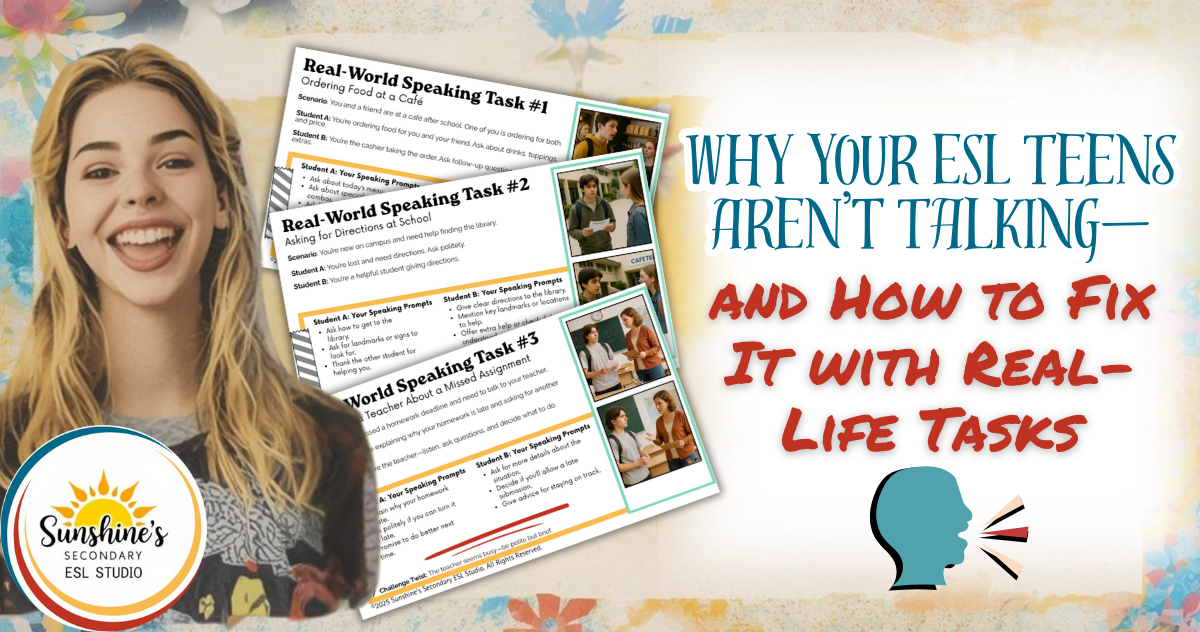
Ready to see how real-world speaking can transform your ESL classroom? Start with a free sample from my Real-World Speaking Tasks: ESL Teen Life Edition. You’ll get one complete speaking task with printable cards, digital slides, and optional audio — everything you need to test it out with your students this week.
Once you see how much your teens open up, you can grab the full set of 20 tasks — covering real-life teen scenarios like ordering food, asking for help, resolving conflicts, and planning events. Each task includes built-in scaffolds, student-friendly prompts, and natural conversation models to make speaking practice feel effortless. When speaking feels real, students stop memorizing — and start communicating.