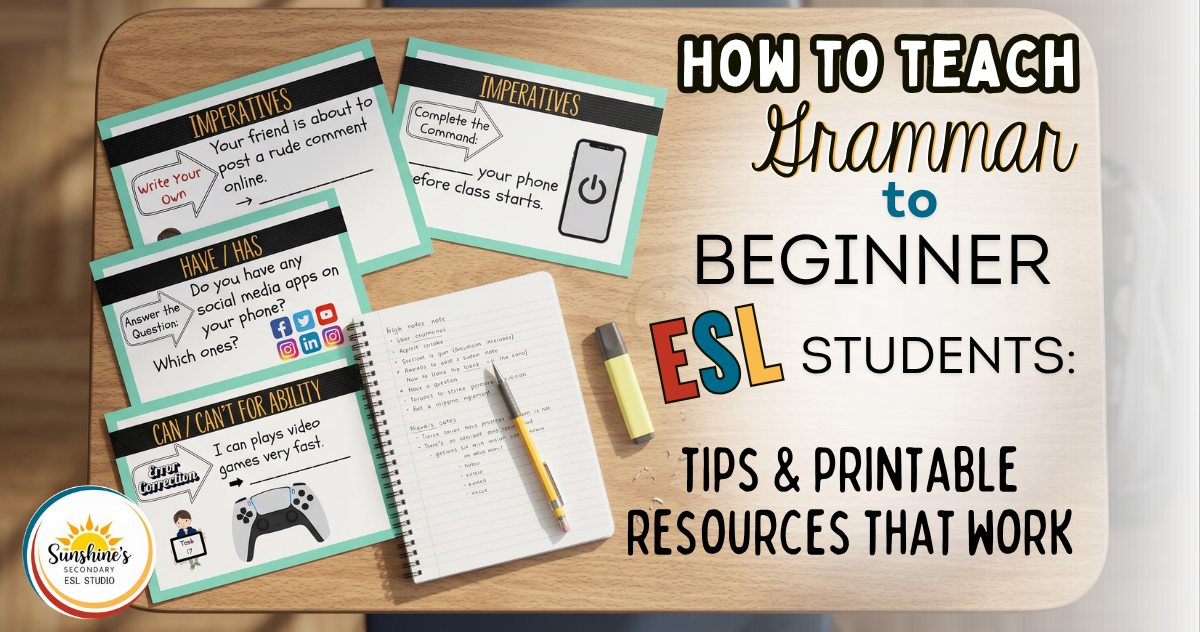

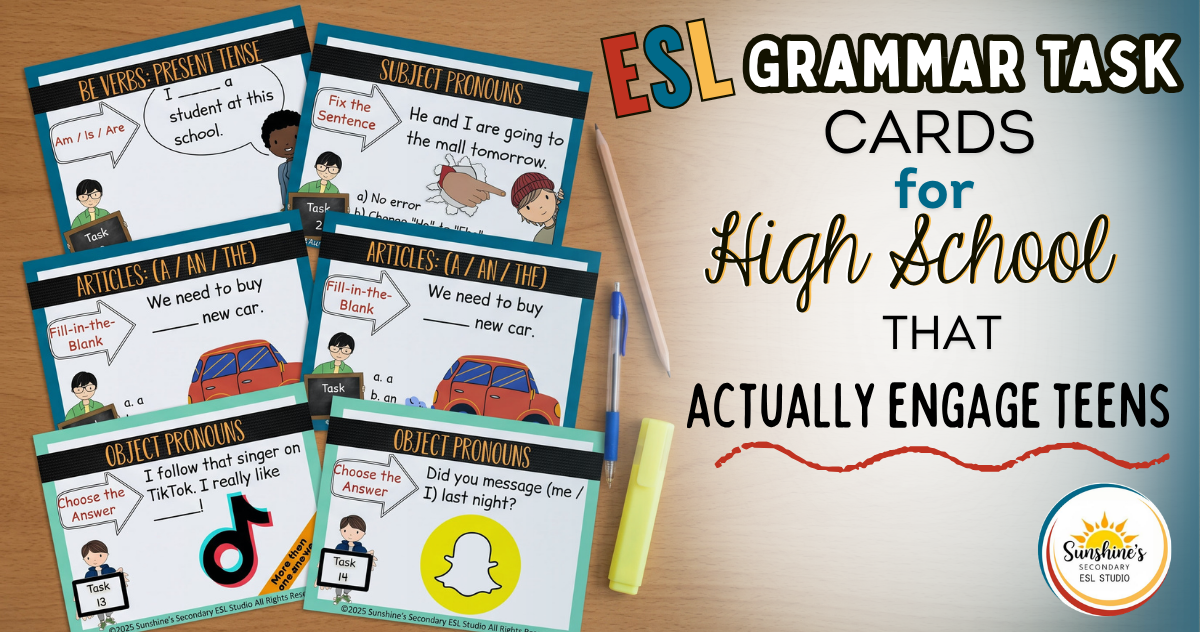
Grammar practice can be one of the hardest parts of teaching high school ESL. Students need repetition and structure, but they also need activities that feel age-appropriate and interactive. After years of searching for grammar materials that actually worked for teens, I started creating my own ESL grammar task cards for high school classrooms.
I’ll be honest with you—grammar used to be my least favorite thing to teach.
Not because grammar isn’t important. It absolutely is. But every year, I found myself digging through activities that either felt too childish for teenagers or looked like they had been photocopied since the 1990s. My students needed practice with real language they could actually use, not random sentences about pencil cases and pet goldfish.
That frustration eventually pushed me to start creating my own task cards. At first, I made a few sets just for my classroom. Then I kept adding more grammar skills, more levels, and more ways to use them with different groups of students.
Now they’ve become one of the resources I reach for constantly during the school year.
Why ESL Grammar Task Cards Work So Well
One reason I love task cards is because they don’t feel like traditional grammar drills. Students are much more willing to participate when activities are interactive, short, and flexible.
In my classroom, I use grammar task cards for:
- Warm-ups
- Stations
- Partner work
- Small groups
- Speaking activities
- Fast finisher work
- Review games
- Exit tickets
- Emergency sub plans
They’re especially useful in secondary ESL because students can move around, collaborate, and practice grammar in smaller chunks instead of staring at a giant worksheet full of corrections.
I’ve also noticed that activities like these help support better engagement and smoother routines in class. Interactive practice tends to work much better for me than lecture-heavy grammar instruction, especially with multilingual learners. A lot of the same strategies connect closely with my approach to ESL classroom management in high school because students stay more actively involved in the lesson.
Grammar Practice for Mixed-Level ESL Classes
If you teach secondary ESL, you already know how difficult differentiation can be.
Some students are still learning basic sentence structure while others are ready for complex grammar and academic writing. Trying to meet all of those needs at once can become exhausting.
That’s one reason I built these task cards across A1 to B2 CEFR levels. I wanted something I could use with newcomers, intermediate students, long-term English learners, and mixed-level groups without rewriting every activity from scratch.
Learning how to differentiate ESL instruction in high school made a huge difference in my classroom, and having leveled grammar activities ready to go saves me so much planning time during busy weeks.
For beginner students especially, grammar instruction needs a balance of support and repetition. If you work with newcomers, you might also enjoy my post about how to teach grammar to beginner ESL students.
The Types of Grammar Skills Included
Over time, I created task card sets covering many of the grammar skills I spiral throughout the year, including:
- Be Verbs
- Present Tense
- Past Tense
- Future Tense
- Modal Verbs
- Pronouns
- Comparatives and Superlatives
- Subject-Verb Agreement
- Commands and Classroom Routines
Each set includes short, manageable practice activities designed for teen learners. Some focus on sentence correction, while others include sentence building, writing prompts, or short-response activities.
More importantly, the language itself feels more natural for teenagers. I wanted topics connected to real student experiences—music, friendships, routines, opinions, technology, school life, and everyday conversations.
Want to See the Full Collection?
Over time, these grammar activities grew into a large collection of ESL grammar task cards for secondary students covering A1 to B2 levels and a wide variety of grammar skills. If you want to browse the full bundle or look through individual sets, you can check them out here:
ESL Grammar Cards and Practice for A1-B2
I also made many of the grammar sets available individually because sometimes teachers only need practice for one specific skill or unit.
How I Actually Use These in Class
One thing I’ve learned over the years is that the activity itself matters less than how you use it.
Sometimes my students complete task cards as a gallery walk around the room. Other times we use them for partner races, whiteboard competitions, or speaking warm-ups.
I also like pairing grammar review with conversation practice whenever possible. Many of these activities work well alongside my regular ESL teen speaking activities because students get to apply grammar while actually communicating.
For example:
- students answer cards verbally with partners
- groups explain why an answer is correct
- students rewrite incorrect answers together
- pairs create their own examples using the grammar target
This kind of interaction usually leads to much better participation than isolated drills.
And honestly? These cards have saved me more than once when I needed quick easy no-prep ESL sub plans for secondary students.
Flexible for ELDA, Sheltered, and Intervention Classes
Another reason I continue using task cards is flexibility.
I can use the same grammar skill with multiple classes while adjusting the level of support depending on the students. Sometimes I even let students choose which level they want to try based on their confidence.
That flexibility is especially helpful in:
- ELDA classes
- Sheltered English
- Inclusion support
- Intervention groups
- TELPAS/WIDA preparation
- Mixed-language-level classrooms
When students feel successful with grammar practice, they’re usually more willing to participate in speaking and writing activities too.
Related ESL Grammar and Speaking Resources
If you use grammar task cards regularly, you might also like these related resources and activities:
- ESL Grammar Task Cards
- Pronouns ESL Grammar Cards
- ESL Commands and Routines Task Cards
- Free A1 Grammar ESL Activities
- Conversation Starters for ESL Teens
- How to Build ESL Speaking Routines
I also made many of the grammar sets available individually because sometimes teachers only need practice for one specific skill or unit.
Final Thoughts
Grammar instruction will probably never become every student’s favorite part of class, but the right activities can make it far more interactive, manageable, and meaningful.
For me, task cards became one of those tools that simplified planning while still keeping students engaged. They give students structured grammar practice without making lessons feel repetitive or overly worksheet-driven.
If you want to take a closer look at the grammar task card collection I use in my own classroom, you can find the full bundle and individual sets here:
Mega ESL Grammar Task Card Bundle | A1–B2 CEFR | 744 Task Cards in 31 Sets