

Estimated reading time: 7 minutes
If you teach secondary ESL, you’ve probably seen it more times than you can count. ESL speaking confidence activities can be a key tool in helping students overcome shyness and become more fluent speakers.
❧ ESL speaking confidence activities
You ask a question.
You give wait time.
You encourage.
You smile.
And your students still avoid eye contact like it’s an Olympic sport. Building speaking confidence with teens is hard. Even native English speakers freeze when they’re asked to speak in front of others. Now imagine doing that in a second language—while worrying about grammar, pronunciation, accents, and whether classmates will laugh.
The truth is, ESL students usually aren’t quiet because they don’t want to talk. They’re quiet because speaking feels risky. That’s why ESL speaking confidence activities have to be designed differently for teens. Not louder. Not flashier. Just smarter, safer, and more intentional. Let’s talk about what actually works.
Why ESL Students Struggle With Speaking Confidence
Before we jump into ESL speaking confidence activities, it’s important to understand the hesitation behind the silence. Many secondary ESL students:
- are afraid of making mistakes publicly
- are translating in their head before speaking
- have strong ideas but limited language to express them
- have experienced embarrassment in the past
- are navigating adolescence and language learning at the same time
When speaking feels like a performance instead of communication, students shut down. So the goal isn’t to force participation. The goal is to lower the emotional risk while keeping the language meaningful.
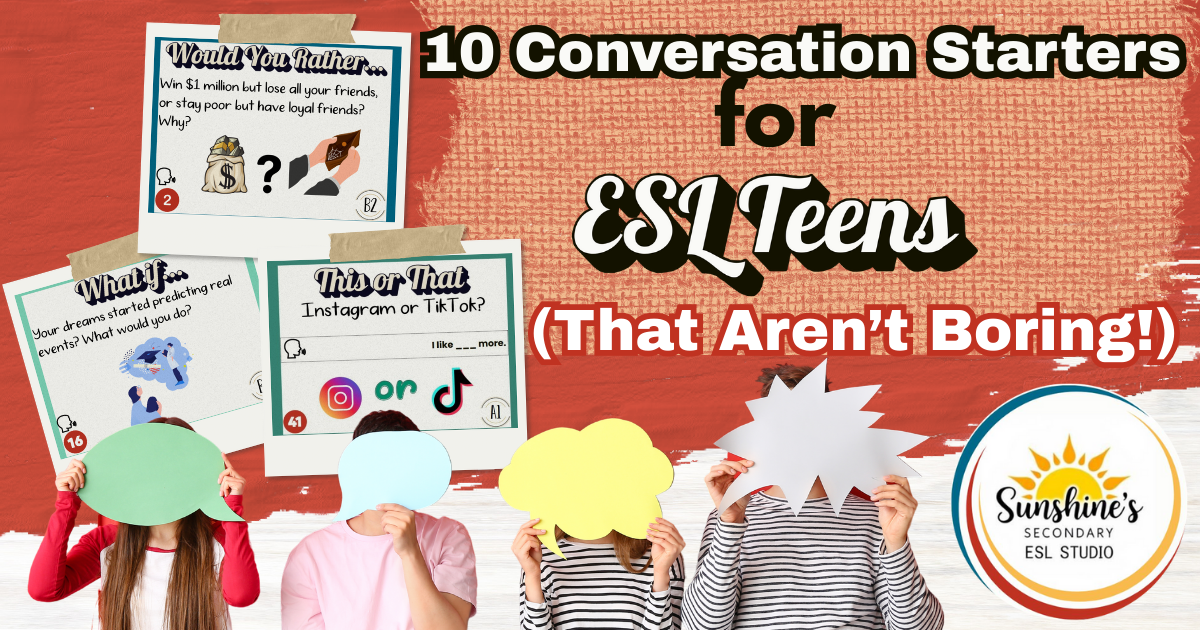
One way to do this is by starting with low-risk, choice-based speaking, like [Free Teen Talk ESL Conversation Cards | A1 “Would You Rather?”], where students can respond without fear of being “wrong.”
Respecting the Silent Period in ESL Speaking Confidence Activities
One thing that’s important to acknowledge when talking about ESL speaking confidence activities is the silent period. Many multilingual learners go through a phase where they are listening, processing, and absorbing language long before they feel ready to speak. This isn’t defiance. It isn’t disengagement. And it definitely isn’t a lack of learning. During the silent period, students are:
- building receptive language
- noticing sentence structure
- internalizing vocabulary
- developing confidence quietly
And that time deserves respect. Forcing students to speak before they’re ready can actually increase anxiety and delay confidence rather than build it. That said, respecting the silent period does not mean removing speaking opportunities altogether.
How ESL Speaking Confidence Activities Can Gently Support Students Out of the Silent Period
The goal isn’t to rush students out of the silent period—it’s to invite them forward when they’re ready. Well-designed ESL speaking confidence activities do exactly that by:
- allowing students to listen before responding
- offering optional participation at first
- providing sentence frames and modeled language
- using pair or small-group settings instead of whole-class pressure
- creating predictable speaking routines
When students feel safe, supported, and successful in low-risk situations, they often begin to participate naturally—sometimes without even realizing it. This is why ESL speaking confidence activities should be seen as invitations, not requirements. Students don’t need to be pushed. They need to be supported until they’re ready to step forward.
Why This Matters for Secondary ESL Students
At the secondary level, the silent period can be especially misunderstood. Teenagers are already navigating:
- social pressure
- identity development
- fear of embarrassment
Adding language learning on top of that makes silence feel even heavier. By honoring the silent period while still offering meaningful speaking opportunities, teachers strike the balance between:
- respecting student readiness
- and encouraging growth
That balance is where real speaking confidence begins.
What Makes ESL Speaking Confidence Activities Actually Work
Effective ESL speaking confidence activities for teens have a few things in common:
- They feel purposeful, not childish
- They offer structure without scripting every word
- They allow students to rehearse before speaking
- They start small and build gradually
- They feel authentic and relevant
If an activity skips those elements, it usually turns into awkward silence or forced responses. Let’s look at what does work.
ESL Speaking Confidence Activities That Start With Low Risk
One of the biggest mistakes teachers make is starting with whole-class speaking too early. Instead, strong ESL speaking confidence activities start small.
Try this:
- Partner talk before group sharing
- Student A / Student B roles
- Turn-and-talk with sentence frames
- Whisper rehearsals before speaking aloud
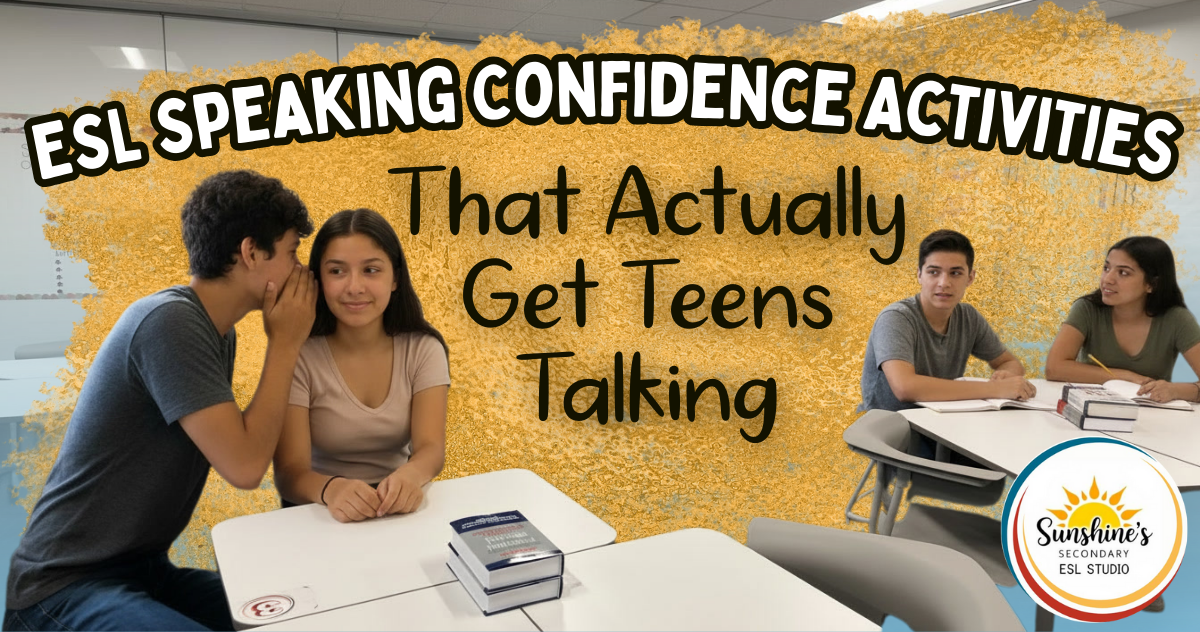
When students can practice privately first, their confidence grows naturally. Low-risk speaking builds trust. Trust builds confidence. Confidence leads to participation—especially when students use structured partner speaking tasks that feel authentic without the pressure of whole-class performance.
Use Structured ESL Speaking Confidence Activities (Not Open-Ended Chaos)
Use Structured ESL Speaking Confidence Activities (Not Open-Ended Chaos)
“Just talk about it” is rarely effective for ESL learners. Teens need:
- clear expectations
- visible language support
- predictable formats
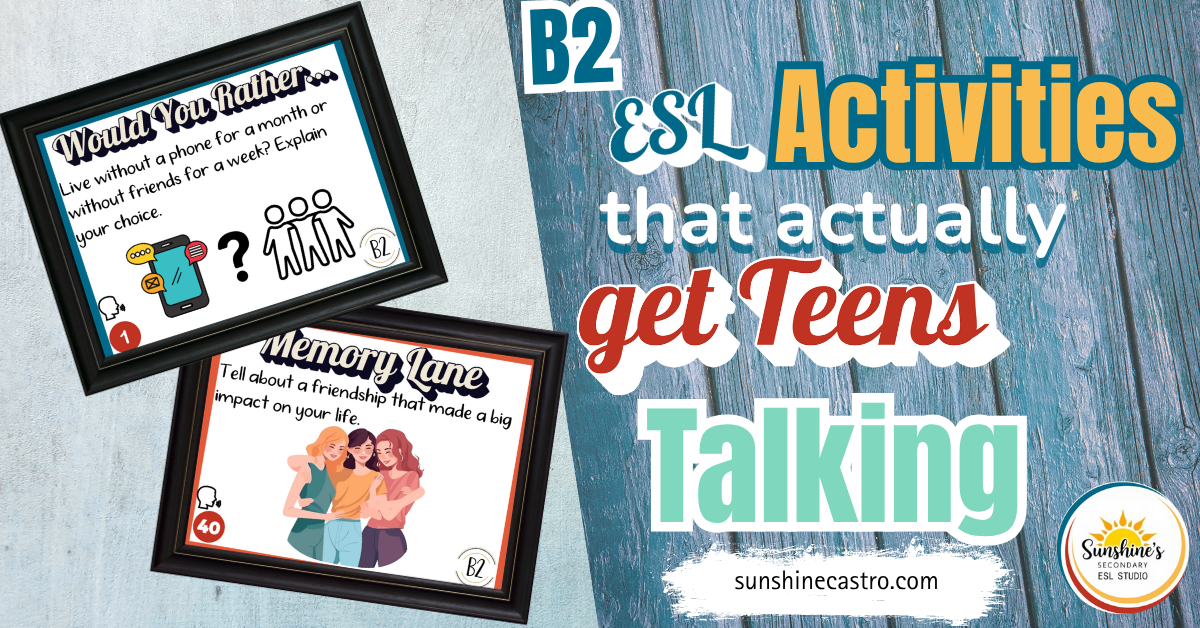
Some of the most successful ESL speaking confidence activities include sentence starters, response stems, guided prompts, and visual supports. When students know how to start a sentence, they’re much more willing to finish it, which is why structured conversation starters are so effective for building confidence.
Structure doesn’t limit speaking—it frees it. When students know how to start a sentence, they’re much more willing to finish it.
Make ESL Speaking Confidence Activities Feel Real
Teenagers can spot fake engagement from a mile away. If speaking activities feel artificial, participation drops instantly. Strong ESL speaking confidence activities connect to:
- real-world situations
- teen interests
- opinions that matter
- choices students care about
Instead of: “Talk about your favorite color.” Try:
- giving advice to a friend
- discussing a real-life scenario
- responding to a problem teens might actually face
- explaining a personal choice
When students feel their voice matters, they use it.
Build in Repetition Without Repetition
This is where many ESL speaking confidence activities shine—or fail. Students need repetition. They just don’t want it to feel repetitive. Effective strategies include:
- rotating partners
- reusing the same structure with new topics
- increasing complexity gradually
- keeping the format familiar while changing the content
Repetition builds confidence. Familiarity lowers anxiety. Over time, students begin speaking more automatically—and more confidently.
Normalize Mistakes During ESL Speaking Confidence Activities
If students believe mistakes equal failure, speaking confidence disappears. You can change this by:
- modeling imperfect language yourself
- praising effort, not accuracy
- responding to meaning before grammar
- allowing self-correction instead of immediate feedback
ESL speaking confidence activities should feel like practice—not testing. When students realize they won’t be “called out” for mistakes, participation increases naturally.
Why ESL Speaking Confidence Activities Work Better in Pairs and Small Groups
Whole-class speaking has its place—but it shouldn’t be the starting point. Pairs and small groups:
- reduce pressure
- increase talk time
- feel safer for teens
- allow more authentic communication
Many students who never speak in front of the class will talk freely with one partner.
That’s still speaking.
And it still counts.
Consistency Is More Important Than Volume
You don’t need a brand-new ESL speaking confidence activity every day. What students need is:
- consistent routines
- predictable formats
- regular opportunities to speak
Short, frequent speaking moments are far more effective than occasional long activities. Five minutes of meaningful speaking, done consistently, will build more confidence than one big activity every two weeks.
Supporting ESL Speaking Confidence Takes Time—and That’s Okay
Speaking confidence doesn’t appear overnight. But when students feel safe, supported, and successful—even in small ways—they start to take risks.
Those risks turn into sentences.
Sentences turn into conversations.
And conversations build real confidence.
Final Thoughts: Supporting ESL Speaking Confidence in Secondary Classrooms
If your ESL students are quiet, it’s not because they don’t care. They care deeply. They just need ESL speaking confidence activities that:
- respect their age
- support their language level
- lower emotional risk
- and give them a reason to speak
If you’re looking for ready-to-use speaking activities designed specifically for secondary ESL students, you can explore my ESL speaking activities here:
👉 ESL Speaking Activities at Sunshine’s Secondary ESL Studio
You’re not failing your students if they’re quiet.
You’re just still building the conditions where their voices feel safe enough to emerge.
And that work matters more than you know. 💛