
When people think about visual supports for ESL students, they often picture elementary classrooms with alphabet charts and colorful posters. But secondary English learners need visual supports too—especially beginners and newcomers who are trying to navigate an entirely new language while keeping up with grade-level expectations.
In my high school ESL classroom, visual supports are one of the biggest things that help students become more independent and confident.
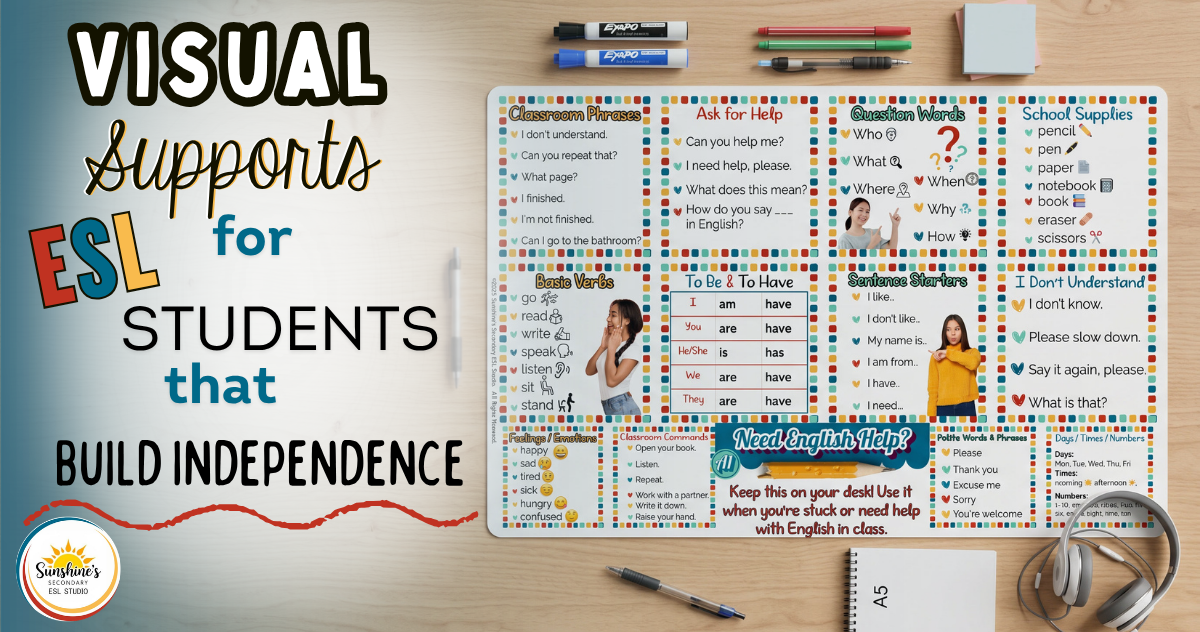
One of my favorite tools? Editable ESL desk mats.
These aren’t just decorative classroom accessories. They’re daily language supports that help students write, speak, participate, and self-correct without constantly depending on the teacher.
If you teach secondary ESL students, especially beginners or mixed proficiency levels, visual scaffolds can completely change the way your classroom functions.
Why Visual Supports Matter in Secondary ESL
Many ESL students spend the entire school day translating, decoding, and trying to mentally organize English structures while also learning content. That’s exhausting.
Visual supports reduce that cognitive load.
Instead of stopping every few minutes to ask:
- “How do I spell that?”
- “What does this mean?”
- “How do I start the sentence?”
- “What comes after ‘he’?”
- “How do I ask a question?”
…students can independently reference the support tools right in front of them.
That independence matters.
When students feel capable of finding answers on their own, they become more confident participating in class discussions, writing activities, and partner conversations.
This is especially important for newcomers and beginner English learners. If you teach students at multiple language levels, you might also enjoy my post about differentiating ESL instruction in high school.
Why High School ESL Students Still Need Visual Scaffolds
Sometimes secondary teachers hesitate to use visual supports because they worry the materials might feel “too young” for teenagers.
I completely understand that concern.
That’s actually one reason I started creating my own ESL visual supports instead of using elementary materials. I wanted supports that respected my students’ ages while still helping them access the language they needed.
Teenagers still benefit from:
- sentence frames
- grammar references
- question stems
- visual cues
- color coding
- structured language support
The difference is presentation.
My students don’t want cartoonish supports. They want tools that help them communicate successfully without making them feel embarrassed.
That’s why I designed my editable ESL desk mats specifically for secondary English learners.
How ESL Desk Mats Build Independence
One of the biggest classroom changes I noticed after introducing desk mats was how much more independently students worked.
Instead of constantly waiting for teacher assistance, students began:
- checking grammar structures independently
- correcting sentence mistakes
- using sentence starters during discussions
- referencing question words during speaking activities
- building longer written responses
As a result, I spent less time repeating the same directions and more time actually teaching.
The desk mats also reduced student anxiety. Many ESL students are terrified of making mistakes in front of peers. Having visible language support directly on their desks gives them a safety net.
That visible support can make participation feel much less intimidating.
If you’re working on helping students feel more comfortable speaking in class, you may also like these ESL speaking confidence activities.
What’s Included on the ESL Desk Mats?
Each desk mat includes grammar references and visual language supports tailored to the student’s proficiency level.
The mats include:
- sentence frames
- pronouns and common verbs
- question words
- grammar examples
- writing support
- visual icons
- color-coded language cues
- commonly used classroom phrases
Because the mats stay on student desks, the language support becomes part of students’ daily routines instead of something they only see during a specific lesson.
I print the mats full size (8.5 x 11 inches) and either laminate them or place them inside plastic sleeves so students can use dry-erase markers throughout the year.
Why I Created Different Levels (A1–B2)
One visual support does not fit every ESL student.
A newcomer learning basic sentence structures needs very different support from a student writing multi-paragraph responses. That’s why I created separate versions for A1, A2, B1, and B2 students.
A1 Desk Mats
These support beginners and newcomers with:
- survival English
- basic sentence frames
- visual vocabulary
- simple grammar structures
A2 Desk Mats
These provide:
- expanded sentence patterns
- question formation support
- present tense reminders
- conversation scaffolds
B1 and B2 Desk Mats
These include:
- more advanced grammar structures
- conjunctions
- transition words
- writing supports
- extended response language
Differentiated supports matter so much in secondary ESL classrooms. If you regularly work with newcomers, you may also find helpful ideas in my post about beginner ESL support in high school.
Why Editable Visual Supports Matter
One of the most important features of these ESL visual supports is that they’re editable.
Every ESL classroom is different.
Some teachers need more speaking support. Others focus heavily on writing. Some classrooms need bilingual vocabulary. Others want to align supports to specific units or testing language.
Because the desk mats are editable in PowerPoint and Google Slides, teachers can:
- add vocabulary
- adjust sentence stems
- include home language support
- customize grammar references
- add QR codes
- match classroom routines
That flexibility makes the supports much more useful long term.
How I Use These Visual Supports in My Classroom
These desk mats are not just “back to school” tools in my classroom. Students use them all year.
I use them during:
- warm-ups
- speaking activities
- partner conversations
- grammar review
- writing assignments
- station work
- independent practice
The mats become part of the classroom routine, which helps students feel more secure and prepared.
I also pair them with other structured supports like ESL routines posters and my first week ESL slides during the beginning of the school year.
Want to Try a Free ESL Visual Support?
If you want to see how desk mats work before committing to the full bundle, you can try my free progressive tense mini mat here:
Free ESL Progressive Tense Desk Mat
It’s a simple half-sheet support that helps students practice present progressive structures using am/is/are + -ing.
More ESL Classroom Supports
If you’re looking for additional visual supports and scaffolds for English learners, you may also like:
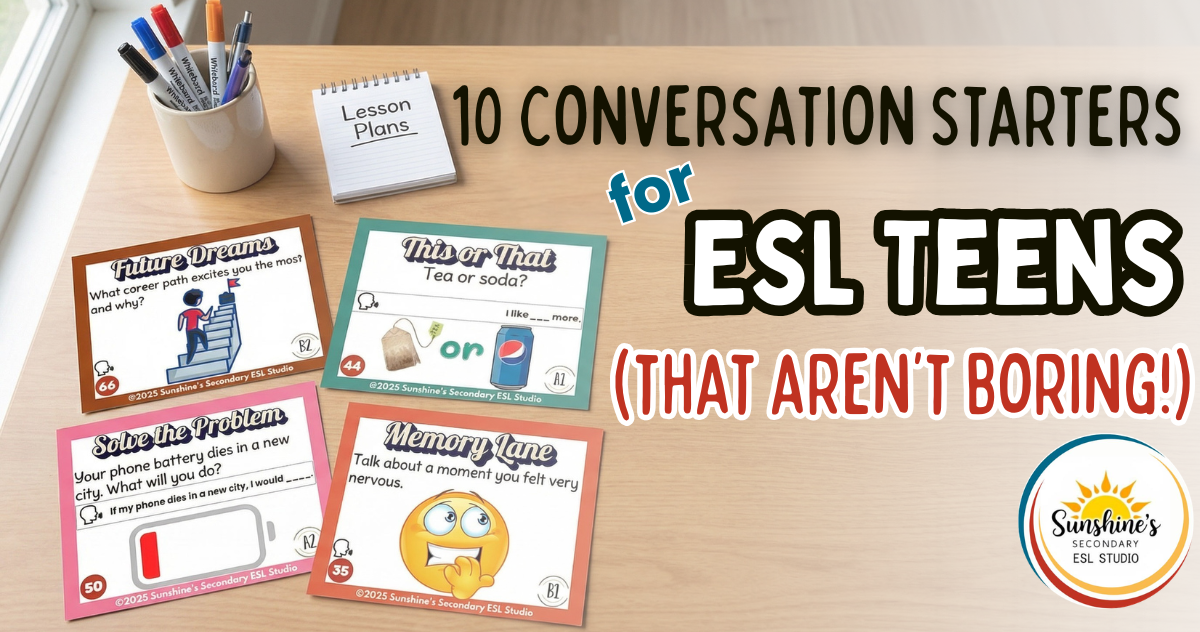
- Free ESL Sentence Starters for Teens
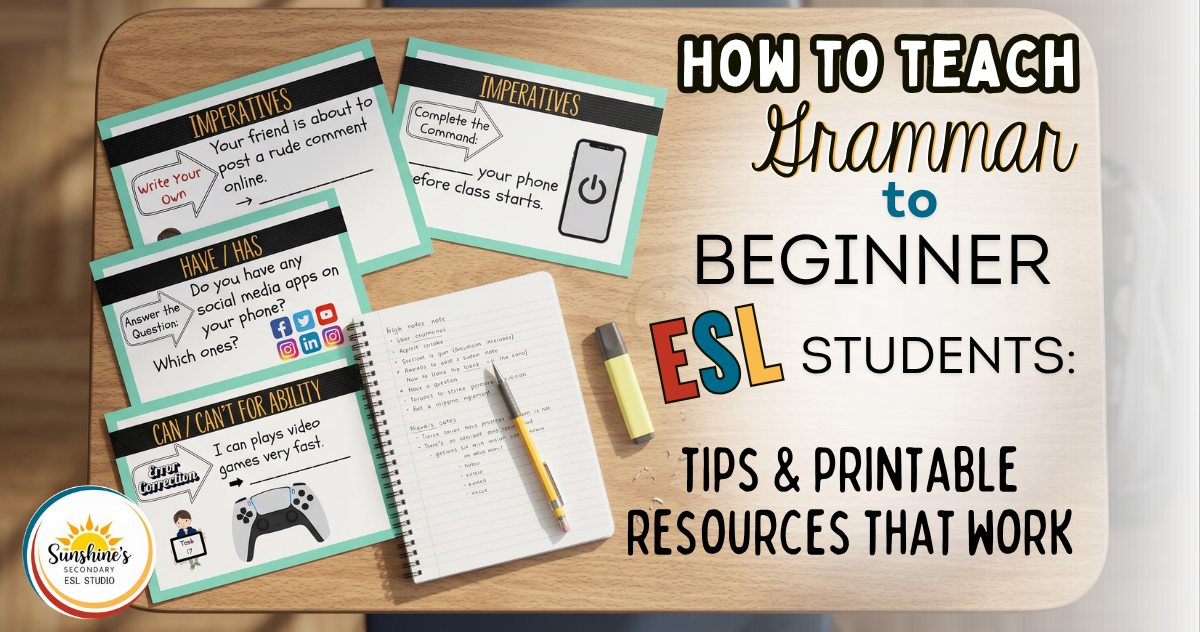
- How to Teach Grammar to Beginner ESL Students
- ESL Back to School Bundle
- Survival English Desk Mats for ESL
Final Thoughts
Visual supports for ESL students are not “extra.” They’re essential.
When secondary English learners have consistent language scaffolds available throughout the day, they participate more confidently, work more independently, and experience less stress during speaking and writing tasks.
For me, editable ESL desk mats have become one of the easiest ways to provide that support without interrupting the flow of instruction.
Sometimes the smallest classroom tools make the biggest difference.