

Estimated reading time: 5 minutes
If you’ve ever tried teaching argumentative writing to ESL students, you already know—it’s not just about the writing. It’s about confidence, vocabulary, sentence structure, and sometimes just getting them to start. This is especially true at the secondary level, where rigor looks different for multilingual learners and requires intentional scaffolding.
For years, I tried different methods. Some worked. Some flopped. But over time, I figured out a system that truly helps ESL teens understand the purpose behind argumentative writing and gives them the tools they need to feel successful.
In this post, I’m breaking down how I teach argumentative writing to ESL students step by step—with tons of scaffolds, modeling, and language support built in.
And if you want to grab the exact tools I use in my classroom, scroll down for a free graphic organizer + English-Spanish essay blueprint you can use right away.
Step 1: Start with Speaking
Before we ever look at a prompt or write a sentence, we start by talking. ESL students need to say it before they can write it. This mirrors the same principles I use when building ESL speaking confidence in my classroom.
I’ll pose an open-ended question like:
“Should students have to wear school uniforms?”
Then I model how to share an opinion using sentence starters:
- “I believe ___ because ___.”
- “In my opinion, ___ is better because ___.”
- “Some people think ___, but I disagree because ___.”
If your students need more structured language support, sentence starters can make a huge difference in helping them express opinions confidently—especially before writing. We practice out loud, in pairs or small groups. This helps students gain confidence forming opinions and using academic vocabulary—without the pressure of writing just yet.
Step 2: Use High-Interest Topics That Matter to Them
Engagement matters. Argumentative writing for ESL students becomes meaningful when they actually care about the topic.
I like to choose prompts related to teen life, school policies, freedom of expression, or social media. Some of our favorites include:
- Should phones be allowed in class?
- Is it ever okay to break the rules to stand up for something?
- Should students be allowed to protest?
High-interest prompts also work best when paired with structured conversation routines that help students practice academic language before writing. When students feel personally connected to the topic, they’re more willing to do the hard thinking and writing that comes with argumentative tasks.
Step 3: Provide Bilingual Scaffolds
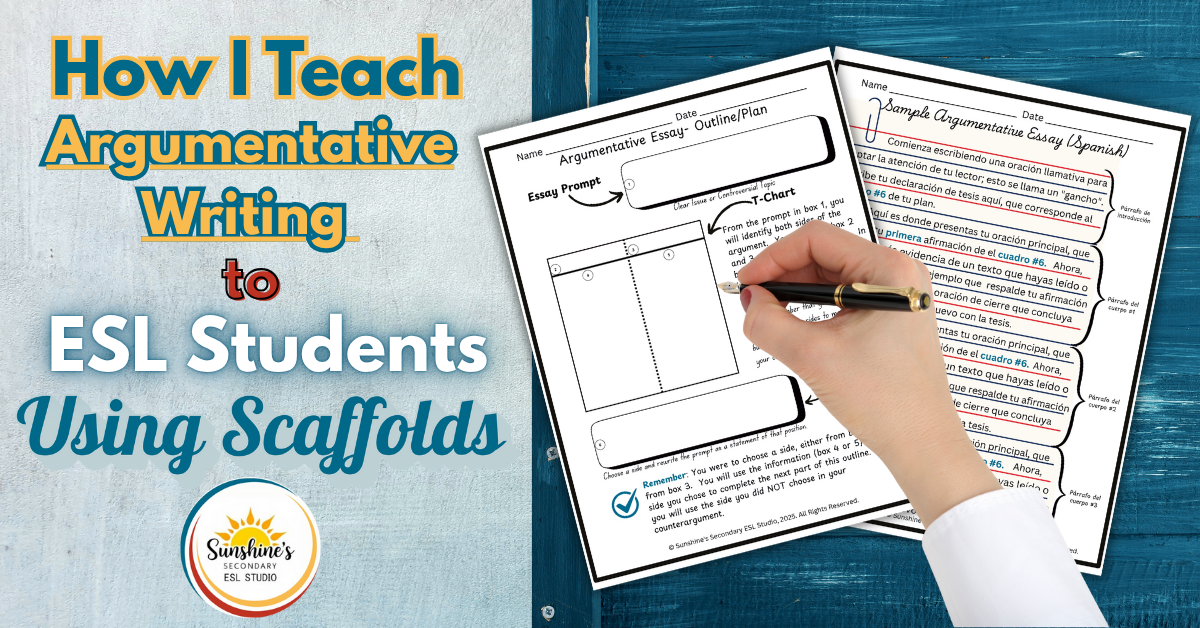
Once we’ve talked through the topic, I give students my bilingual essay blueprint—a visual guide that shows them what belongs in each paragraph. It’s in both English and Spanish, which helps students at all levels understand the structure and feel supported.
Then, we break out the graphic organizer. It walks them through:
- Writing a clear claim
- Listing reasons
- Finding evidence
- Explaining why that evidence supports their claim
- Addressing a counterclaim
- Writing a conclusion
Everything is chunked, with sentence stems and helpful cues along the way. This type of scaffolded writing support is especially helpful for students reading and writing below grade level.
Want the exact tools I use?
Grab your free Argumentative Essay Organizer + English-Spanish Essay Blueprint below!
👉 Download the free Argumentative Essay Graphic Organizer + English-Spanish Essay Blueprint
Step 4: Teach Evidence Like a Detective
ESL students often struggle with identifying and explaining evidence. That’s why we treat it like a skill—and even like a mystery to solve.
We start with short mentor texts (like short opinion pieces or excerpts from Supreme Court cases for advanced students) and highlight:
- The claim (in one color)
- The evidence (in another)
- The explanation (in a third)
This color-coding strategy helps students visually understand the role of each sentence and how evidence supports an argument. This visual breakdown gives students a clear framework they can reuse later when they apply evidence in their own argumentative writing. Then, they apply it to their own writing using the same structure.
Step 5: Counterclaims Through Conversation
Before writing their counterarguments, we do role-play! Students pair up and take opposing sides of an issue.
One defends their point of view, and the other has to respond. It’s like mini-debate practice but low-stakes and fun. This helps them understand how to acknowledge other viewpoints while defending their own—a key part of strong argumentative writing.
After we talk it out, students plug their counterclaim and rebuttal into the graphic organizer.
Step 6: Write in Layers, Not All at Once
Writing a full essay in one sitting is intimidating—especially for language learners. Breaking writing into manageable chunks is one of the most effective ways to differentiate instruction across A1–B2 proficiency levels.
Each day we write one section of the organizer, revise it together, and then move on to the next. I always give sentence starters, word banks, and examples on the board (or in a slide).
By the time we’re done, students aren’t panicked—they’re proud. Because they’ve built their essay step by step and actually understand what each part is supposed to do.
Step 7: Revise Together
Finally, we go back and revise—but we do it together. We look at:
- Do I have a strong claim?
- Is my evidence clear?
- Did I explain “why it matters” after every quote or fact?
- Did I acknowledge the other side?
Students use a peer checklist (we often do a gallery walk with post-its!) and then revise their final draft with guided feedback from me.
Final Thoughts
Argumentative writing for ESL students doesn’t have to be overwhelming. With the right scaffolds, visual tools, and pacing, our students can do so much more than just fill in blanks—they can form real arguments, support their opinions, and take ownership of their ideas.
If you want to try the same tools I use in my own classroom, you can grab them for free below:
These print-and-go pages will give your students a clear starting point and help them build confidence one paragraph at a time.