

Estimated reading time: 4 minutes
If you’ve been an ESL teacher for more than five minutes, you’ve probably heard it: “But are your lessons rigorous enough?” This raises the question, what does rigor look like in ESL classrooms?
The question usually comes from a well-meaning colleague or administrator who has never actually taught English learners. They peek into an ESL classroom, notice that the text or activity looks different from the mainstream English class, and immediately assume different equals easier.
Here’s the thing: rigor in ESL doesn’t always look like the exact same poem, short story, or assignment being used down the hall. But that doesn’t mean our classes lack challenge. It just means rigor in ESL takes a different path, much like exploring what rigor truly resembles in ESL classrooms.
What Does Rigor Look Like in ESL Classrooms?
For our students, rigor is not about piling on difficult texts and hoping they’ll sink or swim. It’s about stretching language skills while building confidence to engage with content. That means:
- Scaffolding complex texts so students can access meaning without drowning in vocabulary.
- Teaching academic language directly—the transition words, tone, and phrasing mainstream teachers often take for granted.
- Designing tasks that push thinking (analysis, synthesis, evaluation) even if the language demands need adjustment.
- Gradual release of responsibility so students move from guided practice to independent application.
In other words, rigor in ESL is about providing multiple ladders up the same mountain, reflecting what rigor represents in ESL settings.
Why “Same Poem” ≠ Same Rigor
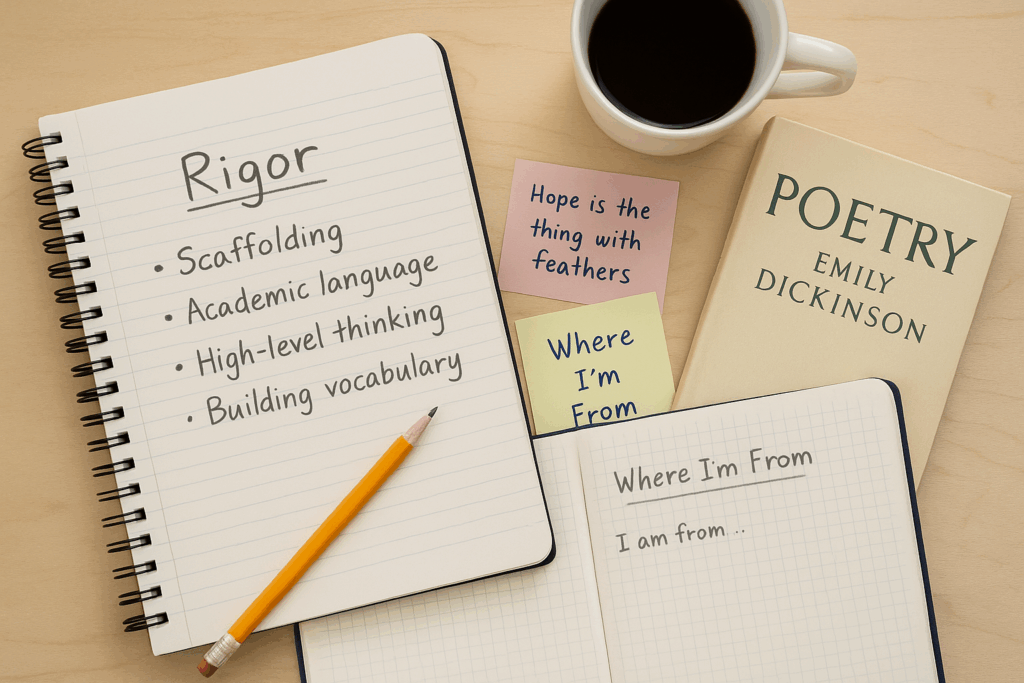
Let’s take poetry as an example. A mainstream English II class might dive right into an abstract modern poem. In ESL, we may choose a text like “Hope is the Thing with Feathers” or “Where I’m From.” On the surface, it looks “simpler.” But in practice, ESL students are:
- Unpacking metaphor and symbolism in a new language.
- Practicing oral fluency through read-alouds and partner discussion.
- Connecting personal experiences to universal themes.
- Building vocabulary that will transfer into other genres.
That’s rigor. It just happens to look different from what’s on the board next door and illustrates what ESL teachers recognize as rigor.
The Problem with the R-Word
The word rigor gets tossed around like a magic spell in education. But when it’s used against ESL teachers, it often carries an undertone: Your work isn’t challenging enough.
That’s not only frustrating—it’s untrue. ESL teachers balance language acquisition with content mastery every single day. We walk the tightrope between accessibility and challenge, making sure students aren’t overwhelmed but are still growing.
If anything, we are experts in real rigor: pushing students forward while giving them the tools to succeed. This is what rigor truly looks like in ESL classrooms.
Respect the Expertise
The next time someone wonders whether ESL instruction is rigorous, I hope they pause to consider:
- ESL teachers are trained to differentiate without oversimplifying.
- We build language and content knowledge at the same time.
- Our students often work harder than anyone else in the building—learning algebra, history, and literature in a brand-new language.
Different doesn’t mean easier. It means intentional, and that’s a vital aspect of understanding what rigor actually involves in ESL classrooms.
A Word to ESL Teachers
If you’ve ever felt diminished by the “rigor” argument, you’re not alone. Keep doing what you know works for your students. You’re designing lessons that are both accessible and challenging, even if outsiders don’t always see it.
And if you’re ever looking for ready-to-go ESL resources that balance scaffolding with rigor, I create materials for secondary ESL classrooms over in my Teachers Pay Teachers store. Everything I make is classroom-tested, scaffolded, and built with what we know as rigorous standards—just the way our students deserve.