

Estimated reading time: 7 minutes
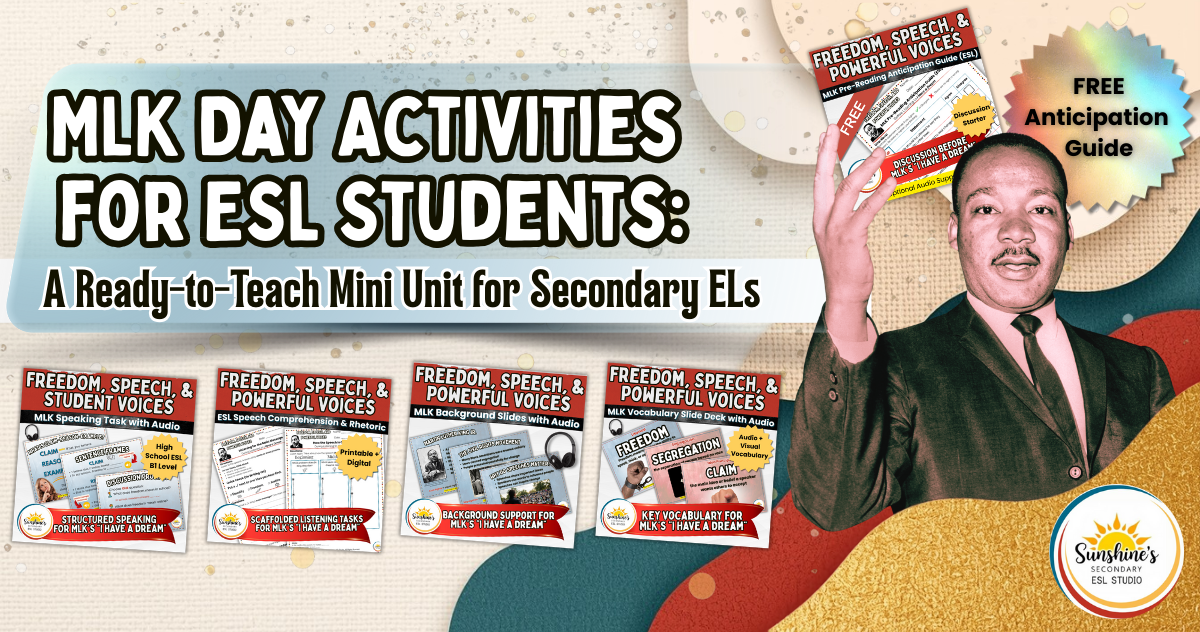
If you’re looking for MLK Day activities for ESL students that feel meaningful and doable in a real secondary classroom, this mini unit is designed to save you time while supporting English learners. The week back from break is busy, and students need lessons that are structured, engaging, and language-focused—without requiring hours of prep.
Below are 7 MLK Day activities for ESL students you can mix and match to create a 2–4 day mini unit around Dr. King’s “I Have a Dream” speech. Each activity includes a classroom-ready idea plus a direct resource link so you can build your plan quickly.
Activity 1: MLK Day Activities for ESL Students: Start with Background Knowledge
Before English learners listen to a historical speech, they need context. Background slides help students understand key people, events, and vocabulary so they can follow the message instead of getting lost.
How to use it (10–15 minutes):
- Project slides and pause for quick “turn-and-talk” questions
- Have students complete a simple note catcher: 3 facts / 2 questions / 1 connection
- Use the audio option for extra support (great for mixed-level classes)
Why it works for ESL students: Background knowledge reduces cognitive load so English learners can focus on meaning instead of getting stuck on unfamiliar historical context. Visuals + audio support build comprehension for students who need extra processing time or language scaffolds.
❧ Resource to use:
MLK Background Slides with Audio | Civil Rights Movement (High School ESL)
Activity 2: Vocabulary Preview with Audio Support
Frontloading key vocabulary makes the speech dramatically more accessible. This also reduces frustration for students who are still developing academic language.
How to use it (10 minutes):
- Show 8–10 words and have students do: word + student-friendly definition + quick sketch
- Finish with a 60-second partner quiz (“Point to the word that means…”)
Why it works for ESL students: Pre-teaching key words helps students understand more during listening and prevents frustration mid-lesson. Audio + student-friendly definitions support pronunciation and make academic vocabulary more accessible for secondary ELs.
❧ Resource to use:
MLK Vocabulary Slide Deck with Audio (Key Vocabulary for “I Have a Dream”)
Activity 3: Anticipation Guide Discussion (Pre-Reading)
An anticipation guide is an easy, high-participation way to introduce the themes of the speech—freedom, equality, justice—before students listen. It also sets up better discussion later.
How to use it (8–12 minutes):
- Students choose agree/disagree
- Pair share using sentence frames
- Do a quick class poll and ask: “Why do you think that?”
Why it works for ESL students: Anticipation guides increase participation because students can respond with simple language (agree/disagree) while still discussing big ideas. Sentence frames and partner talk provide a low-risk way to practice academic discussion.
❧ Resource to use (FREE):
Get the free MLK Anticipation Guide with Audio (ESL “I Have a Dream” Pre-Reading)
Optional upgrade (if you want it bundled):
MLK Pre-Reading Mini Bundle with Audio
Activity 4: Listening + Comprehension for “I Have a Dream”
This is the centerpiece of the mini unit. Structured listening tasks give ESL students a way to track meaning without being overwhelmed.
How to use it (20–35 minutes):
- First listen: “gist” question (What is his main message?)
- Second listen: targeted questions (key lines, repeated words, central idea)
- Optional: play short chunks and pause for quick annotations
Why it works for ESL students: Structured listening gives students a clear purpose and prevents them from “tuning out” when the language gets complex. Scaffolds like chunking, repeated listening, and targeted questions help ELs track main ideas and key details.
❧ Resource to use:
MLK “I Have a Dream” ESL Listening & Viewing / Comprehension Guide
If you want it in a done-for-you bundle:
MLK Speaking & Listening Mini Bundle with Audio
Activity 5: MLK Day Activities for ESL Students: Structured Speaking + Discussion
After listening, students need a safe and structured way to respond orally. Speaking tasks help students process ideas while practicing academic language.
How to use it (15–25 minutes):
- Give students sentence frames and discussion roles (Speaker A/B)
- Students discuss 2–3 prompts in pairs or small groups
- End with a quick share-out: “One idea I agree with is…”
Why it works for ESL students: Speaking tasks with sentence starters help students express ideas confidently without needing spontaneous, perfect English. Partner structures increase talk time, support academic language, and help students rehearse before sharing with the class.
❧ Resource to use:
MLK Speaking Task with Audio (Structured Speaking for “I Have a Dream”)
Optional Extension: Teach Persuasive Appeals (Ethos, Pathos, Logos)
If you want to connect MLK to argument/persuasion (or you teach rhetorical analysis), this mini-lesson fits perfectly after students understand the speech.
How to use it (15–25 minutes):
- Teach each appeal with student-friendly examples
- Students label appeals in short excerpts
- Quick reflection: “Which appeal is strongest and why?”
Why it works for ESL students: Explicitly teaching persuasive appeals gives ELs the language tools to analyze and discuss arguments in a clear, concrete way. It turns “rhetoric” into something students can actually label, explain, and use in speaking and writing.
❧ Resource to use:
Ethos, Pathos, Logos Mini-Lesson with Audio (Persuasive Appeals)
Optional Extension: Rhetorical Devices Mini-Lesson
This is a great add-on if your students are ready for higher-level analysis.
Why it works for ESL students: Identifying repetition, imagery, and parallel structure helps ELs notice meaning patterns without relying on complex literary analysis. Short excerpts + clear examples make higher-level skills more accessible for secondary learners.
❧ Resource to use:
Rhetorical Devices Mini-Lesson with Audio (Repetition, Parallelism, Imagery)
Bundle option:
MLK Listening & Rhetoric Mini Bundle
Activity 6: Writing the Short Constructed Response (SCR)
After students listen to and discuss the I Have a Dream speech, they are ready to put their thinking into writing. This short constructed response helps students practice citing evidence and explaining ideas clearly—without overwhelming them.
How to use it (12–15 minutes):
- Introduce the writing task and review expectations (claim + evidence + explanation)
- Model one strong sentence using a sentence frame
- Students write independently or with a partner
- Optional: quick peer check using a checklist or teacher guidance
Why it works for ESL students:
Short constructed responses allow students to demonstrate understanding while keeping writing focused and manageable. Built-in structure and sentence frames reduce cognitive load and support multilingual learners as they practice academic writing tied directly to the speech.
❧ Resource to use:
MLK Writing Task with Audio | Short Constructed Response (SCR) for ESL
Activity 7: Exit Tickets (End-of-Lesson Reflection)
Exit tickets provide a quick, low-stakes way to check for understanding and reflection at the end of the lesson. They help students process what they heard while giving teachers immediate feedback on comprehension and engagement.
How to use it (5 minutes):
- Students respond independently at the end of class
- Collect responses digitally or on paper
- Use student responses to guide the next lesson or reteaching
Why it works for ESL students:
Exit tickets allow students to reflect using short, structured responses. This keeps language demands reasonable while still encouraging meaningful thinking about the speech’s ideas, tone, and message.
❧ Resource to use:
MLK Exit Tickets for ESL | I Have a Dream Speech
Want Everything in One Place?
If you’d like all of these activities—pre-reading, listening, speaking, writing, and exit tickets—organized and ready to go, the MLK ESL Mega Bundle includes everything you need to teach I Have a Dream from start to finish.
- Audio-supported resources
- ESL scaffolds and sentence frames
- Listening, speaking, reading, and writing activities
- Ideal for MLK Day and civil rights units
🌟 Explore the MLK ESL Mega Bundle
Wrap-Up
If you’ve been searching for MLK Day activities for ESL students that are meaningful, structured, and teen-friendly, this mini unit is designed to make your planning easy. Choose one activity for a quick lesson, or combine all five for a complete MLK mini unit you can teach with confidence.