
Estimated reading time: 7 minutes
Why Supporting ESL Students During Novel Studies Is So Complex
Early in my career, I used to think helping ESL students meant watering down difficult texts or switching to easier novels—books usually reserved for middle school. Over time, I realized that this approach actually limited my students. They deserve access to the same rich literature as their monolingual peers. Knowing how to support ESL students during novel studies can empower educators to provide these opportunities effectively.
However, figuring out how to support ESL students during novel studies can be complicated. Some texts are so language-dense—filled with idioms, figurative language, or culturally embedded references—that my English learners can’t keep up with the pacing of mainstream English classes without additional scaffolding.
Unfortunately, not every book has a strong adapted version available, and some that do exist are overly simplified. I’ll never forget the “adapted” Romeo and Juliet I was once given—it had only three characters and entire scenes missing! That experience changed everything for me. It pushed me to start creating my own materials that preserved story depth while simplifying language for true understanding.
Adapted Texts: When They Work and Why They Matter
A high-quality adaptation mirrors the pacing, structure, and emotional tone of the original story. When done right, it gives ESL students a parallel experience that feels authentic and empowering. That’s the goal behind my ESL adaptation of Julius Caesar (free sample here) — complete with visuals and audio — designed to help A2–B1 learners access Shakespeare without feeling overwhelmed.
My mission is to keep the essence of Shakespeare alive while making it linguistically accessible to A2–B1 learners.
In my own classroom, I can legally create such adaptations for educational use. But on a public platform like TPT, the rules change. I can’t legally publish or sell rewritten versions of copyrighted novels like To Kill a Mockingbird. Even though teachers may find “adapted” versions online, many of those unfortunately cross copyright lines.
That legal reality led me to a crucial question: How can we still support ESL students during novel studies when full adaptations aren’t possible?
Summaries vs Adapted Texts: Understanding the Difference
An adapted text is a rewritten version of the original, simplified for language learners but meant to follow the same plot and pacing.
A summary, however, condenses a chapter or section, highlighting key events, vocabulary, and themes in simplified English.
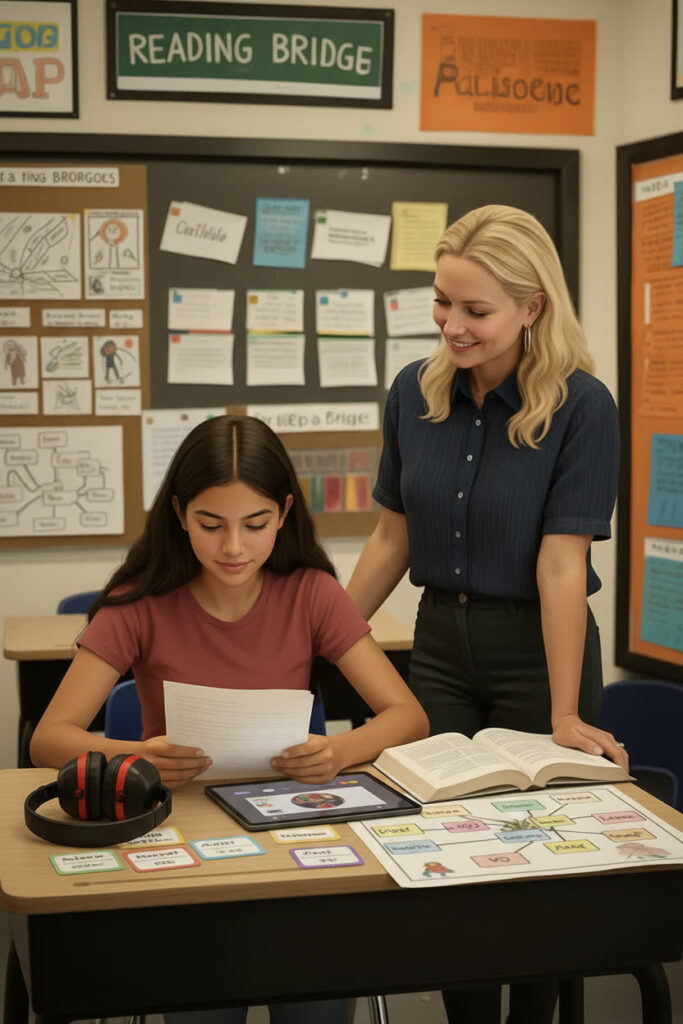
While adapted texts immerse students in the story from start to finish, summaries give them an essential roadmap. Summaries provide the “big picture” so learners can enter each reading section with context and confidence.
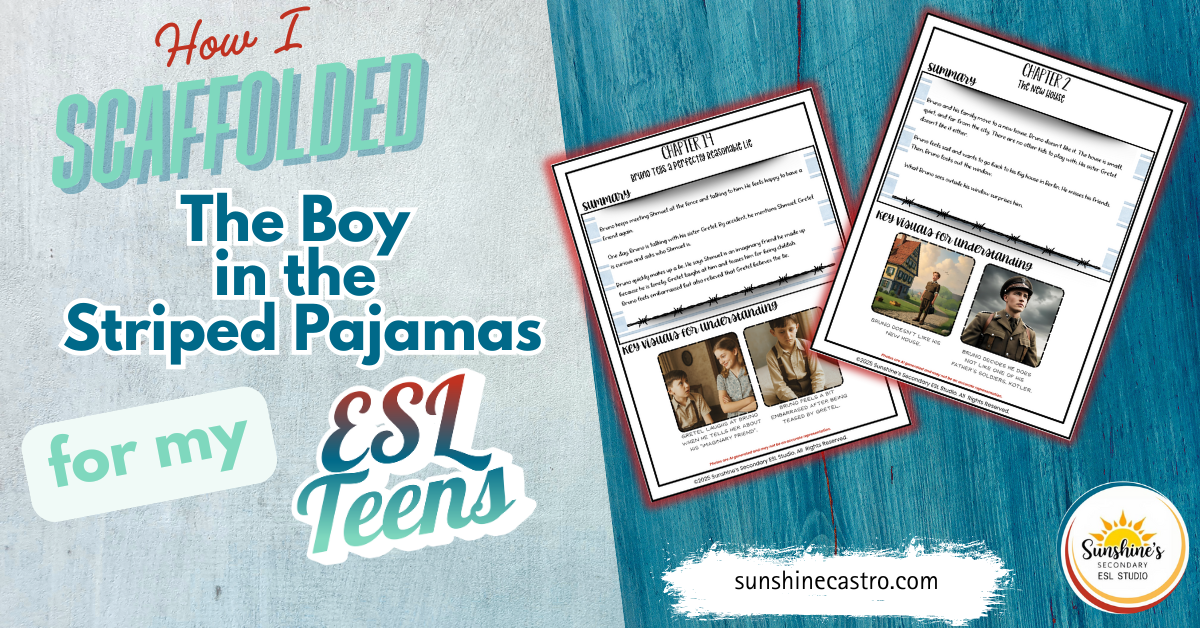
For copyrighted novels like To Kill a Mockingbird, where full adaptations aren’t legal to share, summaries are often the only classroom-safe solution. That’s why I created this summary and audio resource for To Kill a Mockingbird—it gives ESL students access to the story’s key events and themes while staying legally compliant. When paired with visuals and MP3 audio, summaries become a dynamic comprehension scaffold that transforms reading from a struggle into an achievable challenge.
If you’d like to preview how this approach works in practice, you can try the free sample chapter from my To Kill a Mockingbird ESL summary companion. It’s a great way to see how summaries (combined with audio and visuals) can transform reading from a struggle into a more confident and meaningful experience.
The Pedagogical Power Behind Summaries
According to Stephen Krashen’s theory of Comprehensible Input, language learners acquire English most effectively when they understand enough of what they’re reading to infer new meaning without frustration. Summaries make that possible.
They also align with SIOP and sheltered instruction strategies—front-loading vocabulary, previewing complex sections, and allowing students to connect meaning before tackling authentic text.
When ESL students read a short A2-level summary of a To Kill a Mockingbird chapter and then move into Harper Lee’s original language, they bring confidence and comprehension with them. Add in visual supports and audio narration, and you’ve created multimodal input that hits multiple learning styles—auditory, visual, and linguistic.
A Teacher’s Perspective: Why I Use Summaries
I often use summaries when I’m pressed for time or working with a text that’s just too linguistically advanced to adapt within my schedule. In these cases, summaries aren’t a shortcut—they’re a bridge. They help students grasp plot and theme while we reserve class time for discussion, inference, and analysis.
When I design resources for my TPT store, I always check the public domain first. If the text is legally adaptable (like Julius Caesar), I create a full version. But when the book is copyrighted—like To Kill a Mockingbird—I craft high-quality summaries with visuals and MP3 audio.
These summary companions are built to support ESL students during novel studies, giving them context, comprehension, and confidence without overstepping copyright law.
When to Use Summaries vs Adapted Texts
| Teaching Scenario | Best Approach | Why It Works |
|---|---|---|
| Public domain text (e.g., Shakespeare) | Adapted text | Full legal freedom to rewrite while keeping structure |
| Copyrighted modern novel | Summaries | Legally safe and pedagogically effective |
| Limited prep time | Summaries | Quick, accessible scaffold to build understanding |
| Deep literary analysis unit | Adapted text or mix | Students engage with tone, nuance, and symbolism |
| Multilingual, mixed-proficiency class | Summaries + visuals + audio | Universal accessibility without oversimplifying |
Legal and Ethical Considerations
It’s important for teachers—especially sellers on TPT—to understand that not all adaptations are legal. Copyrighted novels require permission from the publisher to redistribute rewritten versions, even for educational purposes.
Creating or selling those adaptations without rights is infringement, even if done with good intentions. That’s why summaries are such a valuable—and ethical—alternative. They’re transformative, teacher-created scaffolds, not replacements of the original work.
By choosing summaries, teachers model integrity and creativity. They demonstrate to students that respecting intellectual property is part of academic honesty.
My Approach: Building Access, Not Shortcuts
When I design summaries for my students, I keep one principle in mind: they should feel like an entry point, not a downgrade. My ESL learners use the summaries to preview what’s coming, build vocabulary, and identify characters before diving into the full chapter.
I’ve seen students who once dreaded reading actually look forward to novel units because they finally understand what’s happening in the story. That confidence creates momentum, and momentum creates engagement.
For To Kill a Mockingbird, my summaries, visuals, and audio files help bridge the gap between Lee’s complex prose and my learners’ current proficiency levels. For Julius Caesar, I can go further—offering a full adapted text—because Shakespeare’s works are public domain. Each project reflects a different solution to the same question: How do we support ESL students during novel studies while staying authentic, legal, and effective?
Final Thoughts: Meeting Students Where They Are
Supporting ESL students during novel studies isn’t about making literature easy—it’s about making it possible. Whether through adapted texts, summaries, visuals, or audio, our goal is to build comprehension without diminishing rigor.
By respecting copyright, embracing scaffolds, and teaching with empathy, we can open the literary world to every learner—no shortcuts, just access.
Looking for ready-to-use ESL scaffolds that follow this approach?
If you’re working with To Kill a Mockingbird, I’ve created full-chapter ESL summaries with visuals and MP3 audio designed to help students preview, process, and understand key events before engaging with the original text.
If you’re teaching Julius Caesar, my A2–B1 ESL adaptation (public domain compliant) preserves the full plot and dramatic tone while simplifying the language and including visuals and audio support.
You can explore these and more ESL literature supports in my TPT store: Sunshine’s Secondary ESL Studio
Want to try one of my ESL novel study tools for free?
Download a free sample summary + audio pack from my Julius Caesar adaptation to see how visual scaffolding and simplified language can boost your students’ confidence.