

Estimated reading time: 5 minutes
When it comes to TELPAS writing practice grades 9-12, a lot of secondary ESL teachers feel unsure about what really matters. Expectations sound high, guidance can feel vague, and it’s easy to overthink what TELPAS-aligned writing should look like in a high school classroom.
Here’s the reassuring truth: you don’t need a formal writing collection or anything complicated. TELPAS writing practice in grades 9–12 is really about giving students regular, meaningful opportunities to use academic English in writing — the same kind of writing they already do in class.
Let’s break down what that actually looks like and how you can support strong TELPAS-aligned writing without adding stress to your plate.
What TELPAS Writing Practice Grades 9–12 Really Focuses On
TELPAS writing isn’t about perfect essays or flawless grammar. At the secondary level, TELPAS writing practice grades 9-12 focuses on how students use English to communicate ideas.
Effective TELPAS-aligned writing helps students:
- Share ideas clearly
- Use grade-appropriate vocabulary
- Expand sentences and explanations
- Organize their thinking
- Show growth in language use over time
This is why short, consistent writing tasks work so well. Frequent writing beats one long assignment every time.
What TELPAS Writing Practice Grades 9–12 Looks Like in the Classroom
In secondary ESL, writing practice should feel connected to real instruction — not like test prep.
Strong TELPAS writing practice grades 9-12 often includes:
- Short paragraph responses
- Opinion or explanation writing
- Short constructed responses (SCR)
- Extended constructed responses (ECR)
- Claim-based or argumentative writing
- Reflections tied to content
These types of writing naturally show how students are developing their English skills, which is exactly what TELPAS is designed to measure.
TELPAS-Aligned Writing Practice by Proficiency Level
Beginning (A1–A2): Supported TELPAS Writing Practice
Students at this level still need a lot of structure.
Helpful strategies:
- Sentence frames and starters
- Word banks
- Modeled examples
- Very focused prompts
Example prompts:
- I agree because…
- One important idea is…
- This rule is fair/unfair because…
At this stage, TELPAS writing practice grades 9-12 is about helping students express meaning — even with simple language.
Intermediate (B1): Expanding TELPAS Writing Practice
Intermediate students are ready to stretch their ideas a bit more.
Helpful strategies:
- Paragraph-length responses
- Claim + reason writing
- Reduced sentence frames
Example prompts:
- Do you agree with this idea? Explain why.
- Which option is better? Give one reason.
This is where consistent TELPAS-aligned writing practice really starts to pay off.
Advanced (B2): Academic TELPAS Writing Practice
Advanced students should be practicing more complex academic writing.
Helpful strategies:
- Multi-paragraph responses
- Argumentative writing
- Evidence-based explanations
- Clear organization and transitions
Example prompts:
- Should schools limit ___? Support your opinion.
- Do you agree with the author’s point of view? Why or why not?
This level of TELPAS writing practice grades 9-12 closely matches what students are expected to do in content-area classes.
How Differentiation Fits Into TELPAS Writing Practice in Secondary ESL
One of the biggest misconceptions about TELPAS writing is that every student needs to complete a different assignment. In reality, effective differentiation in TELPAS writing practice is about adjusting support — not changing the task.
In secondary ESL classrooms, differentiation often looks like:
- Using the same prompt for all students
- Providing different levels of scaffolding
- Allowing students to show their thinking using language they can currently control
For example, a beginner student might respond using sentence frames or a word bank, while an advanced student answers the same prompt with a multi-paragraph response. Both students are practicing academic writing — just at different levels.
This approach makes TELPAS-aligned writing practice more manageable in mixed-proficiency classrooms and keeps expectations high without overwhelming students.
If differentiation feels challenging, focusing on supports like sentence starters, outlines, and modeled responses can make a huge difference. These strategies help students build confidence while still pushing their language development forward.
Why Argumentative Writing Is Perfect for TELPAS Writing Practice Grades 9–12
One of the easiest ways to strengthen TELPAS writing in high school is through argumentative writing.
Argumentative tasks naturally require students to:
- State a clear claim
- Explain their reasoning
- Use academic vocabulary
- Expand sentences
- Organize ideas logically
The best part? The same argumentative prompt can be used with different levels of support, making it ideal for mixed-proficiency classes.
👉 That’s why I regularly use argumentative writing and ECR resources as TELPAS-aligned writing practice in my secondary ESL classroom. They provide structure without feeling scripted and give students repeated practice with academic language.
Easy Prompts for TELPAS Writing Practice Grades 9–12
You don’t need dozens of prompts to support TELPAS writing. A few flexible ones work all year long.
Try prompts like:
- Should students be allowed to use cell phones in class?
- Is this school rule fair or unfair?
- Which option is better? Explain your thinking.
- Do you agree with this idea? Why or why not?
The prompt stays the same — the scaffolding changes. That’s the key to effective academic writing for English learners.
An Easy Way to Scaffold High School ESL Writing Practice
One common challenge for English learners is organizing ideas before they start writing.
A simple outline can:
- Lower writing anxiety
- Improve organization
- Encourage longer responses
- Support hesitant writers
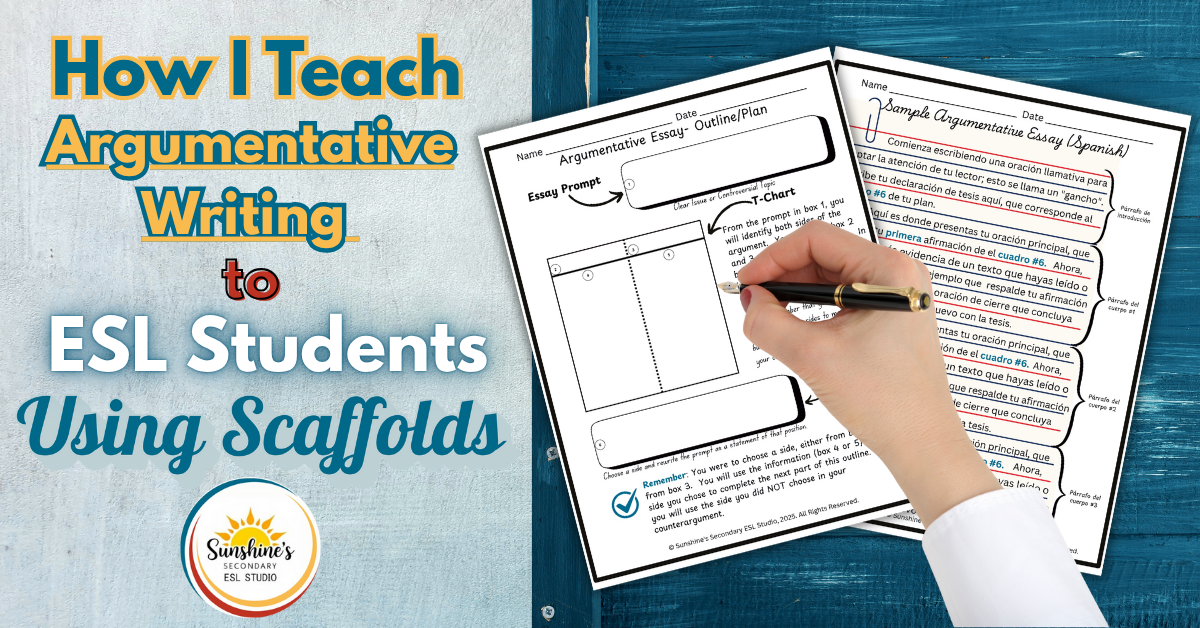
If you’re looking for an easy scaffold, an argumentative writing outline works especially well for TELPAS-aligned writing.
👉 I offer a free argumentative outline that’s perfect for supporting TELPAS writing practice in secondary ESL classrooms.
Final Thoughts on TELPAS writing expectations
Supporting TELPAS writing practice grades 9-12 doesn’t require extra programs or complicated systems. When students write regularly, explain their thinking, and use academic English in meaningful ways, you’re already doing the right work.
Focus on:
- Consistent writing opportunities
- The right level of support
- Academic tasks students actually need
When writing is built into everyday instruction, TELPAS becomes far less stressful — and far more manageable.