


Estimated reading time: 5 minutes
ESL logic puzzles for teens are one of the most engaging ways to build critical thinking and language development in a secondary ESL classroom.
If you teach middle or high school multilingual learners, you already know the challenge. Teenagers want activities that feel mature. At the same time, they still need structured language support. Therefore, finding tasks that are both academically rigorous and engaging can feel difficult.
Recently, I introduced ESL logic puzzles for teens in my own classroom — and the response surprised me.
Why I Introduced ESL Logic Puzzles After TELPAS Testing
After two full days of TELPAS testing (similar to WIDA in other parts of the country), my students were mentally exhausted. However, instruction still had to continue. I didn’t want to assign busy work, and I definitely didn’t want something that felt elementary.
Instead, I needed an activity that was:
- Structured
- Academic
- Language-rich
- Engaging
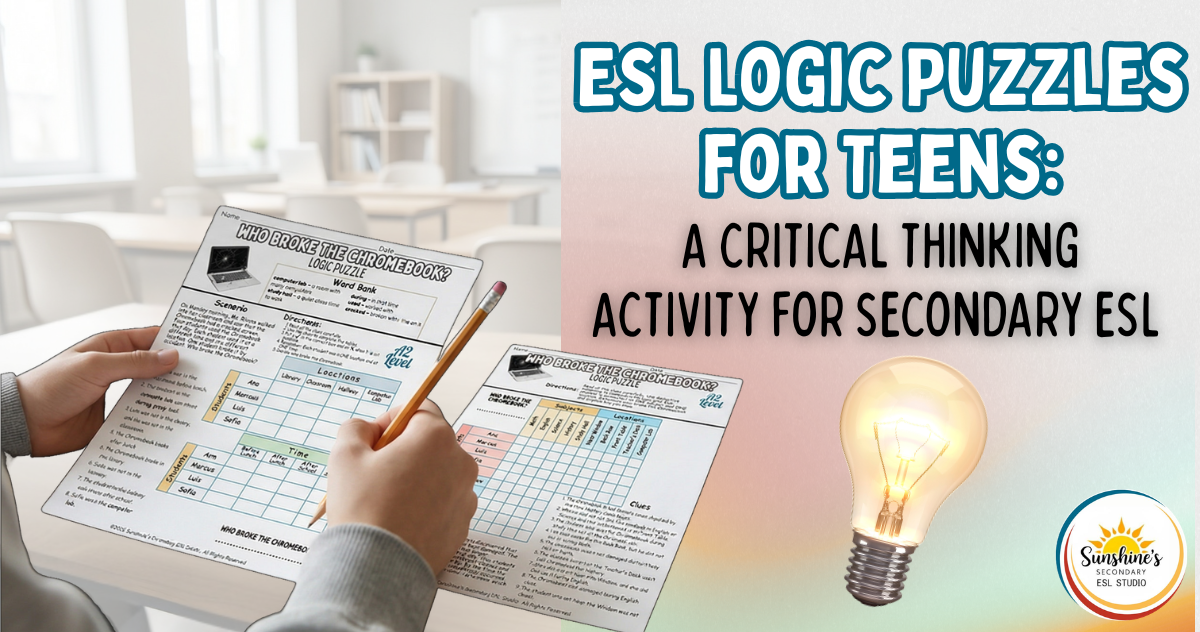
That’s when I decided to create and test ESL logic puzzles for teens centered around a classroom mystery: Who broke the Chromebook?
Why ESL Logic Puzzles for Teens Work in Secondary Classrooms
First, these puzzles require careful reading. Students must analyze each clue and interpret vocabulary in context.
Second, they promote deductive reasoning. Learners eliminate impossible combinations and make logical connections across clues.
Additionally, ESL logic puzzles strengthen:
- Inferencing skills
- Attention to detail
- Academic language processing
- Cross-referencing information
- Justifying conclusions
In other words, students move beyond literal comprehension and begin practicing analytical thinking. For secondary ESL learners, this shift is critical.
In fact, rigor in ESL classrooms does not always look like longer texts — sometimes it looks like deeper thinking. I talk more about that in why rigor in ESL looks different.
Moreover, because the puzzles are framed as mysteries, teens remain motivated. They want to solve the problem. They want to know what happened.
Teaching Students How to Solve ESL Logic Puzzles
However, there is an important step teachers should not skip.
You must explicitly teach students how to complete ESL logic puzzles for teens before expecting independent success.
When I first introduced them, I modeled the process whole-group. We read clues together. I demonstrated how to mark Xs and checks. We discussed how one clue affects another. Then, we practiced eliminating impossible options.
After whole-group modeling, I provided small-group support. Some students grasped the system quickly, while others needed additional scaffolding.
Although it required intentional instruction at the beginning, that investment paid off quickly.
Differentiating ESL Logic Puzzles for Multiple Language Levels
Because I teach multiple proficiency levels, I created differentiated versions:
- A1
- A2
- B1
- B2
If you want to see how I approach leveling instruction across proficiency bands, you can read more about differentiating ESL instruction from A1–B2.
For example, emerging students worked with simplified clues and smaller grids. Meanwhile, higher-proficiency students analyzed more complex language and additional categories.
As a result, every group could participate at an appropriate challenge level.
Differentiation is essential in secondary ESL classrooms, and ESL logic puzzles for teens make that adjustment manageable. You can increase linguistic complexity without reducing cognitive rigor.
The Moment I Knew It Was Working
Once students understood how the puzzles functioned, the energy shifted.
They leaned in, debated clues, and double-checked each other’s reasoning. Most importantly, they were determined to discover who broke the Chromebook.
At the end of the activity, several students asked, “Do you have another one?”
That question told me everything.
When teenagers ask for more academic work, you create more.
When to Use ESL Logic Puzzles for Teens
These puzzles are especially useful for:
- Early finishers
- Post-testing days (TELPAS or WIDA)
- End-of-year activities
- Small group instruction
- Critical thinking warm-ups
- Sub plans
Because the format feels like a mystery, students remain engaged. At the same time, they are strengthening language skills and higher-order thinking.
Try the Free A2 Sample Before Committing
If you want to test ESL logic puzzles for teens in your classroom, I created a free A2 sample so you can try the format first.
Download the free A2 ESL Logic Puzzle sample here.
The full differentiated set includes:
- A1–B2 leveled versions
- Printable PDFs
- Google Slides
- PowerPoint
- Answer keys
Starting with the free sample allows you to model the process with your students before implementing additional levels.
See the full A1–B2 ESL Logic Puzzle bundle here.
Final Thoughts on Using ESL Logic Puzzles for Teens
Ultimately, ESL logic puzzles for teens offer something secondary classrooms desperately need: structured critical thinking that respects students’ age and ability.
They combine:
Language development
Analytical reasoning
Engagement
Differentiation
These same reasoning skills also support structured academic writing, especially when students transition into argumentative tasks.
Furthermore, they emerged from a real classroom need during two long days of TELPAS testing. I needed something meaningful yet enjoyable. My students needed something challenging but accessible.
Now, this classroom experiment is growing into a full series — and I am already working on creating more.
If you are looking for a way to build critical thinking while strengthening language skills, ESL logic puzzles for teens might be exactly what your classroom needs.

