

Estimated reading time: 5 minutes
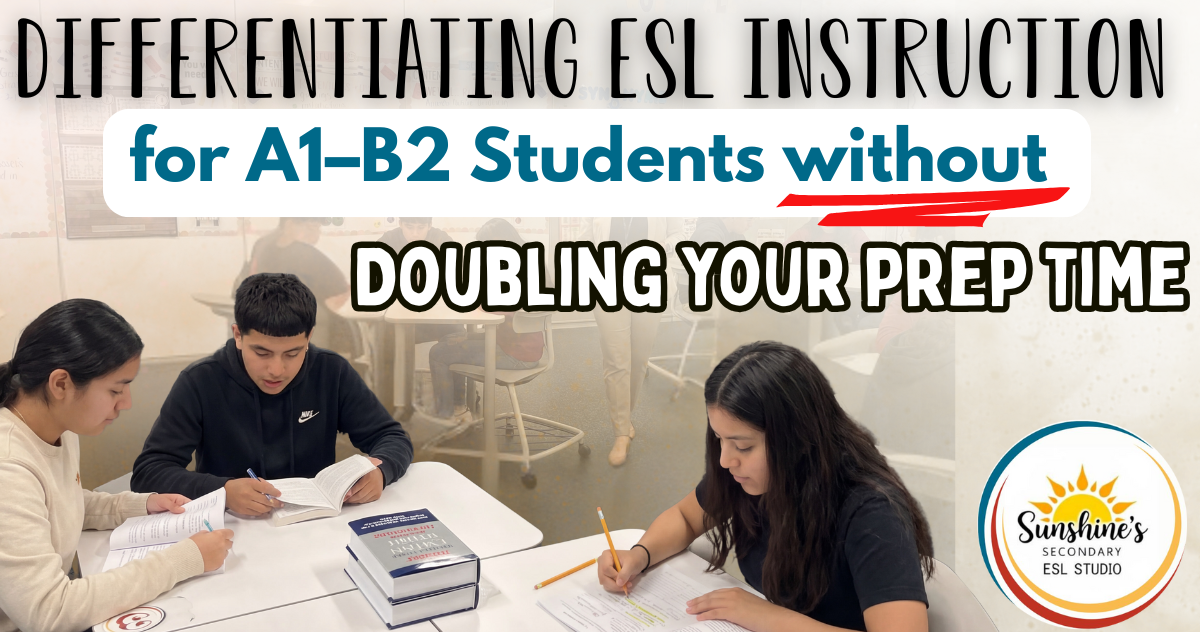
Teaching ESL at the high school level is both exciting and overwhelming, especially when your classroom includes A1 newcomers, A2 developing learners, and B1–B2 students who are ready for deeper thinking. It can feel impossible to reach everyone at once. That’s why differentiating ESL instruction is not just helpful — it’s essential.
The good news? Differentiation doesn’t have to mean creating five separate lesson plans. With the right structures in place, you can support all levels without burning out.
Why Differentiating ESL Instruction Matters in the Secondary Classroom
Mixed-level classes are the norm in high school ESL. Students arrive with vastly different language backgrounds, schooling histories, and literacy skills. Differentiating ESL instruction ensures every student gets what they need:
- A1s aren’t lost
- B2s aren’t bored
- You don’t become a one-person curriculum factory
The goal is not separate lessons — it’s strategic scaffolding.
Start With One Core Lesson, Then Differentiate Input and Output
Instead of planning multiple lessons, think of differentiating ESL instruction as adjusting the:
- Input students receive (reading supports, vocabulary, audio, visuals)
- Output they produce (writing, speaking, summarizing, discussing)
Example:
If everyone is reading about cultural celebrations:
A1
- Audio support
- Highlight key vocabulary
- Use sentence frames
A2/B1
- Chunked reading
- Scaffolded questions
- Short paragraph responses
B2
- Independent annotation
- Higher-order questions
- Extended writing
Same content. Different pathways. Zero stress.
Use Leveled Texts to Make Differentiating ESL Instruction Easier
Secondary learners want age-appropriate, meaningful texts — not watered-down stories. Leveled A1–B2 readings (on the same topic) let every student engage at the right linguistic challenge without feeling different or singled out.
This is one of the most powerful tools for differentiating ESL instruction, especially with teenagers who are highly aware of their proficiency levels.
Add Audio Scaffolds to Support Differentiated Reading
Audio is one of the simplest ways to boost comprehension for A1–A2 students while still challenging B1–B2 learners.
Audio:
- models fluent reading
- improves pronunciation
- increases comprehension
- builds independence
If you’re differentiating ESL instruction for mixed levels, audio is your best friend — low prep, high payoff.
Use Tiered Questioning When Differentiating ESL Instruction for Mixed Levels
Not every student needs the same type of question. Here’s an easy tiered structure:
A1 Questions (Foundational Understanding):
- Who?
- What is ___?
- Where does it happen?
- Match vocabulary to pictures
A2 Questions (Basic Comprehension):
- Why did ___ happen?
- What happened first?
- Choose the best summary
B1 Questions (Analysis):
- How does the character feel?
- What is the conflict?
- Write a short explanation
B2 Questions (Higher-Order Thinking):
- Compare and contrast…
- Analyze the theme…
- Evaluate the author’s purpose
Tiered questioning is a clean way to begin differentiating ESL instruction without rewriting the entire lesson.
Sentence Frames: A Must-Have Tool for Differentiating ESL Instruction
Many teachers think sentence frames are only for lower levels — but they are essential for all multilingual learners. They remove the fear of “How do I start?” and allow students to demonstrate thinking.
Try frames like:
- “One example from the text is ______ because ______.”
- “The main idea is ______.”
- “This shows that ______.”
When differentiating ESL instruction, sentence frames level the playing field while keeping rigor intact.
Choice Boards: A Student-Friendly Way to Differentiate ESL Tasks
Choice boards allow you to differentiate by output type:
Examples:
- A1: Draw a labeled diagram
- A2: Write 3–4 sentences with frames
- B1: Record a short explanation
- B2: Write an extended response
This empowers students and provides natural differentiation without more prep.
Strategic Grouping Supports Differentiated ESL Learning
When differentiating ESL instruction, grouping is powerful:
✔ Strong + Growing Partnering
Builds academic language through modeling.
✔ L1 Partners
Perfect for previewing instructions or vocabulary.
✔ Level Groups for Task Completion
Students complete tasks aligned to their proficiency level.
Grouping done well builds confidence and community.
Explicit Academic Language Instruction Supports Differentiation
Terms like:
- analyze
- infer
- summarize
- evaluate
…must be explicitly taught.
Students can’t complete differentiated tasks if the academic verbs themselves are confusing.
When differentiating ESL instruction, academic language becomes the anchor.
Predictable Routines Reduce Anxiety in Mixed-Level ESL Classes
Differentiation works best when routines are consistent.
Try:
- Vocabulary → Audio → Read → Discuss
- Warm-up → Mini lesson → Guided practice → Independent work
- Read → Annotate → Pair share → Exit ticket
Predictability allows students to focus on learning rather than worrying about what’s next.
A Final Reminder: Differentiation Isn’t Perfection — It’s Progress
You don’t need to differentiate every single piece of your lesson.
Choose small, strategic moves:
- add audio
- add sentence frames
- create leveled questions
- offer a modified output
- allow illustrated notes
- model academic language
These small shifts compound into major growth.
Your mixed-level students don’t need perfection.
They need consistency, compassion, and opportunities to access grade-level ideas with the right support.
And you’re already giving them that.
Want Ready-to-Use A1–B2 Materials for Differentiating ESL Instruction?
If you need high-interest readings, scaffolded questions, fluency audio, and leveled texts designed specifically for differentiating ESL instruction at the secondary level, I have a full collection in my TPT store:
👉 Shop Ready-to-Use and Leveled Materials at Sunshine’s Secondary ESL Studio
These resources save time, reduce planning stress, and make it easy to reach all learners — from A1 newcomers to advanced B2 students — without creating five versions of every lesson.