

Estimated reading time: 4 minutes
If you’ve ever handed The Necklace by Guy de Maupassant to your ESL students and watched their eyes glaze over, you’re not alone. This short story packs a punch, but the original text isn’t exactly beginner-friendly. Between 19th-century sentence structure and vocabulary like dowry and exorbitant, even intermediate learners can get stuck. That’s exactly why I started creating my own leveled materials for this classic.
I teach high school ESL classes that include a wide range of proficiency levels—some students are just getting the hang of basic sentence frames, while others are preparing to exit the program. So I knew I needed something more flexible than a one-size-fits-all worksheet from the textbook.
Step 1: Chunk the Story by Events, Not Paragraphs
Instead of adapting the story paragraph by paragraph (which often just makes a long story feel even longer), I focused on major events in the plot: the party invitation, the borrowed necklace, the lost item, the years of labor, and the twist ending. This approach helped students grasp the story arc without getting lost in the details.
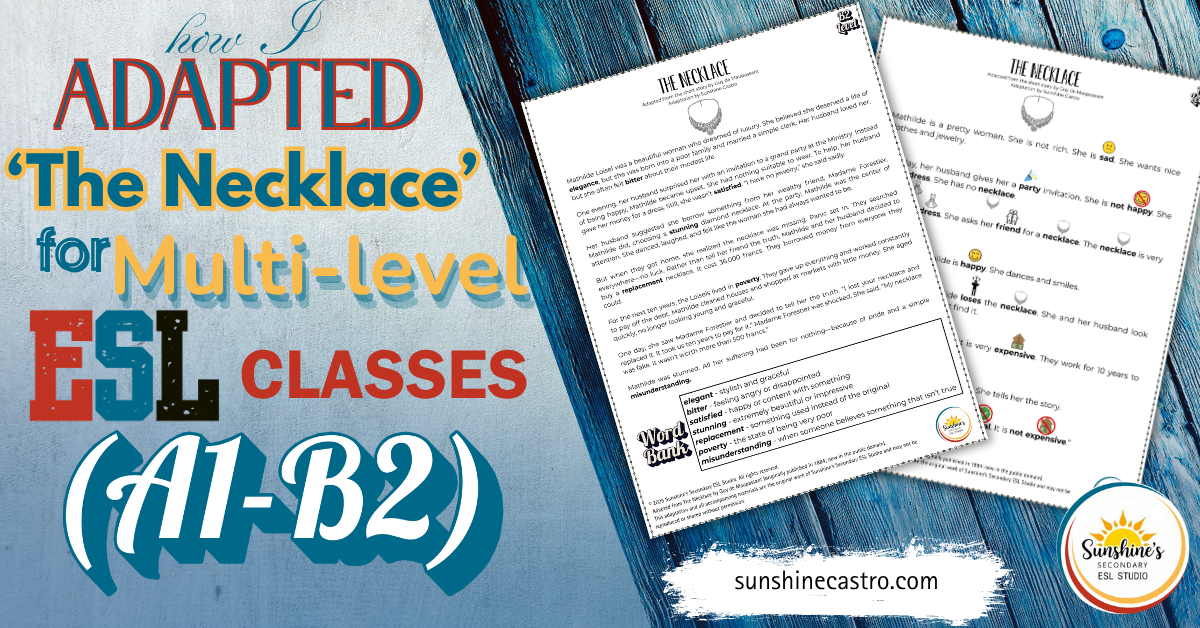
Each CEFR level—from A1 through B2—got its own adapted version of the same story. For beginners, I used short, clear sentences with survival vocabulary. For higher levels, I preserved more original phrasing but added glossed definitions and occasional side-by-side supports.
(If you’re looking for those leveled readings, I have them available in my The Necklace ESL resource set on TpT.)
Step 2: Add Scaffolding That Builds Independence
Every version of the story includes targeted supports like:
- Vocabulary previews with visuals
- Sentence stems for summarizing or retelling
- Quick response questions after each section
- A mix of multiple choice and open-ended prompts
- Graphic organizers for tracking character changes and theme
I even created speaking and listening tasks where students roleplay scenes or discuss what they would have done in Mathilde’s shoes. These tasks gave my quieter students a low-stress way to participate—and the talkative ones a chance to shine.
Step 3: Make Room for Discussion, Not Just Comprehension
One of my favorite parts of teaching The Necklace is watching students debate who was at fault—Mathilde, her husband, or the friend who loaned the necklace. Once students understood the basics of the plot (thanks to the scaffolding), they could jump into deeper conversations. Even A2 students had opinions!
That’s why I also included discussion questions and speaking prompts tailored to each reading level. It helped turn a reading assignment into a classroom conversation.
Final Thoughts: Keep the Literature, Ditch the Stress
Classic literature doesn’t have to be off-limits for ESL learners. With the right supports in place, even a challenging story like The Necklace can become accessible—and meaningful.
If you’re looking for The Necklace adapted for ESL across levels, I’ve bundled my leveled readings, comprehension questions, speaking tasks, and writing prompts in my TpT store. They’re ready to print or assign digitally, and each version is tailored to the A1–B2 range so you can reach every student in your class without reinventing the wheel.