

Estimated reading time: 4 minutes
There are some poems I love as a teacher but always hesitated to teach in my ESL classes—either because they felt too abstract, too fast-moving, or just too far removed from what my students were ready for. Emily Dickinson was one of those poets… until now. Recently, I’ve found ways to scaffold Emily Dickinson’s “Hope is the thing with feathers” for ESL learners.
I wanted my students to feel something when reading poetry—not just decode words and check boxes. So this year, I set out to scaffold Hope is the Thing with Feathers for ESL students from newcomer A1s to upper intermediate B2s. The aim was clear: scaffold the poem to evoke emotions as feathers scaffold hope.
And spoiler: it worked better than I expected.
Why This Poem?
Hope is the Thing with Feathers is short, powerful, and layered with metaphor—but it’s also deceptively complex. For ESL learners, even understanding what “perches in the soul” means can feel like a huge leap.
But it’s also exactly the kind of poem that makes students think—and feel—and reflect. So I decided to meet them where they are by creating four leveled versions of the poem (A1, A2, B1, and B2), each one tailored to what they can actually understand. Clearly, scaffolding ESL lessons fosters hope as the poem does.
What Does “Scaffolding” Actually Look Like?
For me, scaffolding meant:
- Creating a beginner-friendly version of the poem for A1 students (short sentences, clear imagery, and a basic vocabulary box)
- Writing student-level bios of Emily Dickinson so they’d have some context
- Recording MP3 audio files for listening support
- Designing non-editable Google Slides and PowerPoint versions so teachers can project or play them without worrying about formatting
- Keeping the layout clean, visual, and teen-friendly
And of course, for B2 students, I kept the original poem intact—just paired it with vocabulary and analysis supports to help them dig deeper without drowning. Scaffolding is essential when teaching “Hope is the thing with feathers” to ESL learners.
Want to Try the A1 Version for Free?
If you’re curious how this works in action, I created a FREE A1-level version of Hope is the Thing with Feathers. It includes:
- The adapted poem
- A simplified bio of Emily Dickinson
- Vocabulary definitions for key words
- A matching MP3 file
- A Google Slides and PowerPoint version with embedded audio
It’s perfect for newcomers and multi-level classes. You can print it, project it, or use it as a listening station. It’s short, engaging, and totally beginner-friendly.
Click here to grab the free A1 poetry resource. (You’ll be redirected to sign up via MailerLite to get instant access.)
Ready for All Four Levels?
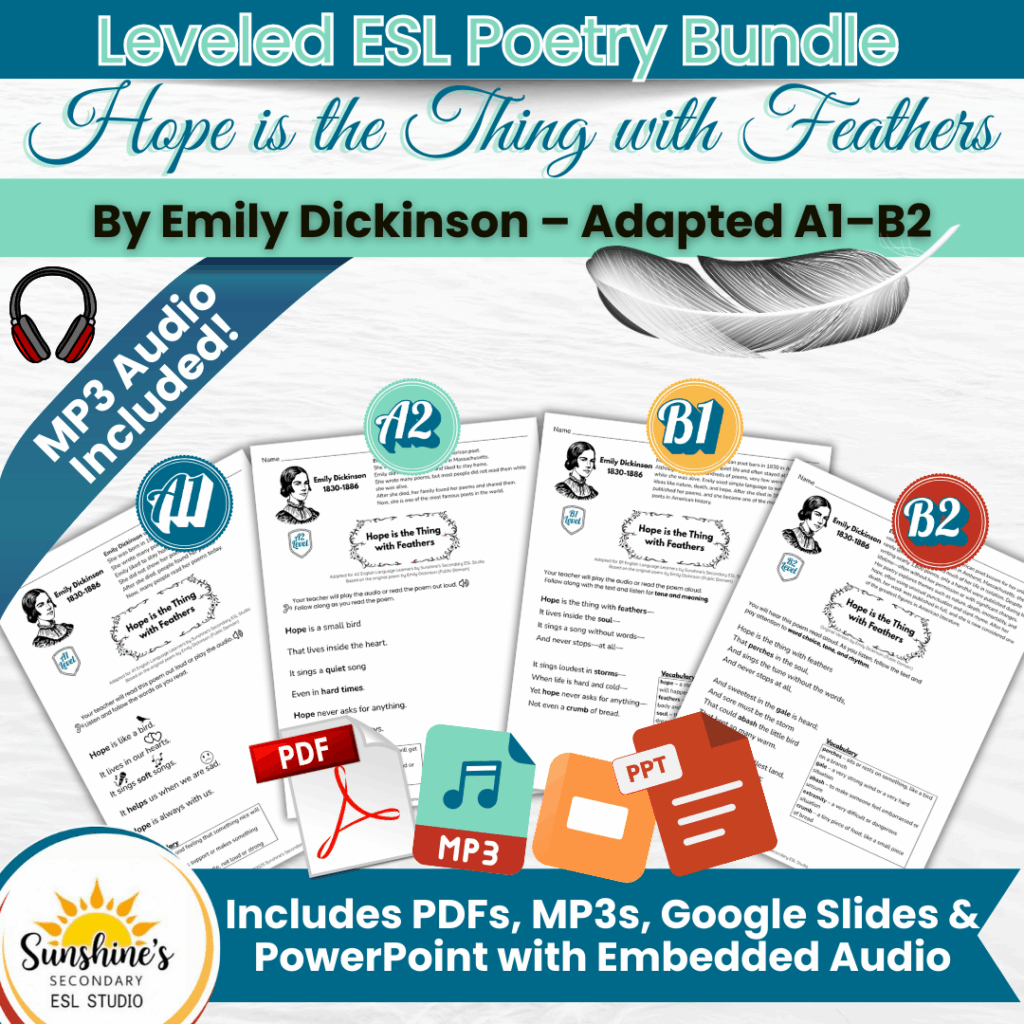
The full resource includes A1, A2, B1, and B2 versions of the poem, each with:
- Printable PDFs
- Leveled bios + vocabulary
- MP3 audio
- Google Slides + PowerPoint with embedded audio
- Listening and reading scaffolds for every level
It’s available now in my TpT store:
Just click the image below
Whether you’re planning a poetry unit, looking for listening activities, or just need something meaningful and flexible for back-to-school, this one checks all the boxes. Truly, scaffolded resources make teaching “Hope is the thing with feathers” engaging for ESL students.
Teaching Poetry Can Work for ESL Teens
If you’ve ever felt nervous about introducing poetry to your ESL students—especially your newcomers—I get it. But with the right scaffolds, even Dickinson becomes accessible, emotional, and classroom-ready.
This has quickly become one of my go-to lessons for building vocabulary, listening confidence, and meaningful discussion across levels.
So grab the freebie, explore the bundle, and let your students feel what hope can sound like.