

Estimated reading time: 4 minutes
Some poems just hit different—and I, Too by Langston Hughes is one of them. It’s powerful, it’s short, and it opens the door to some deep (and surprisingly accessible) conversations with our ESL students. But if you’ve ever hesitated to bring poetry into your ESL classroom because of the vocabulary, the abstract themes, or just not knowing where to start—you’re not alone. I’ve been there.
The good news? I, Too is one of those rare poems that’s actually perfect for English learners. With the right scaffolds in place, it becomes a gateway to important themes like identity, injustice, and hope—and yes, your students can engage with it meaningfully.
Here’s how I teach this Langston Hughes poem in my ESL classroom, step by step—without stress or confusion.
1. Start with a Visual Warm-Up and a Simple Question
Before we even look at the poem, I like to project an image—something symbolic like an empty chair at a dinner table or a set of diverse portraits. Then I ask:
“Have you ever felt left out?”
This instantly gets them thinking on a personal level. Some share stories, others just nod—but either way, they’re already connecting to the theme before we get into the text.
2. Read the Poem Twice—First for Sound, Then for Meaning
We read I, Too once aloud as a group—just to hear it. Then we read it a second time and pause after each line to talk about what’s happening. I keep the questions simple:
- Who is speaking?
- Why do they say “They send me to eat in the kitchen”?
- What does “I, too, sing America” mean?
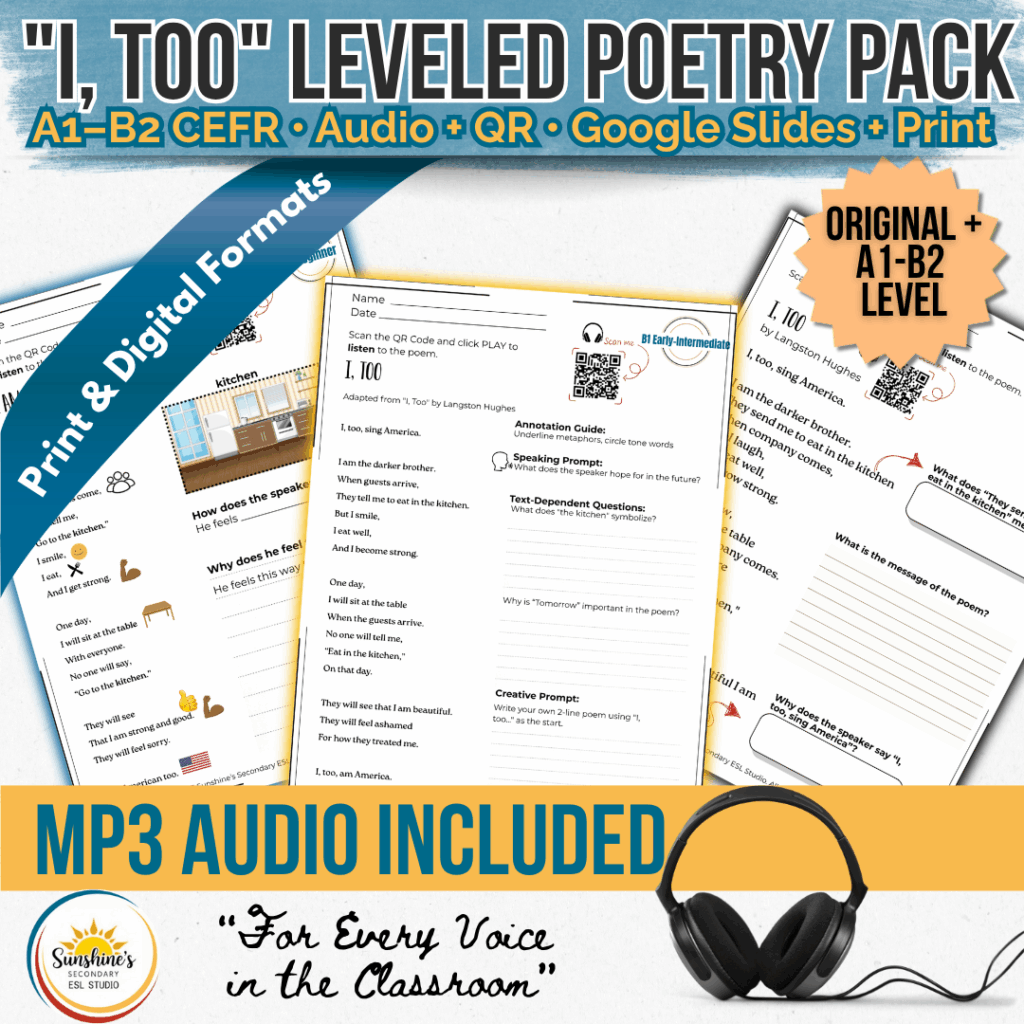
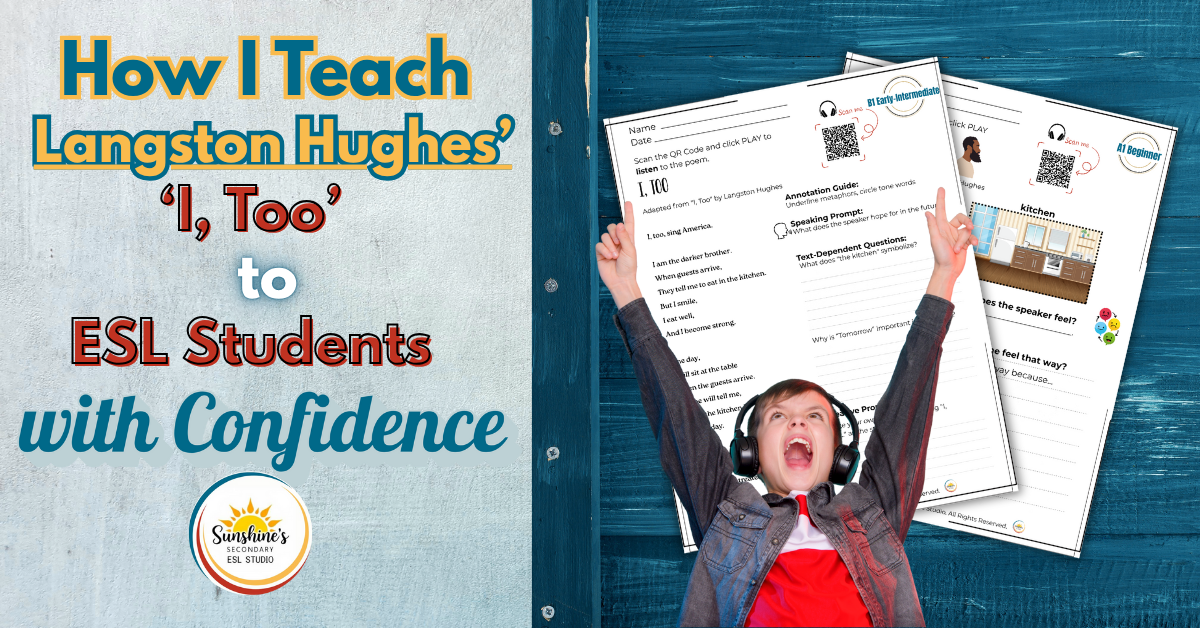
And yes—sometimes I use sentence frames or vocabulary supports, especially for my newcomers or A2/B1 students. (If you’re wondering, I’ve made a few resources that walk students through this poem with built-in support for different English levels.)
3. Use Sentence Starters to Discuss Identity
Once we’ve worked through the text, I like to shift into speaking or writing prompts that help students reflect on their own identity. These are short and open-ended, like:
- “I am proud to be __________.”
- “When I feel left out, I __________.”
- “In the future, I hope __________.”
These frames help even hesitant speakers open up—and it’s beautiful to see how quickly students connect their own lives to Hughes’ words.
If you want to skip the prep work, I have a set of poetry response cards and differentiated writing prompts that pair with this poem (and a few others). I created them for my summer school unit, but they work anytime you’re teaching identity or voice.
4. Keep It Short and Reflective—Not Overwhelming
I don’t turn I, Too into a weeklong analysis. It usually takes us about two class periods: one for reading and discussion, and one for response. That’s it. And honestly? That’s all most ESL students need to walk away with something real.
The point isn’t to break down every literary device—it’s to give them a voice, and to let them know they belong in conversations about literature, too.
Final Thoughts
Teaching a Langston Hughes poem to ESL students doesn’t have to be intimidating. With a little prep, a few visuals, and the right scaffolds, I, Too becomes a poem that resonates deeply—and gives your students a chance to see themselves reflected in the curriculum.
If you’re looking for ready-to-go support, I’ve created some print-and-go activities and response tools for I, Too (and other short poems) that help make poetry feel doable—for you and your students.
At the end of the day, this poem reminds all of us: “I, too, am America.” And your students? They belong in that sentence.