


Estimated reading time: 3 minutes
When I first introduced the poem “I, Too” by Langston Hughes to my ESL students, I wasn’t sure what to expect. Would the language be too symbolic? Would the message be too subtle? But to my surprise, this short and powerful piece became one of our most meaningful classroom discussions.
And honestly? It’s now one of my favorite poems to teach.
Why I Chose a Langston Hughes Poem for ESL Students
My ESL classes are filled with incredible students—many of whom come from backgrounds that mirror the experiences of feeling unseen or unheard. That’s exactly why “I, Too” resonates so deeply. The language is clear but rich, the structure is simple but impactful, and the themes of identity, belonging, and dignity hit home in a way that’s both emotional and empowering.
Plus, Langston Hughes was a master of saying a lot with a little—something that’s perfect for English learners who are just beginning to work with poetry.
How We Break It Down
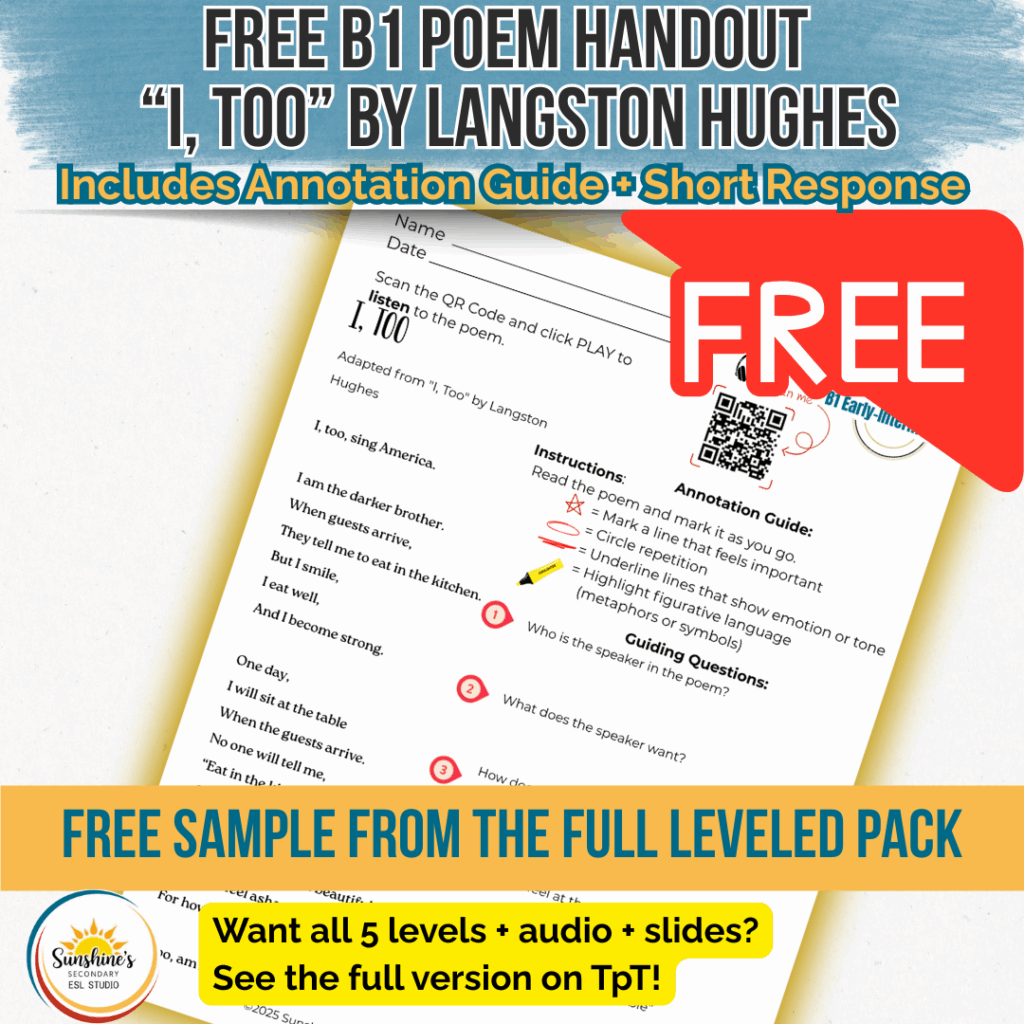
I start by reading the poem aloud to the class, using pauses and expression to model fluency. Then we read it again together, with students chiming in. I use this as an opportunity to build vocabulary like “darker brother,” “ashamed,” and “sing America.”
From there, we annotate the poem together. We identify who is speaking, what the speaker wants, and how the tone shifts from beginning to end. I ask questions like:
- Why does the speaker say “I, too, sing America”?
- What does the table represent?
- How do you think the speaker feels at the end of the poem?
These conversations often open the door for students to share their own stories or reflect on times they’ve felt invisible—and how they’ve found their voices.
Integrating Speaking and Writing
We take it further with sentence stems for oral discussion:
- I think the speaker feels… because…
- This poem reminds me of…
- If I could say one thing to the speaker, I would say…
Then we shift into writing. I offer prompts like:
- Write a short paragraph describing what the poem means to you.
- Write a response poem that begins with “I, too…”
These writing activities not only build language skills but also foster a sense of confidence and self-expression.
Want to Use It in Your Own ESL Classroom?
If you’re thinking, Okay, I want this lesson, I’ve got you. I created a ready-to-go resource designed specifically for ESL students that focuses on “I, Too” by Langston Hughes. It includes vocabulary support, guided questions, writing prompts, and even a speaking component—all scaffolded to support English learners while encouraging real, deep reflection.
You can check it out in my TpT store—it’s classroom-tested and ESL-approved!