

Estimated reading time: 5 minutes
Have you ever chosen the “perfect” grammar worksheet for your ESL class, only to realize your students didn’t retain the grammar concepts? You’re not alone. Many teachers mistakenly introduce grammar as a one-size-fits-all concept. However, when it comes to teaching grammar to beginner ESL students you have to get a bit more creative.
What has been frustrating about teaching grammar is that many materials designed to teach some basic concepts are geared towards little children. Over the years, I have used a black permanent marker to black out the lower grade levels that these materials were designed for. However, you can’t hide the childish graphics that go along with them. That can feel demeaning to our ESL teens.
Understanding Beginner ESL Learners
Teaching grammar to beginner ESL student is challenging. If a rule doesn’t exist in their native language, that can interfere with what you are trying to teach. They may repeatedly make the same errors. This happens because they still try to make sense of English from what they already know in their primary language. For example, in English the adjective goes before the noun, but in Spanish it goes after. Due to this difference, they may need lots of repetition and correction to understand this.
The other issue is the lack of vocabulary and lack of confidence to take risks in a new language. Beginner ESL students rely heavily on what they can see in order to understand. They need visual understandings along with the English grammar to understand the gist of the sentences. If they see just words on a page without a picture that removes some of the comprehension.
Why Traditional Grammar Methods Don’t Work for Beginners
Teaching grammar to beginner ESL students isn’t about handing them worksheets, workbooks, and grammar drills in isolation. They need more to see how grammar works in all the domains: reading, writing, speaking, and listening. It takes modeling the language as a whole group.
Teen English language learners need grammar in context, not just definitions and fill-in-the-blanks. For example, students may need to see what the prepositions look like. Physically showing them these things really helps them to understand the differences between words like in, on, in front of, behind, etc.
Early on in my career, I took the workbooks that lined the classroom shelves, dusted them off, and tried teaching from them. I then showed a few examples on the board. Turning to a group of waiting students, I asked “do you understand?” They eagerly nodded. I went back to my seat thinking everything was great. Then the nightmare came when it came time to grade those workbooks only to find that many didn’t understand. What did I do wrong? Many things went wrong, but I learned from those early mistakes and adopted some tried-and-true methods for teaching grammar.
Go-To Strategies for Teaching Grammar to Beginners
When grammar gets tough, I always lean on these tips:
- Use sentence starters
- Teach one target at a time
- Use real-life teen contexts (social media, texting, school rules)
- Scaffold with visuals and examples
- Practice through movement or games
- Focus on progress, not perfection
Why I Use Grammar Task Cards with Beginners
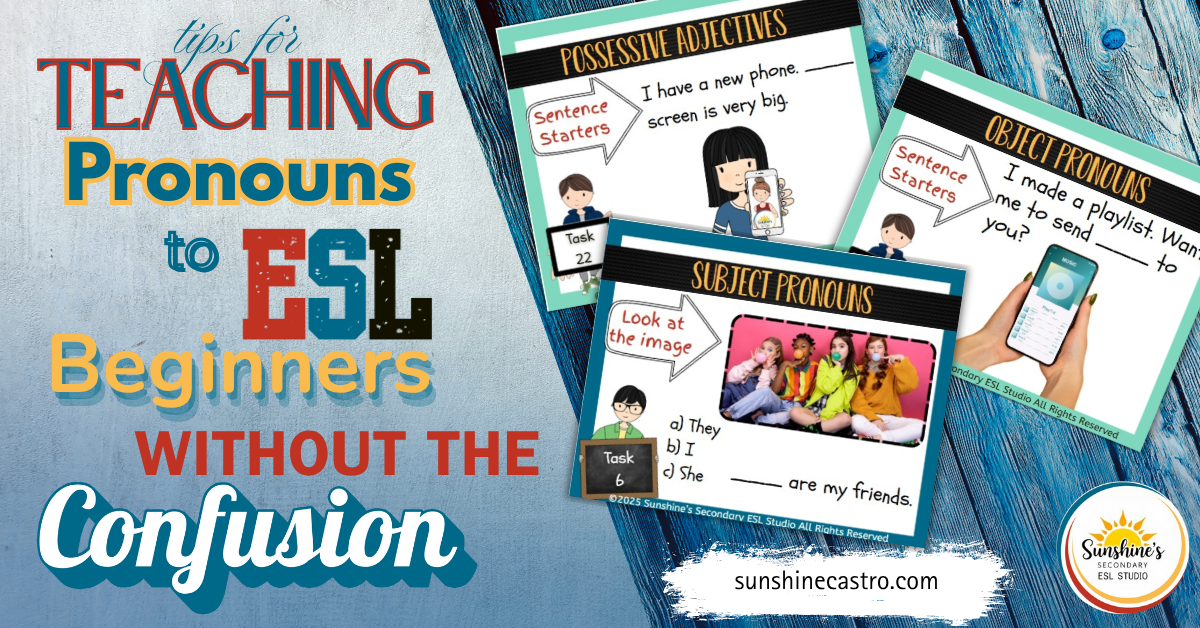
One of the best tools that I have used in my classroom to teach grammar? Task cards. They are usually small, but they can be projected to the class as well. These little cards pack a powerful grammar punch when it comes to supporting ESL teens. Why do they work?
- Bite-sized
- Less intimidating
- Easily used in stations, games, or bellringer warm-ups
- Reusable and flexible
In my classroom, I use them in both independent practice and as a whole group via my Promethean board. I have students of mixed levels and I like to assign them to groups based on their levels. I have been most surprised by my A1-A2 level English language learners. They are more inclined to take risks when they see a sentence stem along with a teen-related concept. They have grown confident in their independent practice because of their use of grammar task cards in small group practice.
Grab Your Free Grammar Task Cards!
You are not alone in struggling to teach grammar to your beginner ESL students. I invite you to try these grammar task cards for yourself. Download my free A1 grammar task card sampler— perfect for beginner ESL students!

Want More?
If the free set works well for your class, check out the full A1 Grammar Task Cared Bundle or the full A2 Grammar Task Card Bundle. You can also get both sets together! The A1-A2 Grammar Task Card Bundle includes both bundles. Each set is designed for teens, low-prep, and aligned with beginner ESL grammar targets.
More Suggested Readings: