

Estimated reading time: 5 minutes
If there’s one thing that keeps my ESL classroom running smoothly, it’s teaching commands and routines early—and teaching them often. Whether it’s “Line up,” “Take out your notebook,” or “Don’t talk while I’m talking,” these little phrases are the foundation of classroom life. But here’s the thing: we can’t just expect our students to pick them up through exposure. They need practice—and they need it in a way that feels useful, not boring.
That’s where grammar task cards have totally changed how I teach this.
I use them all the time with my ESL teens—not just for grammar review, but to teach real-life classroom language that helps students succeed every single day. Here’s how I use grammar task cards for ESL teens to build confidence with commands and routines from day one.
1. I Use Task Cards to Practice Imperatives (Without the Boring Drill)
Let’s be honest—teaching the imperative form (“Sit down.” “Open your book.”) can get really dry if we’re not careful. My students don’t want to diagram grammar—they want to use it. So instead of front-loading a rule chart, I jump into mini task cards that show the language in action.
Some of my cards say things like:
- “Stand up and turn to page 10.”
- “Clean your desk.”
- “Don’t write yet!”
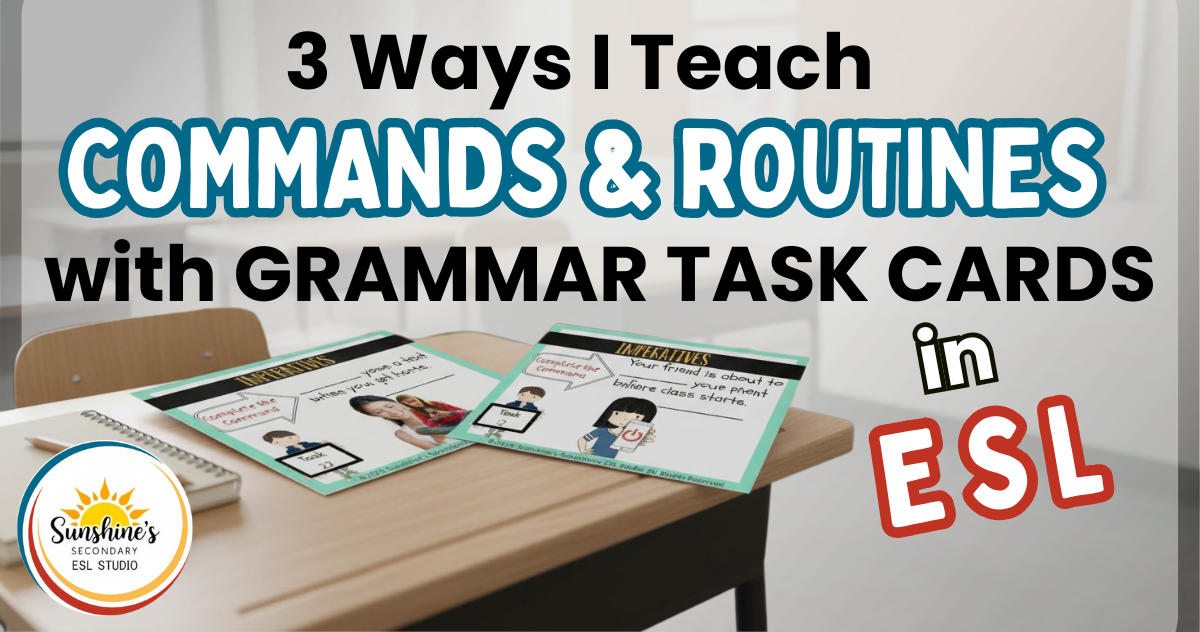
Students match the sentence to a picture, or act it out, or fix errors. They’re practicing the command structure without even realizing it’s “grammar.” I have a whole set of Imperative Command Task Cards that I print, use in stations, or assign digitally in Google Slides. Quick, low-prep, and super effective.
2. I Reinforce Daily Routines with Reusable Warm-Ups
Once students are familiar with basic commands, I use task cards to build routine recognition into my warm-ups. I’ll grab a handful of cards each morning and have students:
- Translate the command into their native language (if we’re bridging vocabulary)
- Rewrite informal commands as formal ones
- Choose the correct command from a group of options
This gives me an easy way to sneak in grammar reinforcement without having to teach a whole lesson. Plus, it helps build consistency—students start understanding that when I say “Pass your paper forward,” they’re expected to do it, not stare blankly and hope someone else figures it out first.
My Daily Commands + Routine Task Cards set includes printable and digital formats, so I just rotate them in as needed. It’s a small habit with a big payoff.
3. I Pair Task Cards with Speaking and Listening Practice
Once we’ve warmed up with a few task cards, I build on that foundation by turning them into real conversations or mini listening tasks.
Examples:
- Partner A reads a command card aloud, Partner B acts it out
- Students work in groups to sort “strong” vs. “polite” commands
- I read a card aloud and students point to or hold up the correct image or phrase
This not only reinforces grammar—it helps them listen for tone, identify context, and respond appropriately in a classroom setting.
When I use Grammar Task Cards for ESL Teens, I’m not just teaching verbs or sentence structure—I’m giving them tools to understand how school works. And for many newcomers, that’s just as important as the content.
Wrap-Up: Grammar That Makes Sense
Teaching commands and routines doesn’t have to mean chanting verbs or filling out grammar worksheets. With the right task cards, you can give your students real language in real situations—the kind that helps them thrive inside and outside the classroom.
If you want a low-prep way to teach this skill, I’ve put together grammar task card sets that focus on:
- Imperatives and Commands
- Daily Classroom Routines
- Teen-friendly scenarios that feel relevant
They’re printable, editable, and designed to make grammar approachable—even for reluctant learners.
Want to try one out? I’ve got a free sample of my KWL chart for ESL students you can use to introduce a routine lesson or warm-up strategy.
Because when classroom routines make sense, learning does too.