

Estimated reading time: 4 minutes
Let’s be honest—teaching pronouns to ESL beginners can feel like a total mess. One day you’re explaining “he” and “she,” and the next thing you know, students are throwing “me,” “mine,” and “us” into places that make zero sense. It’s not their fault—pronouns are confusing, especially when English doesn’t follow nice, neat rules.
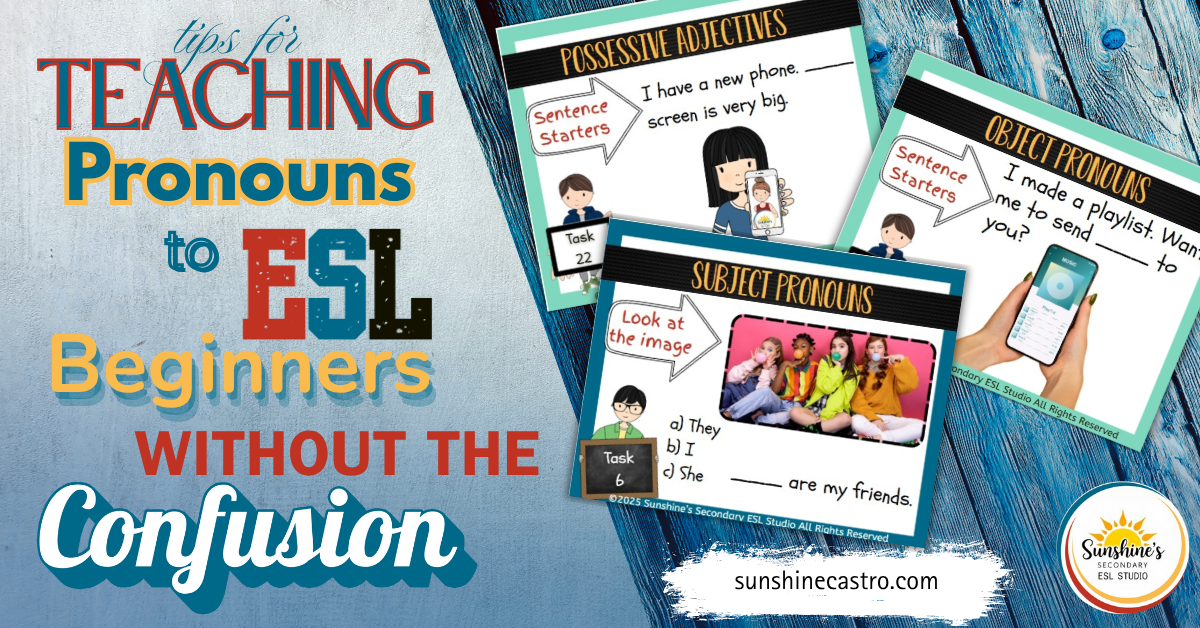
I used to over-explain everything and watch my students’ eyes glaze over. Eventually, I realized that what they needed wasn’t more grammar talk—it was structure, visuals, and real-life examples that clicked with their teen brains. That’s when I started creating my Pronouns ESL grammar cards—and honestly, they’ve made a huge difference in how I teach this stuff.
Here are a few laid-back, classroom-tested tips to help your students actually get pronouns—and maybe even have a little fun along the way.
Tip #1: Start with Subject Pronouns (They’re the Easiest Win)
When in doubt, start with what’s simple—and subject pronouns are the easiest place to begin. I use images of people or groups and let students figure out who we’re talking about.
- “He is a student.”
- “They are my friends.”
It’s super visual, super repetitive, and super effective. My subject pronoun cards have sentence starters, teen-focused photos, and easy multiple-choice tasks that build confidence right away. It’s all about less stress, more success.
Tip #2: Break Down Object Pronouns with Sentence Starters
Object pronouns (like me, him, us) are trickier because they don’t show up at the start of a sentence. That throws beginners off fast.
I keep it real by using sentence starters like:
- “Can you help me?”
- “He gave it to her.”
- “She sent us a message.”
These are phrases my students actually use. The object pronoun cards walk them through conversations, sentence completions, and little real-world moments—like texting, music, or hanging out. It keeps things relevant and low-pressure.
Tip #3: Teach Possessive Adjectives Using Their Things
Teens love talking about what’s theirs—so lean into that when teaching my, your, his, her, our, and their.
- “Her phone is new.”
- “Their project is amazing.”
I like using prompts that let students personalize things. The possessive adjective cards use pictures and sentence frames that invite them to talk about their lives, friends, and favorite things. It’s one of the easiest ways to sneak in grammar practice without it feeling like grammar practice.
Tip #4: Repeat, Repeat, and Keep It Visual
Here’s the real secret: repetition plus visuals = success.
I rotate between:
- Grammar cards
- Partner talk
- Fill-in-the-blank slides
- Quick write-and-share activities
When students hear and use the same patterns in different ways, it finally sticks. No magic needed—just consistent exposure and chances to actually speak.
Final Thoughts: Keep It Simple, Keep It Clear
You don’t need to stress over pronouns (and your students shouldn’t either). Keep it visual, keep it consistent, and give them scaffolding that makes sense.
If you’re looking for ready-to-use materials that break it all down, my Pronouns ESL grammar cards are classroom-tested, beginner-friendly, and designed to make grammar feel doable—not dreadful.
Whether you use these tips or try out the cards, the goal is the same: help your students build real language confidence—without the confusion.