


Estimated reading time: 4 minutes
If you’ve ever asked high school students to write—even just a paragraph—you’ve seen at least a few freeze at the sight of a blank page. Teachers can use effective ESL writing support strategies to help students gain confidence and overcome these obstacles. This happens in every English classroom. Even native English speakers experience writing anxiety, overthinking, or simply not knowing how to begin.
Now imagine all of that layered with the challenge of writing in a new language.
Many multilingual learners want to express complex ideas but lack the vocabulary, structures, or confidence to start. Their writing freeze isn’t a lack of motivation—it’s the natural result of trying to perform a cognitively demanding task with limited linguistic tools.
This is exactly why ESL writing support strategies are essential in the secondary ESL classroom.
Why Writing Feels Overwhelming for Multilingual Learners
Writing is not one skill—it’s a combination of many:
- generating ideas
- organizing thoughts
- using vocabulary accurately
- applying grammar and syntax
- spelling
- understanding the prompt
- maintaining clarity
Even fluent English speakers struggle with these steps.
For multilingual learners, the freeze often happens because they must navigate both:
✔ the universal difficulty of writing
and
✔ the challenge of producing writing in a second language
This doesn’t mean they can’t write.
It means they need intentional scaffolds that make writing accessible.
That’s where the following ESL writing support strategies make a world of difference.
5 ESL Writing Support Strategies That Actually Work for Secondary Students
Below are practical, classroom-tested approaches that help multilingual learners move from silence to starting—and from starting to finishing strong.
1. Sentence Frames Are the Foundation of Effective ESL Writing Support Strategies
Sentence frames remove the fear of “What do I say?” and “How do I say it?”
They help students:
- begin confidently
- structure ideas
- reduce grammar anxiety
- focus on meaning
Examples:
- “One important idea from the text is ______ because ______.”
- “In my opinion, ______. This is because ______.”
- “The character feels ______ when ______.”
Frames build fluency, not dependence—especially when paired with strong modeling.
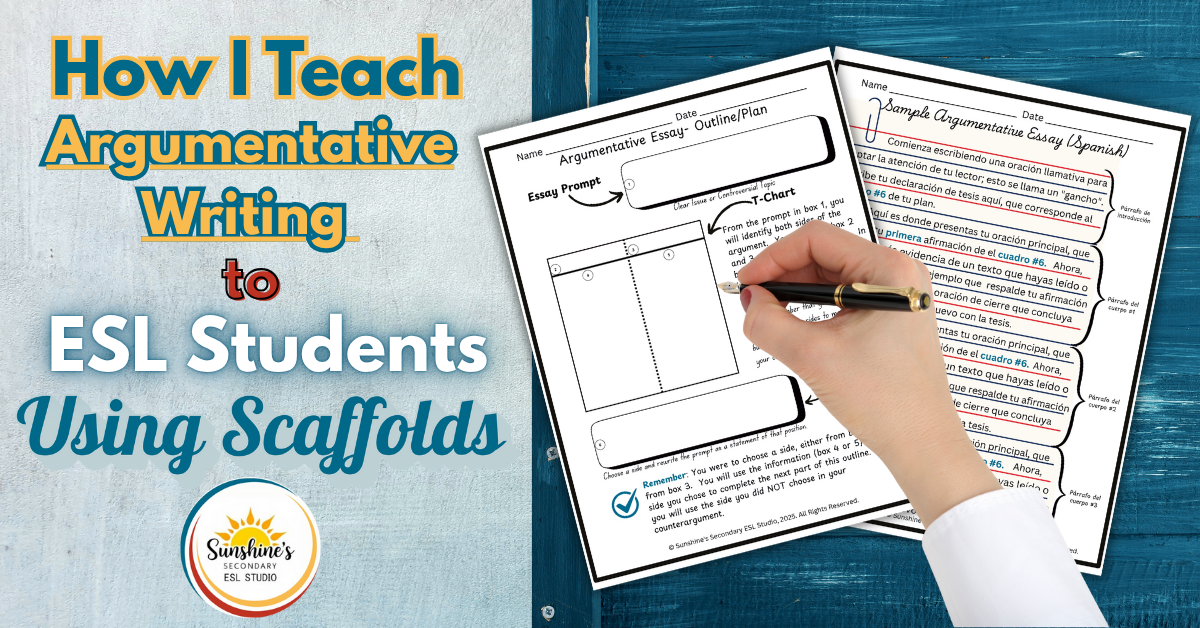
2. Graphic Organizers Are Essential ESL Writing Support Strategies
Many English learners don’t lack ideas—they lack structure.
Graphic organizers help students:
- break writing into manageable steps
- visualize relationships between ideas
- plan before they write
- build strong paragraph organization
Useful organizers include:
- T-charts
- sequence charts
- cause/effect maps
- CER (Claim, Evidence, Reasoning)
- compare/contrast diagrams
When students organize first, their writing becomes clearer and more confident.
3. Allowing L1 Brainstorming Strengthens ESL Writing Support Strategies
Before students write in English, allow them to think in the language they know best.
L1 brainstorming helps:
- generate richer ideas
- reduce cognitive overload
- support accurate vocabulary use
- build confidence
This can be as simple as:
- jotting notes in their native language
- discussing ideas with an L1 partner
- writing a rough outline before translating
L1 is not a crutch—it’s a bridge to stronger academic English.
4. Word Banks and Vocabulary Lists Support Stronger ESL Writing
A lack of vocabulary is one of the biggest culprits behind writing freeze.
Word banks give students:
- the tools to express their ideas
- correct academic language
- transitional phrases
- descriptive vocabulary
Tier your word banks:
A1–A2: visuals + basic verbs
B1–B2: connectors, academic words, transition phrases
This is one of the simplest but most powerful ESL writing support strategies you can implement immediately.
5. Modeling Writing Is One of the Most Effective ESL Writing Support Strategies
Students need to see writing in action.
Modeling removes the mystery and shows the steps.
Model:
- how to expand a sentence
- how to turn a frame into a paragraph
- how to cite evidence
- how to revise a fragment
- how to combine ideas
Your modeling doesn’t need to be perfect.
In fact, imperfect modeling shows students that writing is a process even for adults.
Final Thoughts: Writing Confidence Comes From Support, Not Pressure
When multilingual learners freeze, it’s not a lack of ability—it’s a lack of access.
With the right ESL writing support strategies, your students can:
- start writing without fear
- express deeper ideas
- build vocabulary naturally
- see their progress
- grow into confident academic writers
Every small scaffold you provide becomes part of the foundation they build their English on.
Looking for Ready-to-Use Writing Supports for Your ESL Students?
If your secondary ESL students need help with sentence frames, structured writing tasks, leveled readings, or fluency-building activities, I have a full collection designed specifically for them:
👉 Sunshine’s Secondary ESL Studio
These resources help students overcome writing freeze, develop strong habits, and build the confidence they need to write independently.