

ESL Speaking and Listening Made Easier: Strategies and Resources for Teachers
Helping ESL Students Build Confidence Through Speaking and Listening
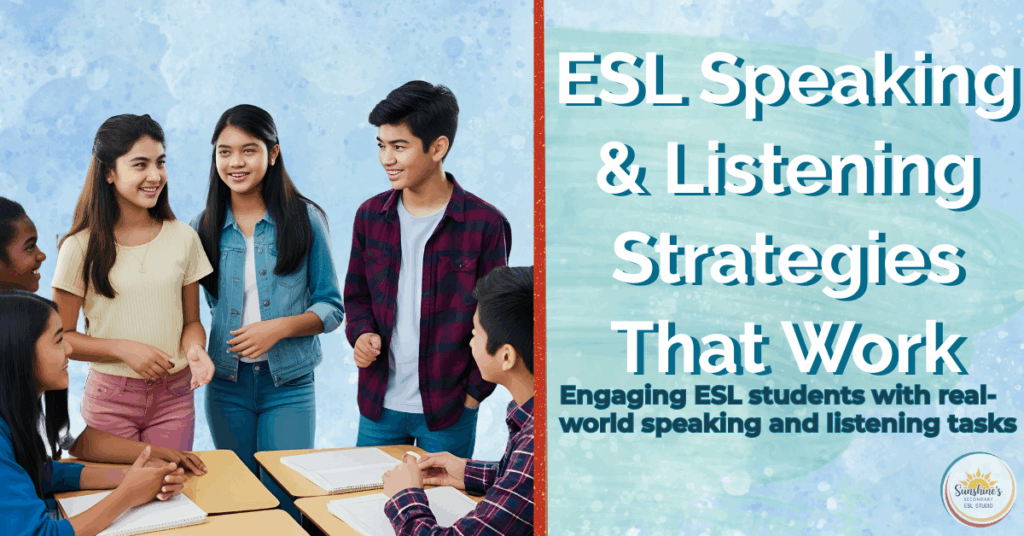
In ESL classrooms, it’s easy to focus on reading and writing—but speaking and listening are just as essential, if not more so. These skills are the foundation for real-world communication and language fluency.
Why ESL Speaking and Listening Matter
Building in consistent opportunities for ESL students to speak and listen in English can:
Increase overall fluency
Expand and reinforce vocabulary
Improve pronunciation
Build confidence in real-time conversations
But how does ESL speaking and listening look in a high school classroom?
Let’s start with this:
An ESL classroom should never be a quiet classroom.
When students aren’t actively encouraged to speak English, they’ll naturally fall back on using their native languages. While we should never discourage students from using their first language, it’s our job to create structured opportunities to speak and hear English during every lesson.
A Common Problem: Calling on Individual Students
Many teachers ask questions aloud and call on individual students to respond—but for English learners, this can create anxiety. Some students:
Didn’t fully understand the question
Are unsure how to answer in English
Feel too nervous to speak publicly
Instead, try this ESL-friendly speaking routine:
ESL Speaking Strategy: Scaffolded Group Talk
1. Project the question clearly on the board.
2. Read the question slowly and clearly—facing the class.
3. Rephrase the question using simpler English or sentence stems.
4. Allow students to discuss the question in small groups.
5. Let them know they’ll need to answer in English.
6. After a few minutes, randomly call on a group to share.
What About Listening Skills?
Listening practice should include both live modeling (where students see your mouth and facial expressions) and recorded audio. Dictation activities—where students write what they hear—are powerful tools for:
Improving auditory decoding
Reinforcing grammar and sentence structure
Strengthening spelling and attention to detail
Dictations don’t need to be boring. Try integrating them with:
Cloze listening activities
Audio story segments
Songs or podcasts
AI-generated audio from tools like ElevenLabs (for classroom use)
ESL Speaking and Listening Resources
I discovered this website over the summer 2025 when I was teaching ESL Summer School. It is essentially a website where students can record their answers and then save them as links or even QR codes.
The best thing about this website is:
- You don’t need to create a sign up for yourself or your students.
- You can pair this with platforms like Padlet or Schoology, so students can turn in their recordings.
- Ease of Use: Super user friendly.
- Students feel more confident in getting to start over should they mess up their English.